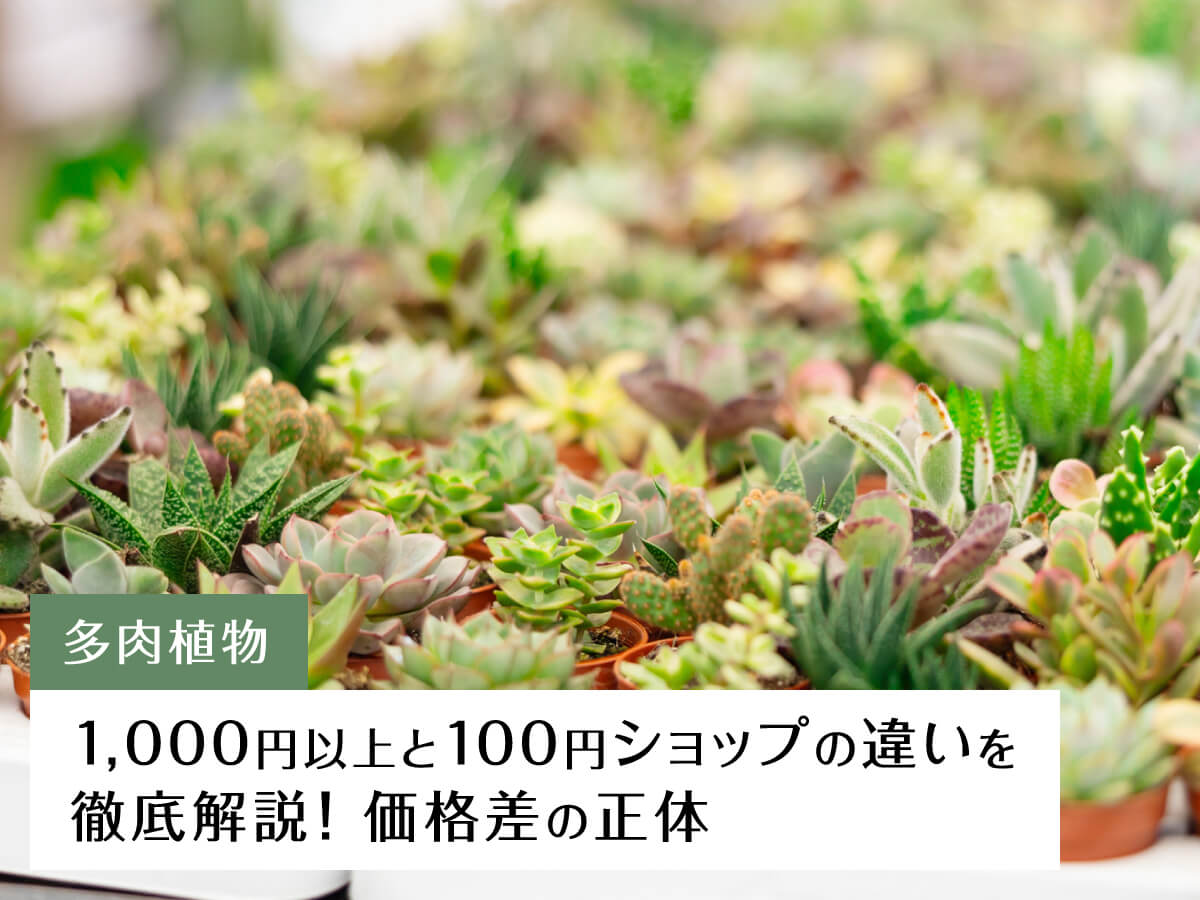
In this article, we will explain in detail the differences between succulents costing over 1,000 yen and those available at 100-yen stores like Daiso and Watts. We will also touch on their respective characteristics, appeal, and how to choose them.
1. Introduction: The popularity and appeal of succulents
Succulents are popular not only among plant enthusiasts but also among a wide range of people due to their charming shapes, unique colors, and ease of care. Recently, they have become known for being available at 100-yen stores such as Daiso and Watts.
On the other hand, there are also succulents in the 1,000 yen and above price range, which are sought after for being larger, rare varieties, or having characteristics such as good health and rapid growth. Even among the same succulents, there are significant differences in the varieties and quality available depending on the price.
This article will explain in detail the differences between succulents in the higher price range (over 1,000 yen) and those from 100-yen stores. We hope this information will help you find the perfect succulent for you from the various options available.
2. Succulent price ranges and their differences
The price range of succulents varies widely depending on their growth condition and type. Here, we will explain the differences between succulents in the higher price range (over 1,000 yen) and those available at 100-yen stores.
(1) High-priced succulents (over 1,000 yen) often include specific varieties, limited editions, or rare types. Also, more mature plants, or those with a certain size and shape, fall into this price range.
(2)On the other hand, succulents at 100-yen stores are mainly common varieties. They primarily consist of varieties that can be mass-produced or small seedlings, allowing people to enjoy succulents at a relatively low price.
(3) The differences in price range are due to factors such as growth condition, size, rarity, and variety. Additionally, the presence of cultivation guidance and after-sales care offered by the selling store is also reflected in the price.
It is important to understand these differences and choose according to your lifestyle and preferences.

(1) Characteristics of high-priced succulents (over 1,000 yen)
Succulents in the higher price range (over 1,000 yen) often have special characteristics, as their price indicates.
First, one notable characteristic is the wide variety of types. There are more types than common succulents, and each has a unique shape and color, making them enjoyable as a collection.
Second, another characteristic is their rarity. Compared to commonly distributed succulents, rare varieties are easier to obtain. These varieties have vivid appearances and a presence that sets them apart from other succulents.
And third, a characteristic is their health and growth rate. High-priced succulents are often carefully cultivated in specialized stores, resulting in good health and rapid growth. These characteristics indicate that even with a higher price range, their value is well reflected.

(2) Characteristics of succulents from 100-yen stores
Succulents from 100-yen stores such as Daiso and Watts are easily accessible due to their low price, making them recommended for beginners who are just learning how to grow succulents. Although the variety is limited, basic succulents are available, making it easy to try new types. However, succulents from 100-yen stores tend to grow slower and are more prone to diseases compared to higher-priced ones, so careful management after purchase is necessary. Understanding these characteristics, choose a succulent that matches your preferences and lifestyle.

(3) Reasons for price differences
As mentioned above, the differences in succulent prices are mainly attributed to three factors: "variety," "rarity and uniqueness," and "health and growth rate."
From these differences, we can understand why succulents vary in price.
3. The appeal of succulents priced over 1,000 yen
Succulents priced over 1,000 yen are appealing for their diverse appearance and growth patterns, their rarity and beautiful colors, their scarcity and high collector value, and their good health and rapid growth rate. Considering these characteristics, it is recommended to choose a succulent that fits your lifestyle and preferences.
(1) Richness of variety
Succulents sold in the higher price range (over 1,000 yen) are characterized by their wide variety. Specialty stores, in particular, offer a large number of rare varieties, new varieties, and large items that are not available at general shops. Furthermore, the price is determined not only by the variety but also by the growing environment, age, size, and beauty of the shape, so the variety is infinite.
Also, advanced succulent enthusiasts often enjoy creating new original seedlings through cross-pollination. These individuals are called "hobbyists," and the cross-pollinated seedlings they create are sometimes sold at succulent specialty stores. These hobbyist seedlings are also sold in the higher price range of 1,000 yen or more.
On the other hand, 100-yen store succulents primarily feature common varieties that are easy to grow. They are easy for beginners to cultivate and carry less risk if they fail, which might be the greatest appeal for those just stepping into the world of succulents.
As such, there are differences in the variety of succulents available depending on the price range. The best place to choose from will vary depending on what you are looking for and your level of experience.

(2) Rarity and uniqueness
Succulents priced over 1,000 yen often include rare or unusual varieties. These plants are harder to obtain than common types, which contributes to their higher price.
In terms of uniqueness, these high-priced succulents are also appealing. For specific collectors and enthusiasts, their rarity and uniqueness further enhance their value.
These high-priced succulents are distinctly different from common varieties or those available at 100-yen stores like Daiso. Their rarity and uniqueness are significant reasons why high-priced succulents are so beloved.
(3) Health and growth rate
High-priced succulents are cultivated in specialized environments with careful attention. As a result, the plants are healthy and grow vigorously. On the other hand, succulents from 100-yen stores are mass-produced, so some may not be in good health. Consequently, their growth tends to be relatively slow.
These differences are summarized in the table below.
|
|
High-priced succulents |
100-yen store succulents |
|---|---|---|
|
Health status |
Good |
Some may not be healthy due to mass production |
|
Growth rate |
Vigorous |
Relatively slow |
It is important to understand the health condition and growth rate you desire for your succulents and make your choice accordingly.
4. Appeal and precautions for succulents available at 100-yen stores
The main appeal of succulents available at 100-yen stores is their accessibility. As they are affordably priced, they are perfect for beginners who are new to growing succulents and want to try their hand at it.
However, 100-yen store products generally have a limited selection, and rare species are hard to come by. Also, some may not be in good health, so it's important to carefully check the product when purchasing. In particular, it is crucial to assess the plant's health from the color and shape of its leaves and the condition of the soil.
On the other hand, 100-yen stores offer limited information about succulents, so beginners need to research how to care for them themselves. Below, we've summarized basic care instructions for succulents purchased at 100-yen stores.
|
Item |
Content |
|---|---|
|
Watering |
About once every 1-2 weeks. Water thoroughly after the soil has completely dried. |
|
Sunlight |
Avoid direct sunlight and keep in a bright location. |
|
Temperature |
Ideal is 15-28℃. Keep above 5℃ in winter. |
|
Fertilizer |
Apply once in spring and once in autumn. |
(1) Easy to start
Succulents from 100-yen stores are appealing for their ease of access. For those new to growing succulents, or those who want to try growing them, there's a natural resistance to buying expensive items. However, with succulents from 100-yen stores, you can easily get them at an affordable price.
Additionally, care methods and suitable environments vary depending on the type of succulent. Therefore, 100-yen store products are ideal for beginners to start with. You can also find a type that is easy for you to grow by trying them out firsthand.
Furthermore, succulents are relatively hardy, so they are unlikely to die from minor mistakes. This is also a welcome point for beginners. You can easily and confidently take on the challenge of growing succulents.
(2) Easy to try
One of the appeals of succulents available at 100-yen stores is that they are "easy to try." For those new to growing succulents or wanting to try new varieties, the low price is a significant advantage.
For example, at Daiso, you can buy succulents for 100 yen each. This means that even if you accidentally kill them while growing, it won't be a big loss. Also, by buying in bulk, you can enjoy various types at once.
However, succulents from 100-yen stores may be of lower quality compared to higher-priced ones. To assess their health and growth, check points such as firm roots and plump leaves when choosing.
It's also important to choose healthy plants that aren't stretched out. Succulents generally love sunlight, so stores that display them near entrances or windows with good light often have relatively healthy seedlings.
(3) Precautions and how to identify good ones
Succulents available at 100-yen stores are easy for beginners to try, but there are a few things to keep in mind.
First, 100-yen store products are unfortunately not always in the best condition. For example, due to overwatering or dryness, or lack of proper light, the product's health may be compromised. Therefore, when purchasing, it is important to carefully examine the color and shape of the leaves, the condition of the base, and choose a healthy plant.
Additionally, the variety of succulents at 100-yen stores is limited. For example, Daiso offers varieties such as Echeveria, Graptoveria, and Kalanchoe. If you are looking for a specific type, a specialty store that handles higher-priced products might be a better option.
Thus, while the convenience of succulents from 100-yen stores is appealing, there are also precautions to consider. It is important to understand these points and choose a product that suits you.
5. How to choose and grow succulents
When choosing a succulent, first check its health. Look for strong new shoots and uniform leaf color and shape. Also, it's important to make sure the base isn't rotten.
Next, choose a variety that suits your growing environment. Succulents have different preferences for sunlight, temperature, and humidity, so choosing one that matches your home's conditions will make it easier to grow.
Regarding cultivation, succulents generally prefer a sunny and well-ventilated location. Water them thoroughly about once a week, after the soil has completely dried out. In winter, it is necessary to take measures such as bringing them indoors to protect them from the cold.
By understanding these basic selection and cultivation methods, you will be able to enjoy beautiful succulents for a long time.

(1) Key points for choosing
There are three main points to consider when choosing succulents.
The first is "health condition." Choosing a healthy plant is important for long-term enjoyment. The health of a plant can be determined by the color and shape of its leaves and the firmness of its stem. Look for bright colors, moderate firmness, and a straight stem.
The second is "type." There are many types of succulents. Consider which type you find appealing and which type is suitable for your home environment.
The third is "price." More expensive ones are often rarer or in better health. However, when you're just starting out, it's also a good idea to begin with more affordable options.
Considering these points, choose the succulent that's right for you.
(2) Beginner's guide to growing
While succulents are easy for beginners to grow, there are a few key points to keep in mind to enjoy even more splendid growth.
First, watering should be done about once every 1-2 weeks. However, since this varies depending on the season and climate, the basic rule is to water only after the soil has completely dried out. Proper water management prevents issues like root rot.
Next, sunlight is essential. Therefore, the ideal is to grow them outdoors. Succulents prefer sunny locations, but avoid direct sunlight in mid-summer. It is ideal to expose them to the soft morning and evening sun.
Finally, it is best to use soil specifically designed for succulents. Such soil drains well and has a moderate nutrient content, making it suitable for succulent growth.
Master these basic care points and start growing your own succulents.
(3) Methods suitable for the plant's environment
Creating the optimal environment for growing succulents is extremely important. One way to do this is by selecting the appropriate "soil."
First, succulents need well-draining soil. Generally, commercially available soil retains moisture well, making it unsuitable for succulents. Daiso does not carry succulent soil, so using other 100-yen shops like Seria is one option. However, soil available at Daiso can be used for succulents with a little ingenuity. You can mix in sand or small stones to improve drainage.
Next, "nutrients" are also important. Succulents don't need a lot of nutrients, so it's important not to over-fertilize them.
Finally, there's "light." Succulents need a lot of light. Even if you're growing them indoors, place them in the brightest spot possible.
Considering the above points, high-priced succulents costing over 1000 yen are typically found in specialty stores with dedicated soil and environmental conditions that allow for precise control of light. On the other hand, 100-yen shop succulents are easy for beginners to grow, and with a little effort, you can create a good environment for them.
6. Summary: Understand the Differences by Price Range and Choose the Succulent that's Right for You
When choosing succulents, it's important to understand the price ranges. First, items priced over 1000 yen are attractive for their variety, rarity, and health. On the other hand, 100-yen shop items are characterized by their affordability and ease of purchase.
Specifically, higher-priced items are suitable for those looking for rare varieties, larger sizes, or excellent health. Conversely, 100-yen shop items are recommended for beginners who want to start growing succulents or those who want to collect many different varieties.
However, just because the price is low doesn't mean you should buy carelessly; you should also consider the plant's health and ease of cultivation. Therefore, choose the succulent that best suits your skills, environment, and preferences. It's important to understand the pros and cons of products in each price range and choose the one that's right for you.