When something grows from your succulent, do you know if it's a flower? This article details how to identify when your succulent is blooming and how to properly care for it afterward.
1. Introduction
Have you ever noticed something growing from your beloved succulent? What exactly is that part that suddenly sprouted, different from its usual appearance? The answer is likely to be a "flower." Succulents are popular as accents in interior design and gardening due to their beautiful shapes and colors. However, their flowers, which further enhance their charm, are also one of the greatest attractions of succulents. In this chapter, we will delve into the possibility of your succulent blooming and how to identify it.
2. My succulent is growing something! Could it be a flower?
If you notice something growing in your succulent pot, it might be a flower. But how can you tell for sure?
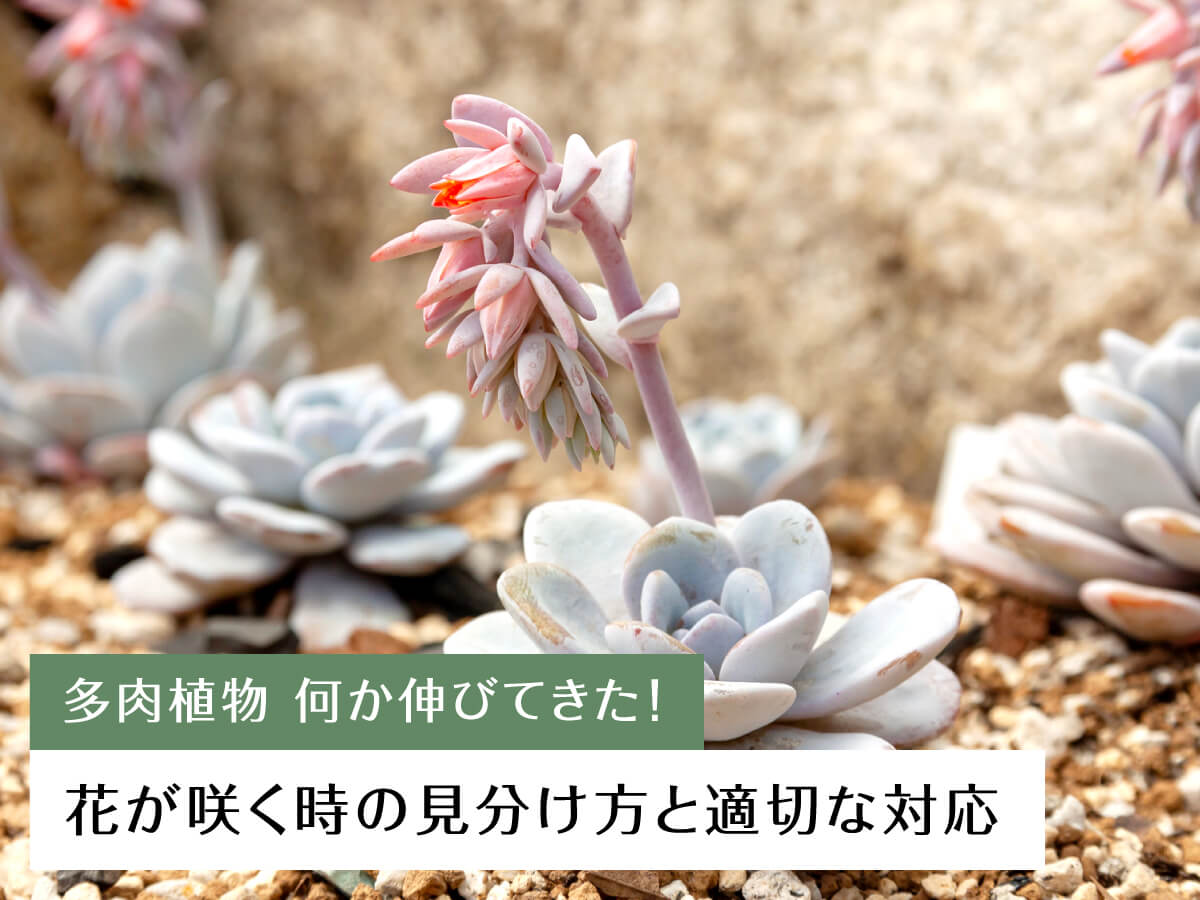
First, if the growing part differs from the leaves in thickness, color, and shape, appearing thinner and more elongated, it could be a flower stalk. Furthermore, if you see small swellings at its tip, it's definitely a sign that a flower is about to bloom.
Also, some succulent species are more prone to flowering than others. For example, Echeveria and Kalanchoe are considered relatively easy to bloom.
By observing these points, you can determine whether that "something growing" is indeed a flower. Next, we will explain what to do when your succulent blooms.

(1) Characteristics of the growing part
Something that suddenly grows from a succulent's leaf might be a flower. The growing part is typically a slender stem with small buds at its tip. This slender stem is called a "flower stalk," and it will bloom as it grows. The stem's color is often reddish, differing from the usual green.
While this flower stalk blooms only once, new flower stalks may continue to emerge afterward. However, not everything that grows is a flower stalk; sometimes, it might just be new leaves sprouting, so be careful.
(2) How to tell before the flower blooms
Signs that a succulent is about to bloom typically include the emergence of a flower stalk that differs in shape from new shoots. This flower stalk is slender and often spiraled. Additionally, it is characterized by the formation of small buds at its tip.
Most importantly, observation is key. When growing succulents, it's crucial to check them regularly and notice any changes. To distinguish between a new shoot and a flower stalk, understanding the plant's growth pattern and accumulating daily observation data is essential.
(3) Which succulent species are prone to flowering?
Succulents with plump leaves, many species of which actually bloom. "Echeveria," "Haworthia," "Sedum," "Agave," and "Kalanchoe" are particularly known for flowering easily.
Echeveria varieties like Shichifukujin, Laui, and Hanaurara are particularly prone to flowering, extending flower stalks from between their leaves in spring. Haworthia, on the other hand, produce delicate and beautiful white flowers in most varieties.
Sedum, a thin-leaved type, blooms yellow or cream-colored flowers in the gaps of its leaves, while Agave, once bloomed, can grow flower stalks over 1-2 meters tall, producing enormous flowers. Lastly, Kalanchoe tomentosa, a member of the Kalanchoe family, is particularly easy to bloom among succulents.

3. My succulent has bloomed! What to do now.
When your succulent blooms, you need to take appropriate measures to enjoy its beauty for a long time.
First, regarding (1) what to do when the flower blooms, generally no special care is needed. However, it's a good idea to place it in a well-ventilated area to prevent the petals from scattering.
Next, regarding (2) preparation and management methods for enjoying the flowers, it's recommended to grow them in the shade, as too much direct sunlight can damage the flowers.
And for (3) after-bloom care, once the flowers wither, remove them and resume your usual growing routine. This will help your succulent regain its vigor.
The above are appropriate actions to take when your succulent blooms. Please refer to the following URL for more details.

(1) What to do when the flower blooms?
When your succulent blooms, no special care is required. Continue with your usual watering and sun exposure. However, keep in mind that blooming consumes a lot of the succulent's energy, so water appropriately and avoid direct sunlight. Succulent flowers are visually appealing with their vibrant colors, similar to their leaves, but some species also have a fragrance, so enjoy that aspect as you care for them.
(2) Preparation and management methods for enjoying the flowers
We will introduce the preparation and management methods to maximize the anticipation and enjoyment of succulent flowers.
First, before blooming, it's necessary to adjust the succulent's position to ensure it receives sufficient light. Insufficient sunlight can prevent flower buds from developing and blooming, so caution is needed. Proper watering is also important. Pay particular attention to hydration while the flowers are in bloom.
Next, as preparation, there is pinching to prolong the life of the flowers. This involves removing new shoots that do not produce flowers, to concentrate the plant's energy on the existing blooms.
The key points for management are as follows:
-
Light: Ensure sufficient hours of sunlight
-
Watering: Appropriate hydration, especially while the flowers are in bloom
-
Pinching: Concentrate the flower's vitality
By following these points, you can fully enjoy your succulent flowers.
(3) After-bloom care
After-bloom care for succulents is crucial for future flowering. First, remove withered flowers and leaves. This not only improves the overall appearance of the plant but also encourages the emergence of new flowers and leaves. Next, proper watering is essential. Succulents prefer dry conditions, so moderate moisture is most important, and excessive watering can lead to root rot. Finally, adequate light exposure is also vital. Insufficient sunlight hinders growth, while plenty of sunlight helps new flowers to bloom. By diligently providing this care, your succulent will bloom beautifully again.
4. Do succulents die after flowering?
Many of you might be worried, "Will my succulent die after it flowers?" But rest assured. Only a few species of succulents die after flowering, and it is not always the case that they will die after blooming.
1. Changes in succulents after flowering
Succulents need energy to bloom, so their overall growth may slow down during this period. Therefore, after flowering, you might observe discoloration or wilting of leaves and stems.
2. Reasons for death after flowering and preventive measures
The reason some succulents die after flowering is that nutrients concentrate in the flowers, weakening other parts of the plant. As a preventive measure, once the flowers have finished blooming, proper pruning and fertilization can help balance nutrient distribution.
3. Regeneration method after blooming
After the flowers have finished blooming, inspection, pruning, appropriate watering, and fertilizer adjustments are necessary to restore the succulent to its original state. By performing these, the succulent will regain its health.
(1) Changes in succulents after flowering
Succulents experience several changes after flowering. First, succulent flowers typically bloom at the tip of a long stem. After the flower blooms, that stem often withers. However, a withered stem does not mean the entire plant will die; the lower part of the stem often remains healthy and green, and new leaves will form.
Next, after the energy consumption for flowering is complete, the plant re-focuses its energy on growth and development, often resulting in an increase in leaf count and size. During this period, paying special attention to water and fertilizer management can maintain the plant's health and encourage future blooms.
Finally, it's also important to watch for abnormalities. If you notice unusual changes after flowering, such as leaves turning yellow or the entire plant looking limp, it could indicate disease or pests, so caution is advised.
(2) Reasons for death after flowering and preventive measures
One reason some succulents die after flowering is that they expend all their life force. Blooming requires a significant amount of energy from the plant, which can lead to a decline in vitality and subsequent death in some cases. This phenomenon is sometimes referred to as "monocarpic flowering."
However, blooming does not always mean the plant will die. It is possible to prevent this through proper care. For example, regular fertilization for nutrient replenishment and maintaining appropriate moisture levels are effective measures. Also, after the flowers have faded, reassessing pot size can prevent root rot.
(3) Regeneration method after blooming
After your succulent's flowers have bloomed, with proper care, it's possible for vibrant new shoots to appear again.
First, once the flowers are completely spent, cut the flower stalk from the main stem. This allows the plant to concentrate its energy on new growth. However, it's important to use clean tools when cutting to prevent infection.
Additionally, temperature and humidity need to be managed. An optimal temperature is 15-25°C, and humidity around 60%. Consider using a humidifier depending on your environment.
Finally, proper watering and fertilization are necessary to promote new growth. Keeping the plant on the drier side while continuously providing nutrients will encourage healthy new shoots.
5. Enjoying the flowering season with succulents
The world of succulents is a treasure trove of astonishing beauty and diversity. Especially during their blooming season, their beauty is enhanced even more. However, many people might not know what to do when they first see a succulent bloom. That is precisely why this article was created.
Through this article, we hope to help you understand how to respond when your succulent flowers and how to care for it after the flowers have faded, so you can enjoy the blooming season with your succulents. While appreciating the beauty of the flowers, experience the joy of growing yourself alongside your succulent.
Finally, please note that this information is a general guideline, and individual succulents have different characteristics, requiring tailored care. Enjoy taking care of your succulents!