Hello!
This is tawawa's store manager.
(tawawa is an online shop that sells succulents (mainly Echeveria) imported from Korea.)
In early May, tawawa concluded its 2022-2023 sales season and began a long summer break until autumn.
With some free time on my hands, I suddenly thought, "Maybe now's my chance!?" and decided to impulsively visit Korea, a place I'd wanted to go ever since tawawa opened (preferably to a succulent farm!).
And so, my impromptu "Korean Succulent Tour" was decided.
I may lack a knack for naming and writing, but I hope this travelogue can be of some help to fellow succulent lovers who wish to see or buy succulents during their trip to Korea, or even to plant enthusiasts interested in dried flowers, artificial flowers, pots for houseplants, or other accessories. I'll share my whirlwind 3-night, 4-day trip, including information on facilities and directions!
This travelogue will be divided into five parts:
①Day 1 ←This article
②Day 2
③Day 3
④Day 4
⑤Preparation and recommended information (extra edition)
Without further ado, here's what happened on Day 1 of my trip to Korea ↓↓
* ┈ ┈ ┈ ┈ ┈ ┈ *
May 21, 2023 (Sunday)
【Entry to Korea】
8:40 Depart Haneda Airport
11:05 Arrive Gimpo Airport
Currently, only two documents are required for entry into Korea, which are distributed on the airplane:
①Arrival Card (small paper)
②Health Condition Questionnaire (yellow paper, English on the back)

For ②, the Health Condition Questionnaire, if you pre-enter the information using the "Quarantine Information Pre-entry System" called Q-CODE and issue a QR code, you don't need to fill out the yellow paper.
Q-CODE website (Japanese) is here
After arriving at Gimpo Airport, the process is as follows: submission of the Health Condition Questionnaire (or presentation of Q-CODE) → immigration.
For the customs declaration form, if you have nothing to declare, you can skip it.
Immigration was also very smooth.
You present your passport and arrival card to the immigration officer, and as instructed in Japanese, your face is photographed by a machine, and fingerprints of both index fingers are scanned, and you're done.
→ Thanks to this, departing from Korea was also instantaneous! (More on this later)
Finally, you pick up your luggage at the carousel, and entry is complete.
All of this took about 30 minutes after getting off the plane.
The only time-consuming part was waiting in line for immigration.
Gimpo Airport is significantly smaller than Incheon Airport.
Therefore, there is less walking involved.
【Airport → Transfer to Central Seoul】
After exiting Gimpo Airport, I took the subway to a hotel in central Seoul.
From Gimpo Airport to the city center, there are several options: ① taxi, ② Airport Railroad to Seoul Station, or ③ subway.
Currently, limousine buses connecting Gimpo Airport to various parts of the city are suspended, so I chose the subway.
My accommodation this time was Hotel Kookdo, which is a direct ride from Gimpo Airport on Subway Line 5.
From inside the airport to the subway station, there are elevators and escalators, so it's fine even with large luggage, but it's a bit of a distance.
Between the airport and the subway station, I did the following:
①Exchanged currency (WOWPASS)
②Obtained a transit IC card (NAMANE card)
Following the signs towards the subway, I walked until I reached Line 5, and on the left side, there was a row of orange machines.

These are the machines for creating a WOWPASS card and for currency exchange.
What is a WOWPASS card...?
It's a prepaid card that you can create at the unmanned machines shown in the photo above. You can also charge it directly with Japanese yen, and use it like a credit card within Korea.
This WOWPASS card also has T-money (a transportation card, like Japan's SUICA or ICOCA) functionality, so you don't need to purchase a separate T-money card. However, to charge the T-money function, you need to use cash (won) at machines in subway stations or convenience stores.
For more details on T-money, click here.
I used this WOWPASS machine to "exchange" Japanese yen for Korean won.

Japanese display available ◎
The top option is to create a card.
The bottom option is to buy won = exchange currency

If you want to exchange money and receive won in cash, select the top option.

The exchange rate doesn't seem to be particularly good, but it's not bad either. If you want to have some Korean won cash on hand for the time being, exchanging money at this machine is convenient!

Since it's for foreigners, you need to hold your passport over the scanner for both currency exchange and card creation.
While cashless payment is advanced in Korea and you rarely need cash for most payments, cash was necessary at local markets and the succulent farm (which I visited on Day 4).
So, for now, I only exchanged 10,000 yen.
Incidentally, this WOWPASS machine was in the lobby of the hotel where I stayed!
Apparently, there are over 70 of these machines installed at major stations and hotels in Seoul.
For more details on WOW PASS, click here.
Since the transportation card (T-money) needed for the subway requires cash (won) for deposit, I decided to get a NAMANE card instead of WOWPASS!
The NAMANE card creation machine is located in front of the 7-Eleven next to the entrance of Line 9, past the entrance of Line 5.

It's plain compared to WOWPASS...
It's a bit hard to tell, but the white machine on the far right is the NAMANE card machine.

This also supports Japanese display.
However...

Charging = Depositing money
Indeed, in English, both are "charge"...
The translation is a bit dodgy, but...
The amazing thing about this machine is that you can get the app in advance and create your card design using your favorite image!!
I had already created my design and obtained the QR code before leaving Japan.
Also, if you register as a member on the app beforehand, card issuance will be much faster.
Since I prepared the design in Japan,
First, I selected "Design a card" on the machine and followed the instructions to create the card.
There is a fee for card creation. Credit card payment is also accepted here.
After about 30 seconds, my original design card quickly appeared!
For loading money onto the card, you can choose between cash (Korean Won only) or credit card. This is the advantage of this card. Even if you don't have Korean Won, you can load money onto the card with a Japanese credit card!

The NAMANE card has two wallets: a pay card that can be used like a prepaid card, and a transportation card that can be used in place of T-money.
I wanted to use this NAMANE card as a transportation card, so I did not deposit money into the pay card, and only deposited money into the transportation card using my credit card.
Although there is a fee, it felt very convenient because it eliminated the hassle of exchanging cash.
Another great feature of the NAMANE card is that you can top it up with a credit card directly from the dedicated NAMANE card app.
You can top it up without having to look for convenience stores or dedicated machines like with T-money cards or WOWPASS cards!
However, with the NAMANE card, you can only directly top up the pay card from the app. To top up the transportation card, you first top up the pay card from the app, and then transfer the balance from the pay card to the transportation card.
(You can directly top up the transportation card from the NAMANE card's dedicated machine.)
For details on the NAMANE card, click here
Perhaps because it's for foreigners, its recognition is still low, and even the Japanese-speaking tourist information staff at the airport were not familiar with the details of the NAMANE card (^^;;
So, I've written a lengthy explanation that's quite unrelated to succulents, but now it's time to take the subway!!
After getting my transportation card, I confidently tapped my brand new card at the subway gate and headed to the platform.
But, however.
There was only the platform for the train going in the opposite direction...
Apparently, in Korea, subway gates can sometimes be separated by destination lol.
Thankfully, you can tap your card and exit the gate even without having ridden the subway!! lol
Basically, at most stations, the gates are unmanned. There are no station staff like in Japan. If there's a problem, you press a button to call a staff member.
So, please check your destination before entering the gate!
After that, I took subway line 5 again to Euljiro-saga Station, which is the closest station to my hotel.
I could get to the ground level by taking several elevators. Exit number 10.
From exit 10 to the hotel was less than a minute's walk.

Hotel Kookdo
I'll write more about the hotel in a separate article ^ ^
【Chang Hee Farm】
Now that I've dropped off my heavy luggage at the hotel and am traveling light, it's time to head to the succulent farm!
The farm I visited today was Chang Hee Farm, from which tawawa has often sold seedlings.
I call it Chang Hee-san, but it's also known as Chang Hee-san.
The English spelling is Chang Hee.
Unfortunately, this farm is not open to the general public, so I can't give detailed directions, but I will share what the greenhouse looks like!!
I went to Chang Hee-san's farm from Seoul by bus.

Local buses don't have English announcements, so please be careful if you're taking a bus outside Seoul!
And so, the main event of Day 1, I safely arrived at Chang Hee Farm ↓↓

This one building is apparently open to vendors who come to purchase seedlings.
Chang Hee Farm is currently run mainly by a couple in their late 30s.
You might own some succulents bred at Chang Hee Farm without even knowing it, but they are breeders who continue to create many cute original hybrid succulents for the world.
I wish there was a list of which farms bred which succulents, not just those from Chang Hee Farm.
Even in Korea, it was said that there aren't many farms like Chang Hee Farm that create original hybrid succulents.
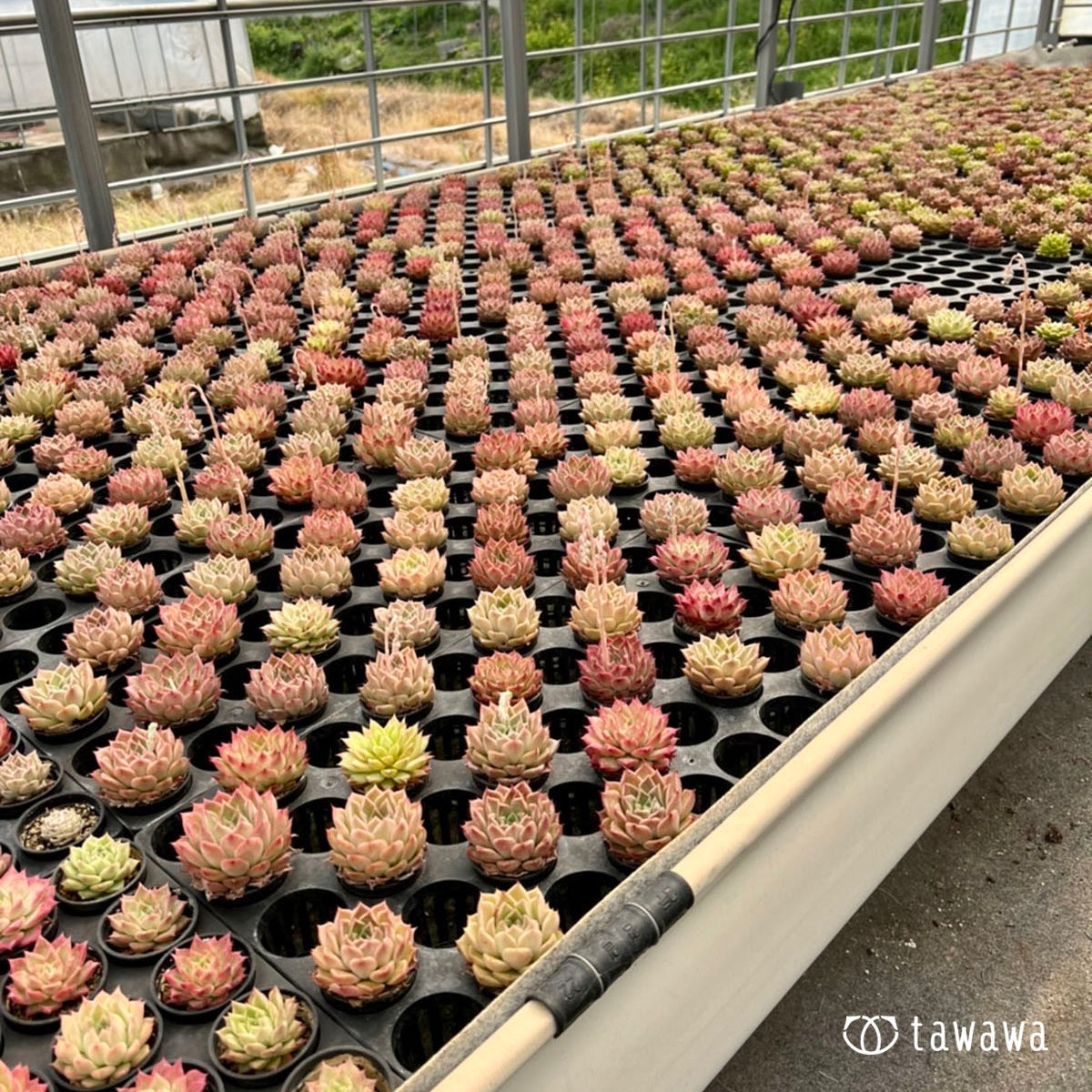
In addition to the open greenhouse, there are several other greenhouses, most of which are for Echeveria, apparently.
And such a large farm is managed by only five people.
They said they were "busy all year round," which is completely understandable!
I introduced the inside of the open house during an Instagram LIVE broadcast, but I'll also show it with photos ^ ^
(You can find the LIVE broadcast in my Instagram posts, so please check it out if you like!)


They basically grow seedlings from seeds, but there were also some from leaf cuttings.
It was an overwhelming sight, and I felt like I could wander around for hours and hours lol.
During the first LIVE broadcast, I received a comment saying "I want it," so I suddenly decided to stock up.

The problem is here ↑
On the right is the wife of Chang Hee Farm ♡ She is very cute and cheerful.
On the left is me lol
What are we doing looking at our smartphones, you ask...

↑ We are having a conversation lol
I can't speak any Korean.
We each used our apps, leaning over to peek at each other's translated sentences as we talked.
It was silent, lol.
In the midst of that, I asked various questions about the seedlings,

↑ It turned into the second LIVE broadcast.
I decided on the seedlings to purchase while receiving comments during the broadcast,

The soil and roots were treated for transport,


I purchased about 60 seedlings and successfully brought them back to Japan as carry-on luggage!
Sales will begin tonight (May 29th) at 9 PM!!
I will provide detailed information on quarantine etc. later ^ ^
The directly imported seedlings are all highly recommended, including new varieties and even some that tawawa will be the first to sell, so please check out our online shop if you'd like♪

↑ Unsold seedling: Dodory × Laui. Everyone who purchases from tawawa will be the first buyer.
After spending a long time admiring many wonderful seedlings, I got back on the bus and returned to Seoul.
【Bonus】
I had airline food for lunch, so my first meal in Korea was a hearty Samgyeopsal♡

It was delicious~~~
Day 1 was full of travel information, but please look forward to the articles about Day 2 and beyond!!
Please find the Korean Succulent Tour series below.
- Korean Succulent Tour ~Day 1~ ← You are here
- Korean Succulent Tour ~Day 2・Morning~
- Korean Succulent Tour ~Day 2・Afternoon~
- Korean Succulent Tour ~Day 3~
- Korean Succulent Tour ~Day 4 (Last Day)~