This article provides a detailed introduction to Echeveria, one of the most popular succulents, focusing on its types and characteristics. Discover the charm of various Echeveria and find the perfect variety for you.
1. Introduction: What is Echeveria?
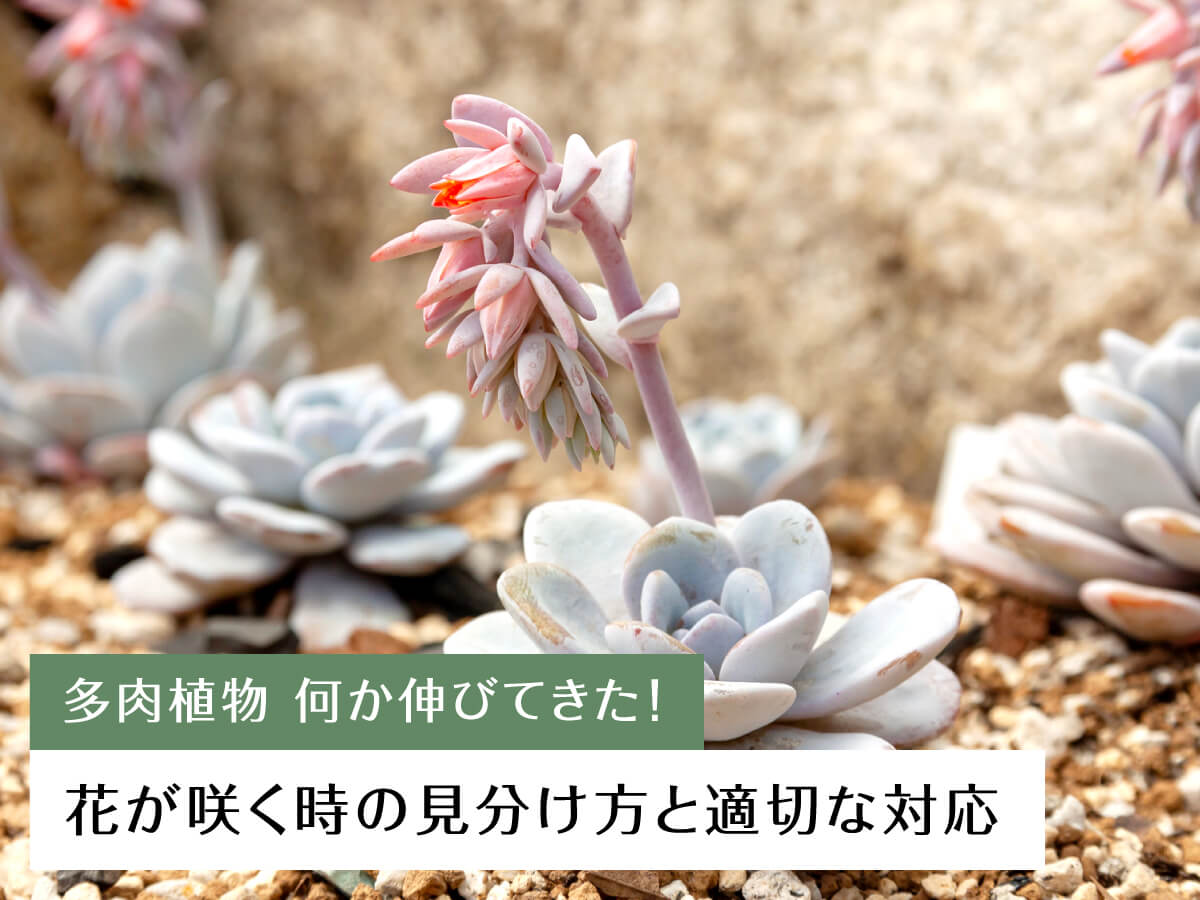
Echeveria is a succulent plant mainly native to Central America and Mexico, with over 200 rich varieties. It belongs to the Crassulaceae family, genus Echeveria, and prefers dry, warm regions. Its characteristic feature is the rose-like arrangement of oval or spatulate leaves, which gives it a delicate appearance. Due to its aesthetic appeal, it is also used in mixed plantings. It grows in spring and autumn, and blooms from spring to early summer or from late winter to spring. Another charm of Echeveria is that its leaves turn red in autumn when the temperature drops.
Related articles: ↓
Enjoying pink autumn foliage with succulents! Recommended varieties and how to grow them
Characteristics and Charm of Echeveria
Echeveria is a type of succulent widely cultivated worldwide for its beauty. The distinctive shape of Echeveria is a "rosette," with thick leaves spreading radially from the center in a beautiful form. The leaf color varies depending on the type, with a wide range including green, pink, purple, and gray, and changes with the season and sunlight conditions. Enjoying this color change is one of Echeveria's charms.
Furthermore, Echeveria has "drought resistance," making it easy for beginners to grow due to less watering effort. Additionally, it can grow sufficiently even in small pots, allowing it to be easily enjoyed as an interior decoration. These characteristics and charms make Echeveria one of the most popular types of succulents.

2. Echeveria Varieties and Their Characteristics
There are various types of Echeveria, each with attractive characteristics.
For example, "Echeveria Elegans" is characterized by its elegant appearance, as its name suggests, and has beautiful rosette-shaped leaves. "Echeveria Laui" is popular for its thick leaves covered in white powder, resembling the beauty of a jewel.
"Echeveria Chihuahuaensis" is known as one of the easy-to-grow varieties, characterized by pale green leaves with pink tips, called "claws," and a soft, rounded, charming form. These are just a few examples, but the charm of Echeveria lies in its diversity.
Learn how to grow each variety and discover the joy of cultivating your own Echeveria.
Echeveria Elegans
Echeveria Elegans is a particularly popular variety among Echeveria species. Native to Mexico, its leaves are pale yellowish-green and semi-transparent. The secret to its color lies in the shape of its flat, spoon-like leaves. Another characteristic is that its rosette shape is slightly distorted.
Echeveria Elegans prefers sunlight but is well-adapted to the Japanese environment, so outdoor cultivation is generally recommended. This plant prefers dry regions, so it is easier to grow if watering is kept to a minimum, especially during the dry season.
《Reference Information》
Ease of cultivation ★★★☆☆
Sunlight full sun to partial shade
Flowering season Spring, Summer, Autumn, Winter
Echeveria Elegans is often used for interior decoration and gardening due to its beauty, and can be enjoyed all year round.
Echeveria laui
Echeveria Laui is a succulent plant characterized by its beautiful powdery white leaves and symmetrical shape. However, Laui is known to be relatively sensitive to cold among Echeveria, so care is needed in winter. The charm of Echeveria Laui lies in its delicate beauty, but growing it requires a bit of know-how.
First, Echeveria Laui prefers sunlight, so growing it in a sunny spot is key. Also, it prefers dry conditions, so water only after the soil has completely dried out. For winter cold protection, measures are needed to keep the pot from getting cold. Caution is required on days when the temperature drops below 5 degrees Celsius. On cold winter days, cover it with non-woven fabric or a blanket from night to morning, or bring it indoors to protect it from the cold.
By taking these measures, Echeveria Laui will enhance its beauty even more. Why not welcome Echeveria Laui, which can be enjoyed visually with its unique leaf shape and coloring, into your room?

Echeveria lilacina
Echeveria Lilacina, as its name suggests, means "lilac-colored" and has a beautiful pale purple hue. A characteristic feature of Echeveria Lilacina is its slightly curled leaves, which give it an elegant atmosphere. The leaves are somewhat thick and sturdy.
Regarding cultivation, it is important to ensure plenty of sunlight. Also, the hot and humid Japanese summer is a major enemy. In summer, a cool place out of direct sunlight is suitable, and in winter, it can withstand temperatures down to about -1°C if it doesn't get frost.
For watering, it is generally recommended to give enough water to the roots after the soil has completely dried out. The interval for this is when the leaves become soft and lose their firmness, which indicates it's time to water.

Echeveria agavoides
Echeveria Agavoides is a succulent plant characterized by its "agave-like" features, as its name suggests. Specifically, its tapered, sharp leaves that grow upright resemble an agave, hence its name. The charm of this Echeveria also lies in its rich variety.
The color and shape vary widely depending on the variety. For example, 'Ebony' has large, red leaf tips and a dynamic appearance, while 'Romeo Rubin' remains purplish-red all year round. Many Echeveria bear the name 'Agavoides,' and each possesses its unique charm.
Regarding cultivation, like Echeveria in general, it prefers dry conditions but has some weakness to heat. Also, there is a large individual difference, so even within the same variety, their appearance is often indistinct. Therefore, you can enjoy the unique beauty of each Echeveria.

Echeveria Shichifukujin (Seven Lucky Gods)
Echeveria Shichifukujin (Seven Lucky Gods) is a type of Echeveria that has been loved in Japan since ancient times. Its characteristic feature is the beautifully balanced leaves that spread in a rosette shape, resembling a rose. In winter, when these beautiful leaves are especially prominent, the edges and tips of the leaves turn red, making it even more attractive. Shichifukujin also has a tendency to cluster and multiply, with new rosettes emerging one after another from a single plant.
For growing Shichifukujin, it is ideal to grow it in a sunny location. For watering, it is recommended to water thoroughly after the soil dries out to avoid over-watering. By following these tips when growing Shichifukujin, you can enjoy its beautiful rosettes for a long time.
Echeveria Momotaro
Echeveria Momotaro is a particularly popular variety among succulents, and its charm lies in its plump, rounded leaves and pale complexion with cute pink "claws" (leaf tips). It was even introduced on NHK's "Shumi no Engei" (Gardening for Hobbies) as "the first Echeveria that comes to mind."
Furthermore, Momotaro thrives vigorously when grown under strong sunlight, and its leaves grow long and slender when grown under milder light. It changes its appearance depending on the growing environment, so even the same Momotaro can have a varied look.
However, the crossbreeding and detailed origin of Momotaro are unknown. Because of this, many names exist, and similar Echeveria varieties can also be found. This, too, can be said to be one of Momotaro's charms.

Echeveria Hanaurara
"Echeveria Hanaurara (also known as Echeveria pulidonis)" is one of the most famous Echeveria varieties, characterized by its pale green leaves with lovely pink edges. Since it has been cultivated for a relatively long time, it is easy to grow in the Japanese environment and can also be easily propagated by leaf cuttings.
To maintain its beauty, proper sunlight and moisture management are essential. Its color tends to fade in dark environments, and conversely, strong sunlight can cause leaf burn, so careful management is required.
Echeveria Hanaurara is widely loved by both succulent beginners and experts alike for its beautiful appearance. It is particularly popular among women and is popular as an interior decoration or gift.
Echeveria Laulinze
Echeveria Laulinze is one of the varieties that is gaining popularity among succulent enthusiasts due to its beautiful appearance. It is characterized by plump leaves covered in powder.
As for cultivation, care is needed to protect it from cold damage in winter. Also, during the spring and autumn growing seasons, ensure it gets plenty of sunlight and moderate watering.
Echeveria Laulinze is also popular as a parent plant for hybridization due to its beauty. For those who want to enjoy succulents even more, there is also the joy of crossbreeding and growing original seedlings.

Echeveria harmsii
Echeveria harmsii is a succulent of the genus Echeveria, characterized by hard, thick green leaves. Fine hairs cover the leaf surface, giving it a velvety texture. In winter, the leaf tips turn wine red, revealing an even more beautiful appearance.
For cultivation, a well-ventilated outdoor location is ideal, as it is relatively tolerant of both summer heat and winter cold. Water in spring and autumn growing seasons 2-3 days after the soil dries, and in mid-summer and mid-winter, water every 2 weeks to a month.
Since Echeveria harmsii grows vigorously, repotting once a year is recommended. Also, depending on the cultivation environment and pot type (plastic pots retain more moisture, ceramic pots drain better), it may be beneficial to mix in potting soil, slow-release fertilizer, or insecticides.
Echeveria chihuahuaensis
Echeveria chihuahuaensis is a special Echeveria, named after its origin in Chihuahua, Mexico. This Echeveria is characterized by its plump, rounded leaves, and its strong pink color is also appealing.
It is also very similar to the Echeveria 'Momotaro', almost indistinguishable. However, compared to 'Momotaro', its leaves are shorter and smaller, its growth is slower, it is fairer in complexion, and its pink color becomes more pronounced during autumn foliage. Therefore, although it may look like 'Momotaro' at first glance, a detailed comparison will reveal the differences.
As for cultivation, since it prefers sunlight, it is recommended to grow it in a sunny spot with 3 to 6 hours of daylight. Also, strong light can cause sunburn, so provide adequate shade.

Echeveria zaragosa
Echeveria cuspidata var. zaragozae, or Echeveria Zaragoza, evokes a cool, mature aesthetic with its dense, slender leaves and vibrant red tips.
Furthermore, this species has a tendency to form clusters. Therefore, the sight of multiple plants growing in a single pot is like a work of art. Its beauty also makes it suitable for interior decoration.
Basic cultivation tips include placing it outdoors in a location that avoids western sun (3-6 hours of sunlight daily) during the spring and autumn growing seasons. Also, strong sunlight can cause sunburn, so it's crucial to provide adequate shade.
3. Echeveria's Appeals and Advantages
The first appeal of Echeveria is its beauty. In particular, the rosette-shaped leaves of Echeveria can be said to be a symbol of its beauty. These leaves are thick and, depending on the variety, may be covered with white powder or white hairs, offering rich visual variations.
Furthermore, some varieties change leaf color with the seasons, and those that display autumn colors can be enjoyed throughout the year. For example, 'Chihuahuaensis' changes leaf color from December to February, and 'Romeo Rubin' displays red leaves all year round in a sunny environment.
In addition, due to their aesthetic appeal, Echeveria are used as accents in interior design and gardening. You can plant just one in a small pot, or create a mixed planting of several varieties to enjoy a variety of expressions within a single pot.
Because of these charms, Echeveria is a popular type among succulents, and its beauty and rich variations are loved by many people.
Related articles: ↓
【Beginner's Must-Read】A Beginner's Guide to Succulent Arrangements: Starting from the Basics!
The Beauty of Echeveria and Its Reasons
The beauty of Echeveria stems from its unique shape and coloration. Echeveria features leaves that spread out in a rosette form, providing a refined visual. Furthermore, their coloration varies greatly depending on the species, ranging from pale green to vibrant pinks and purples, offering a very broad palette. Moreover, some Echeveria varieties become even more vibrant in color when exposed to sunlight, which further enhances their appeal.
These characteristics are also the reasons why Echeveria is widely used in interior design and gardening. In other words, its beauty is not merely visual but also plays a role in enhancing the entire space.
Creating Ambiance and Decorating with Echeveria
Echeveria varieties are diverse, and their vibrant colors and unique shapes are suitable for decorating spaces. Not only can you plant just one in a small pot, but by combining multiple types and planting them to fill a pot, you can create an interior that resembles a work of art.
Furthermore, due to their durability and low maintenance, Echeveria are also very suitable as gifts.
With Echeveria, which emits unique beauty and presence, you can decorate your space and enjoy a comfortable time.
4. How to Grow Echeveria and Points to Note
There are three key points to growing Echeveria. First, grow it in a sunny location. Echeveria are native to warm, dry regions, so they prefer sunny, well-ventilated spots. Be especially careful of direct sunlight in summer; placing them in partial shade is good.
Next, soil preparation. Soil that combines water retention, fertilizer retention, and good drainage is optimal. Use commercially available succulent soil, or if blending your own, combine akadama soil, kanuma soil, hyuga soil, granular potting soil, etc.
Finally, temperature management. Echeveria's cold hardiness is generally up to 0°C (most varieties of Echeveria that are well-rooted and grown outdoors for a long time can withstand cold down to about 0°C), so if it gets colder than that, move it indoors or cover it with non-woven fabric to protect it.
By following these growing methods and precautions, you can grow Echeveria beautifully for a long time.
Related articles: ↓
Explaining Succulent Types and How to Grow Them
Basic Growing Methods
The basic method for growing Echeveria is to ensure plenty of sunlight and good ventilation. Specifically, place it in a sunny and well-ventilated spot, and water thoroughly when the soil dries out, especially in spring and autumn. In summer, growth slows down, and direct sunlight is too strong, so from July to early September, move it to bright shade or use a shade net, and water only at night when the leaves shrivel. For fertilizer, mix slow-release fertilizer when repotting, or give liquid fertilizer only during the growing season. Also, Echeveria is relatively cold-hardy, but it weakens below 0 degrees Celsius, so in that case, it is recommended to move it indoors to a sunny location.
Changes in Cultivation Methods Depending on Environment and Season
Echeveria ideally needs a sunny environment that can maintain temperatures above 5°C in winter. However, cultivation methods change depending on the growing environment and season.
From spring to autumn, it's important to pay attention to the temperature difference between day and night. It's crucial to give them sun exposure during the day and let them rest in a cool place at night. This allows Echeverias to develop vibrant colors and grow healthily.
On the other hand, if it gets too cold in winter, Echeverias will go into dormancy and stop growing.
Echeverias also prefer dry conditions, so it's best to water them when the soil is dry. Water thoroughly until water drains from the bottom of the pot.
By keeping these points in mind and observing your Echeveria as you care for it, you can enjoy its beauty all year round.
5. Summary: Find and enjoy your own Echeveria
Echeverias, a type of succulent, are gaining popularity due to their wide variety and beauty. By finding your own favorite Echeveria, you can add color to your daily life. A deeper understanding of how to care for Echeverias and their charm will only enhance their appeal.
Moreover, creating arrangements that highlight the characteristics of each Echeveria is another enjoyable aspect. By combining Echeverias of various colors, you can create your own unique and beautiful display.
And don't forget to appreciate the Echeverias you've grown and decorate them to enhance their beauty. How you care for them can greatly change their appearance. Enjoy the world of Echeverias and feel the joy of nurturing them.
The joy of finding your favorite from a variety of types
One of the appeals of Echeverias is their wide variety of species, allowing you to find one that suits your taste from various shapes and colors. For example, "Echeveria elegans" has elegant and beautiful rosette-shaped leaves, as its name suggests. "Echeveria laui" is characterized by powdery leaves and a pinkish hue.
Furthermore, "Echeveria Romeo Rubin" has vibrant reddish leaves that attract attention. In addition to these, there are many other types such as "Echeveria lilacina," "Echeveria agavoides," and "Echeveria shichifukujin," each with its unique shape and color.
Enjoying the diverse expressions of Echeverias at home can truly be considered a hobby. Their beauty also brightens up any space as interior decoration. Find the Echeveria that most captivates you and experience the joy of growing it.
Tips for further enjoying Echeverias by understanding how to grow them and their appeal
Echeverias are loved by many for their beautiful shapes and ease of care. The key to further enjoying these Echeverias lies in "knowledge" and "observation."
The care methods, amount of sunlight, and watering vary slightly depending on the Echeveria species. By understanding the characteristics of each type, you can create the most comfortable environment for that specific Echeveria.
Furthermore, Echeverias are plants that undergo many changes. Their appearance transforms with seasonal fluctuations and growth, and there are new discoveries with every observation, such as changes in color and flowering. By enjoying each moment, your time with Echeverias will become even richer.
By grasping these points, you can maximize the charm of Echeverias and enjoy your own unique Echeveria life.