This article provides a detailed explanation of the tips and procedures for successful "leaf propagation" for beginners, one of the methods for propagating succulents.
1. Introduction
There are various ways to grow succulents, and "leaf propagation" is particularly popular. Its appeal lies in the ability to grow a new plant from a single leaf.
Leaf propagation, as the name suggests, is a method of growing new succulent plants by inserting a leaf. This method is particularly suitable for varieties like Echeveria and Sedum. These plants tend to root easily from leaves, making it simple to grow new plants.
However, not all succulents can be propagated by leaf. Some varieties require other methods, such as stem cuttings or seeds, so this point needs to be noted. If you're new to leaf propagation, start by checking if your succulent is suitable for this method.
Related articles here↓
[Beginner's Must-See] Tips for successful succulent stem cuttings
(1) What is succulent leaf propagation?
Succulent leaf propagation is one method of propagating succulents where a new plant is grown from a single leaf. This method is particularly suitable for situations where a leaf has fallen off easily or for using leaves removed during stem cutting. Observing a new plant grow from a single leaf is one of the fascinations of succulents.
The specific procedure is simply to insert the base of a leaf that has fallen from the plant or a leaf removed from the plant into dry soil and wait for roots or new leaves to emerge. While not 100% guaranteed, there's a chance a new plant will grow from a single leaf using this method.
By understanding and properly performing "leaf propagation," one of the attractive characteristics of succulents, you can enjoy the pleasure of easily increasing your succulent collection.

(2) Introduction to suitable varieties for leaf propagation
Succulents vary in their suitability for leaf propagation depending on the species. Characteristics of succulents that succeed well with leaf propagation include having relatively large and fleshy leaves. Also, species whose leaves are easy to remove, i.e., those with many deciduous leaves, are suitable for leaf propagation. Specific examples include Echeveria, Graptopetalum, Sedum, and Pachyphytum. These types of succulents tend to have easily removable leaves, and those leaves root relatively easily. However, even within these species, there are individual differences, and not all will succeed with leaf propagation. If you fail, try again or consider other methods (like stem cuttings or offsets).

2. Basic steps for succulent leaf propagation
For succulent leaf propagation, first prepare the leaves. Use fallen leaves as they are. When removing leaves, do so from a slightly dried plant, not one that is heavily watered.
For soil preparation, spread dry soil evenly in a tray. Then, insert the base of the prepared succulent leaves into the soil. For small-leaved Sedums, simply placing them on the soil is fine.
Roots and shoots will emerge in 1 to several weeks. No watering is generally necessary until roots appear. However, some succulent growers water to encourage faster rooting, so choose the method that suits you best.
Related articles here↓
【Succulent Soil Selection】Even beginners won't fail! How to make easy-to-grow soil?
(1) Preparing for leaf propagation
First, half of leaf propagation depends on "choosing the right leaves." Select healthy leaves from a slightly dried succulent. It's easier to remove leaves from a dried plant rather than one that has just been watered. When removing leaves, hold them firmly and carefully twist them from side to side. It's crucial that the base of the leaf is removed cleanly because new shoots emerge from the base of the leaf. If the base is damaged, new shoots may not grow easily, so be careful.
(2) Preparing the soil
Prepare soil suitable for succulent leaf propagation. You can use a tray or a flat dish as a container. At this stage, it's fine if the pot doesn't have drainage holes.
First, spread dry soil as evenly as possible over the container. It's important to spread the soil flat, not too thick. For leaf propagation, it's crucial to create an environment where roots can absorb enough oxygen, which requires the soil to be spread flat and evenly.
This completes the soil preparation. In the next step, we will insert the leaves into this soil.
(3) Inserting leaves into soil
Insert the leaves taken from the original plant into the soil just enough to bury the base of the leaf, meaning not too deeply. You can insert the leaves horizontally and diagonally, or vertically. Either method is fine. When inserted horizontally, new shoots are more visible than when inserted vertically. When inserted vertically, they are more stable than when inserted horizontally, so they are less likely to fall out of the soil. Also, for small-leaved Sedums, you can insert each leaf into the soil, but since it takes time, simply "placing" them on the soil is fine due to their strong propagation ability.


(4) Management methods until rooting
After leaf propagation, it's fine to either withhold watering for about a week, or water immediately after propagation, whichever method suits you. Some growers prefer to withhold water to create an environment where the leaves naturally absorb moisture more easily, while others water immediately to encourage rooting as the leaves sense the moisture. In both cases, the seedlings have grown successfully, so it's fine to use the method that suits your growing environment. In either case, moderate humidity and temperature are necessary to promote rooting.
In particular, temperatures around 20-25 degrees Celsius are ideal, as it can dry out too much if it's too hot and growth can stagnate if it's too cold. It's also desirable to maintain humidity.
3. Tips for successful succulent leaf propagation
Here are some tips for successful succulent leaf propagation. First, choosing the right leaves is crucial. It's important to use fresh, healthy leaves. Leaves with diseases or insect damage are not suitable. Carefully remove the leaf from the base, ensuring that the growth point, the reddish or dark part at the base of the leaf, remains firmly attached to the removed leaf.
Second, watering technique is key. It's important to maintain adequate humidity to prevent dehydration. However, be careful not to overwater, as this can cause the leaves to rot.
Third, manage shade and sun exposure. Avoid direct sunlight; partial shade is ideal. Also, temperatures between 15 and 28 degrees Celsius are ideal.
Finally, preventing pests and diseases is important. This can be done by mixing insecticide into the soil used for leaf propagation.
By following these tips, the success rate of succulent leaf propagation will significantly increase.
Related articles here↓
"How to water succulents" How to avoid failure? Expert tips on watering

It is crucial to remove the leaf so that the growth point remains on the leaf.
(1) Choosing the right leaves
The choice of leaves used for propagation greatly influences growth. The secret to success is selecting vigorous, healthy leaves. In particular, pay attention to the following three points:
1. Color: Healthy succulent leaves are deep green or have a color specific to their species. Avoid faded or blackened ones, as they may indicate disease or nutrient deficiency.
2. Shape: Choose leaves with a uniform shape and undamaged tips. Damaged or irregularly shaped leaves may indicate poor health.
3. Elasticity: Select leaves that feel elastic when gently touched. Leaves that lack elasticity, are shriveled, or sticky are not suitable.
By focusing on these points and choosing healthy leaves, you will increase your chances of successful leaf propagation.
These are the tips for choosing appropriate leaves for succulent leaf propagation.
(2) Watering tips
Regarding when to start watering after leaf propagation, as mentioned above, some people start immediately, while others wait about a week. In either case, water more frequently than you would for larger plants. The reasons are that leaf propagation requires adequate humidity for rooting, and frequent watering after roots begin to emerge helps prevent them from drying out. However, it's important not to overwater. You don't need to water daily, but add water as needed when the soil dries out. Increase the success rate of leaf propagation with proper watering.
(3) Appropriate sun exposure management
In succulent leaf propagation, managing appropriate sunlight is extremely important. Succulents generally prefer sunny environments, but it is advisable to avoid strong direct sunlight in the initial stages of leaf propagation.
The reason for this is that in the early stages of leaf propagation, there are no roots to absorb water, so avoiding direct sunlight helps retain moisture by suppressing transpiration. Therefore, it is recommended to manage newly propagated leaves in a partially shaded location.
Once roots have formed, gradually move them to a sunnier location. At this stage, management in a bright area is necessary while still avoiding strong direct sunlight. However, some species prefer strong sun, while others prefer shade. Therefore, it is important to understand the characteristics of each species and provide an appropriate environment.
(4) Pest and disease prevention methods
To prevent pests and diseases in succulent leaf propagation, daily management is crucial. First, ensure proper watering. Since leaf propagations don't have roots yet, they absorb water through their leaves. However, excessive watering can lead to root rot. On the other hand, too much dryness can attract insects, so maintaining appropriate humidity is important.
Also, adequate sunlight is important. Strong direct sunlight can not only cause sunburn but also stress the plant, attracting pests and diseases. Bright, partial shade is ideal.
Furthermore, regular observation is essential. Detect changes in color or shape and insect infestations early, and take necessary measures.
Additionally, mixing insecticide into the soil for leaf propagation is a good method.

4. Growth process of succulents propagated from leaves
Once successful leaf propagation has occurred and roots have formed, the succulent will begin to grow new leaves over time.
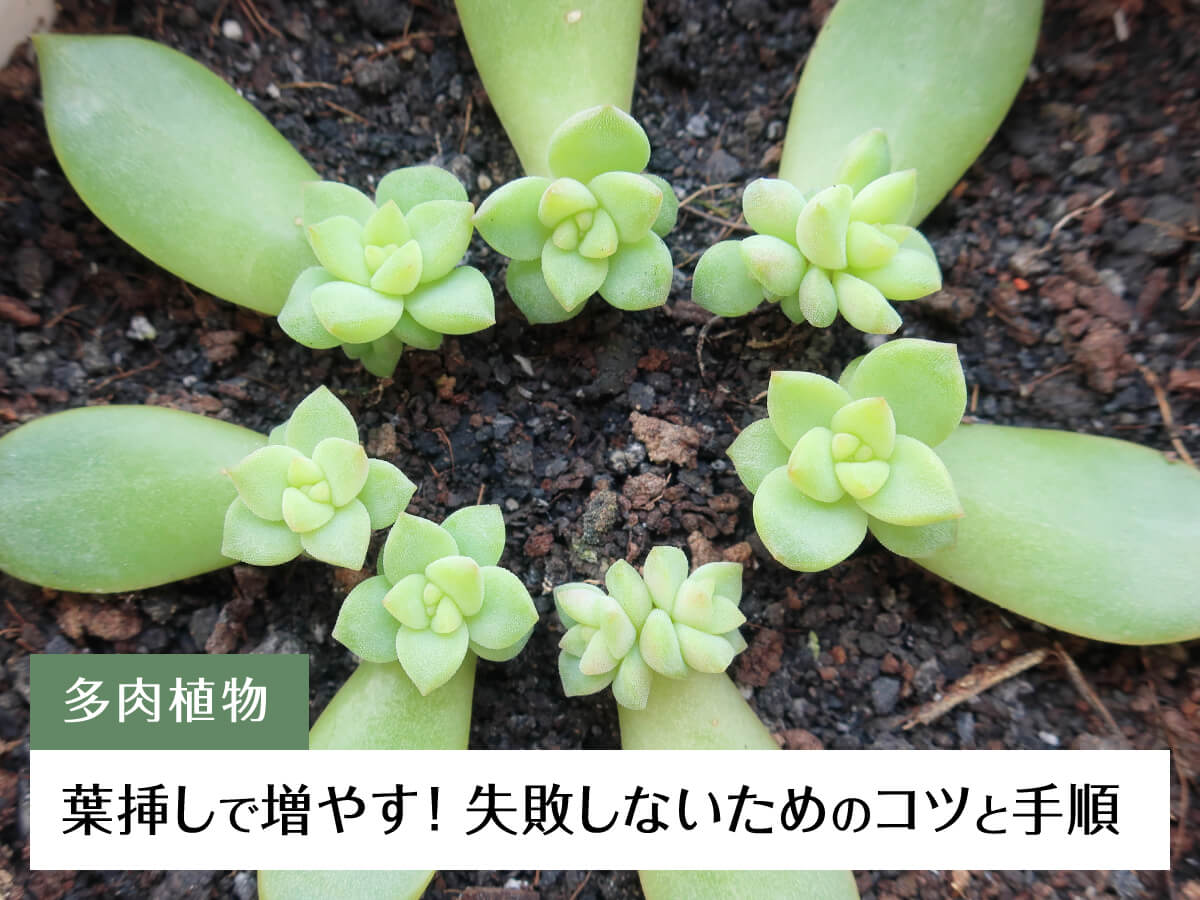
The process from germination to growth involves thin roots starting to emerge in the first 1-2 weeks, followed by small leaf buds gradually growing over several weeks, forming a new succulent. Also, as the new succulent continues to grow after leaf propagation, the initial leaves will wither and fall off. This wilting process is a natural phenomenon and a sign of new life growing.
(1) From germination to growth
The process from germination to growth after succulent leaf propagation is generally as follows:
First, within a few days to 1 to several weeks after leaf propagation, tiny roots begin to grow from the base of the leaf. This is the initial stage of rooting. It is important to ensure sufficient moisture and an appropriate temperature environment during this period.
Next, after the roots have grown to some extent, new succulent shoots (germination) begin to emerge from the base of the leaf. After germination, the growth rate accelerates, and a seedling forms in about a month.
Observing the growth process is one of the fascinations of succulent leaf propagation, and correctly understanding the growth process allows for more effective care.
(2) What is growth after leaf propagation?
"Growth after leaf propagation" refers to the process where a succulent progresses to the next stage. After new roots emerge, a new plantlet develops from the base of the leaf. This plantlet grows and gradually becomes a succulent with the same shape as the parent leaf.
Initially, it will be small, but it will grow larger over time, sometimes reaching the same size as the parent leaf. However, the growth speed and shape vary depending on the type of succulent and the growing environment.
Additionally, the newly formed succulent is nourished by the parent leaf until it withers. Therefore, there is no particular need to remove the parent leaf until it has completely died back.
The above explains the growth process of succulents after leaf propagation. By committing to proper care, you can enjoy the growth of new life.
5. Subsequent care for succulents propagated from leaves
The care of succulents propagated from leaves significantly impacts their growth.
(1) Transplanting time and method: Once the seedlings grown from leaf propagation reach a certain size, transplanting is necessary. The optimal time for transplanting is from spring to summer, and when repotting into a new container, prepare dry soil.
(2) Long-term growing tips: For long-term growth, sunlight and water are key for succulents. While some varieties grow in the shade, they generally prefer good sun exposure. Also, it's ideal to water only after the soil has dried out. Keeping these points in mind, nurture them with care and affection.
Related articles here↓
Do you know where to place succulents? The reason why "outdoors" is optimal.
(1) Transplanting time and method
The transplanting time after successful succulent leaf propagation is when you can confirm that new leaves have grown firmly from rooting. Specifically, about 2-3 months from rooting is a general guideline. However, if there are no particular problems with growth during dormant periods, such as when the plant is absorbing enough moisture, you can grow it as is without transplanting. Please wait until the appropriate time for repotting.
Follow these steps for transplanting:
-
Place well-draining soil, such as pumice, in a pot that matches the size of the seedling.
-
Remove the leaf propagation seedling, and gently remove any old soil or dead roots.
-
Place the leaf propagation seedling in the pot and add soil to cover the roots.
-
Water an appropriate amount after the soil has dried.
As a precaution, gradually acclimatize newly planted seedlings to direct sunlight, and it's best to water after the soil has thoroughly dried, similar to other seedlings.
By transplanting using the above method, the succulents grown from leaf propagation should grow healthily.
(2) Long-term growing tips
Let's consider how to care for succulents long-term after leaf propagation. Like mature plants, they require different care depending on the season. From spring to summer, during their growth period, water thoroughly until it drains from the bottom of the pot after the soil has completely dried, and ensure adequate sunlight. During winter, which is their dormant period and when cold is a concern, reduce watering and manage both sunlight and temperature carefully.
Mature succulents can be kept healthy by regularly repotting them into larger containers or by dividing them. Furthermore, preventing pests and diseases is crucial, and it's important to take prompt action as soon as they are spotted.
Fertilizer is best applied during the growing season from spring to autumn. In winter, however, they are dormant, so fertilize sparingly.
Thus, caring for succulents according to the seasons, regular repotting/division, and appropriate fertilization are key to long-term successful succulent cultivation.
6. Frequently Asked Questions about Leaf Propagation
(1) Reasons for leaves withering and countermeasures: The main cause of leaves withering is lack of water. However, in the early stages of leaf propagation, the leaf receives moisture and nutrients from the mother plant to produce roots and sprouts, so there is no need to be overly concerned about watering. After the leaves have rooted and sprouted, it's good to maintain appropriate humidity by watering moderately.
(2) Reasons for not rooting and countermeasures: Causes for not rooting include strong light and temperature. Under strong light, the moisture in the leaves evaporates quickly, which can hinder their ability to root. Also, rooting does not progress if the temperature is too low. Check for an appropriate environment. Additionally, not all succulents can be propagated by leaves. Some varieties have a low success rate for leaf propagation, or cannot be grown by leaf propagation at all.
(3) Differences in cultivation methods by season: Leaf propagation of succulents requires different management methods depending on the season. For example, in winter, rooting is slower, so temperature control is necessary.
The information above provides important tips for successful succulent leaf propagation. Take appropriate measures based on the specific situation.
Related articles here↓
[Reasons for Succulent Wilting] Care Methods and Revival Tips for Beginners
(1) Reasons for Leaves Withering and Countermeasures
In succulent leaf propagation, the main reasons for leaves withering are "excessive moisture" and "direct sunlight." Particular caution is needed in summer; as heat increases, so does evaporation, which can lead to overwatering. However, succulents do not tolerate excessive moisture well, so there is a high risk of the leaves rotting and dying.
As a countermeasure, it is important to patiently wait for rooting. Water only after the soil has dried, approximately every few days to 10 days. Also, avoid direct sunlight. Especially in summer, it is recommended to grow them in the shade.
By maintaining proper care as described, it is possible to cultivate beautiful succulents.
(2) Reasons for Not Rooting and Countermeasures
The main reasons why succulent leaves may not root during propagation are as follows:
-
Leaf handling: If the growth point, which is a pink or reddish-black part at the base of the leaf, is not present on the detached leaf when it is removed, the chances of roots or sprouts emerging are low.
-
Watering frequency: Overwatering can cause the leaves to rot, preventing roots from emerging. While more frequent watering than for mature plants is needed, moderate watering is crucial.
-
Environmental conditions: Inappropriate temperature or humidity can also prevent rooting. Maintaining adequate temperature and humidity can increase the rooting rate.
(3) Differences in cultivation methods by season
The success rate of succulent leaf propagation varies by season. Spring and autumn are particularly recommended. This is because succulents become more active during their growing season in spring and autumn, increasing their ability to form new roots. Conversely, in winter, growth slows down and they have less energy to produce new roots, making leaf propagation less likely to succeed.
Leaf propagation is possible in summer as well, but avoid direct sunlight. The leaves may get scorched. A cool, shaded spot is suitable.
Also, be aware of seasonal differences in humidity. In dry seasons, it is recommended to water more frequently.
7. Summary
Succulent leaf propagation is an easy method once you understand the steps and tips, allowing you to enjoy growing various types of succulents. It is essential to acquire basic knowledge, including how to select the right leaves, watering tips, managing shade and sunlight, and pest and disease prevention. Furthermore, post-propagation care is crucial, and it's important to continuously pay attention to details such as transplantation timing and methods, and long-term care points. If succulent leaf propagation fails, it's important to identify the cause from common questions and implement countermeasures. Based on this information, why not try growing beautiful succulents yourself?