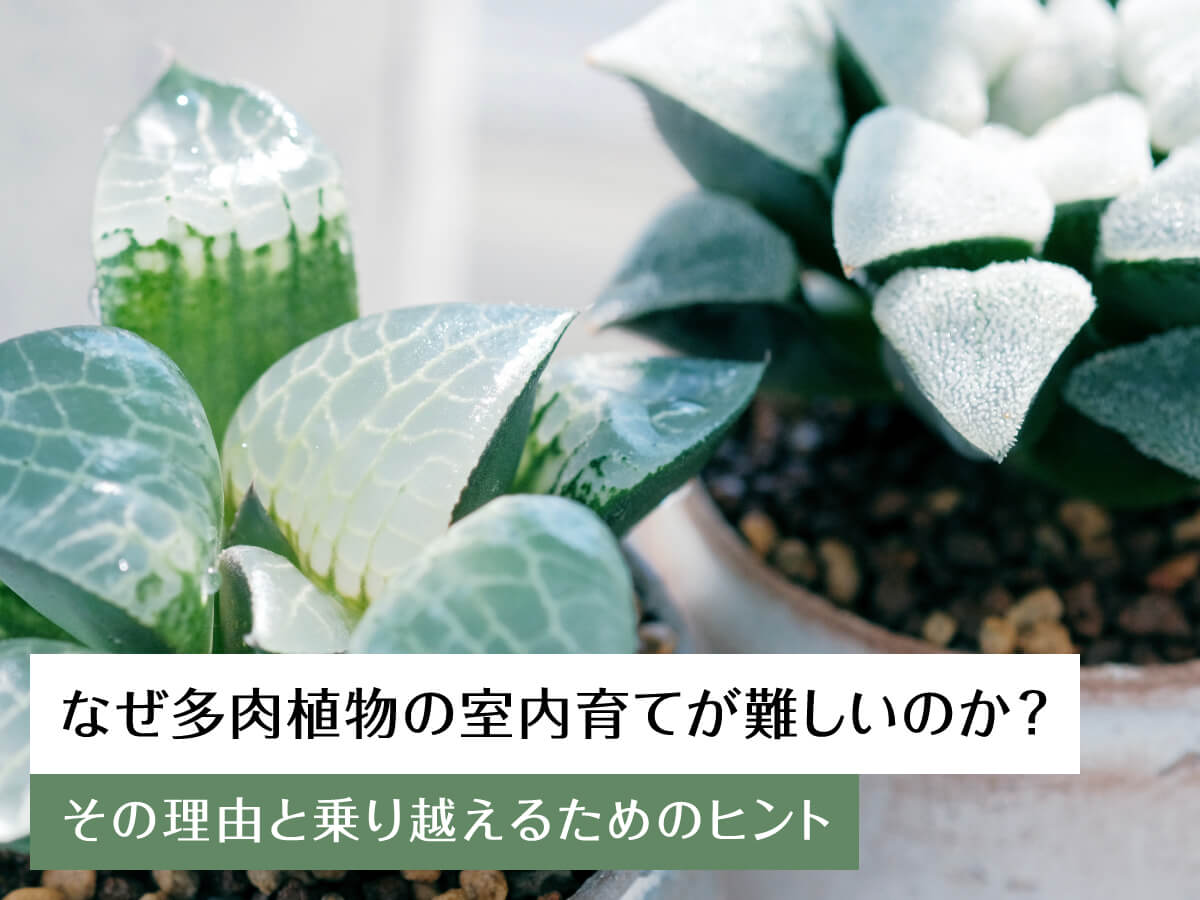
This article details why it is fundamentally difficult to grow succulents indoors. It also provides specific tips and advice on the best methods for growing them indoors, despite these challenges.
1. Introduction: Why is it difficult to grow succulents indoors?
Succulents are often grown outdoors, but recently, more and more people are looking to grow them indoors. However, why is it difficult to grow succulents indoors? The reasons can be summarized into the following four main points:
① Insufficient sunlight
② Proper ventilation
③ Watering
④ Temperature control
By understanding these challenges and carefully following the advice to address them, it is possible to enjoy growing succulents indoors.
2. Main challenges in growing succulents indoors
There are several challenges to growing succulents indoors.
(1) Insufficient sunlight: Indoor environments have limited natural light, making it difficult to provide the adequate light succulents need. A lack of sunlight can lead to etiolation, where the stems stretch out.
(2) Proper ventilation: Indoor spaces tend to have poor air circulation. Poor ventilation can lead to high humidity, which causes pests, diseases, and root rot.
(3) Watering: Succulents have evolved to thrive in harsh environments, so overwatering can cause root rot. This makes proper moisture management difficult indoors.
(4) Temperature control: Indoor environments have less temperature fluctuation, making seasonal temperature adjustments difficult. Succulents, in particular, need cool conditions in summer and warm conditions in winter, requiring careful temperature management.
(1) Insufficient sunlight: Limited light sources indoors
Succulents naturally grow in environments with abundant sunlight, so insufficient sunlight is a problem for indoor cultivation. While placing them near a window is common, it can still be difficult to ensure sufficient light intensity.
In particular, insufficient light can significantly affect their growth, leading to poor coloration or stretching. Additionally, direct summer sunlight can cause high-temperature damage, so caution is needed.
Therefore, we recommend using supplemental lighting that allows you to adjust the light intensity and duration. With such measures, you can compensate for insufficient sunlight and grow succulents healthily indoors.

(2) Proper ventilation: Air circulation is essential for healthy growth
When growing succulents indoors, proper ventilation is crucial. Succulents are generally tolerant of dry conditions, but high humidity can cause them to rot, so air circulation is essential.
Placing them in a well-ventilated spot, opening windows for airing, or using a circulator or small fan to create airflow can reduce humidity and prevent mold and mildew. However, too much direct strong wind can dry out the leaves, so aim for moderate ventilation.
These measures can create a healthy environment for succulents to grow.
(3) Watering: Difficult to manage moisture properly
Watering succulents indoors is not straightforward. Different types of succulents have varying needs for moisture and watering frequency, so there's no single "correct" amount of water to give. Furthermore, indoor environments tend to have high humidity, and overwatering can lead to root rot.
A common watering tip is to wait until the soil is completely dry, then water thoroughly. However, this varies depending on the plant species and season, so continuous observation is crucial.
To determine if the soil is dry, you can insert your finger into the soil; if your fingertip feels moist, no water is needed yet, but if it's dry, it's time to water.
While managing moisture for succulents may seem difficult, it's important to nurture them with care, appreciating the vitality each plant possesses.

(4) Temperature control: Effects of indoor temperature changes
Succulents are extremely sensitive to environmental temperature changes, and this is the biggest challenge in indoor cultivation. In nature, temperatures vary significantly between day and night, but indoors, temperatures tend to remain constant. This can hinder the growth of succulents.
Succulents require a diurnal temperature range; without it, they cannot perform photosynthesis adequately and will struggle to grow healthily. Particularly in winter, if indoor heating makes the room too warm, succulents may not be able to "hibernate" and can experience stress.
Therefore, careful temperature management is essential indoors. Various measures are required, such as maintaining appropriate temperatures for each season and using heating sparingly.
3. Specific advice to solve the challenges
Here is some advice to address the challenges of sunlight, ventilation, watering, and temperature control, which are often considered difficult when growing succulents indoors.
(1) Sunlight issues : Insufficient indoor sunlight can be resolved with supplemental lighting. Choose light intensity and color temperature appropriate for your succulents, and use it especially during winter when daylight hours are short.
(2) Ventilation issues : Using a fan improves ventilation and provides sufficient oxygen to the plants. However, be careful not to let the fan blow directly on the plants, as this can dry them out too much.
(3) Watering issues : Succulents prefer dry conditions, so check the soil's dryness by touching it with your finger. Check not only the surface but also 1-2 cm deep.
(4) Temperature control issues : Indoor temperature changes require seasonal measures. For example, in winter, keep plants away from heaters, and in summer, avoid placing them where they receive direct drafts from air conditioners.
(1) Adjustable light source: Utilizing supplemental lighting
First, succulents require abundant light, but natural light alone may be insufficient indoors. Therefore, using supplemental lighting is crucial.
LEDs and fluorescent lights are recommended for supplemental lighting. They are energy-efficient and suitable for long-term use. LED lights, in particular, can control light wavelengths, efficiently supplying the red and blue light necessary for succulents.
The placement of the light is also important. Illuminating the plants from above at a 45-degree angle can mimic natural light conditions. These efforts can help you succeed in growing succulents indoors.
(2) Efforts to improve ventilation: Using fans and timing window openings
For healthy succulent growth, proper ventilation is necessary in addition to sunlight. Ventilation helps dry the entire plant, preventing mold, mites, and rot.
When growing indoors, one method is to frequently open and close windows to improve ventilation. However, direct drafts can stress the plants, so be mindful of the window's position relative to the plants. Besides opening windows, using a fan or circulator is also recommended. These fans can be positioned to circulate air throughout the plants without blowing directly on them.
However, in winter, be careful not to let them dry out too much. Remember to provide adequate moisture to maintain humidity.
With the above efforts, it is possible to grow healthy succulents indoors.
(3) Watering tips: How to gauge soil dryness
Watering, often considered the most challenging aspect of growing succulents indoors, actually varies depending on their growth type. To water appropriately, it's crucial to first know which growth type your succulent belongs to.
For example, for spring/summer growing succulents, it's recommended to reduce watering during summer temperatures above 30 degrees Celsius and winter temperatures below 10 degrees Celsius. Conversely, for summer growing succulents, reduce watering in winter when temperatures are below 10 degrees Celsius, and for winter growing succulents, reduce watering in summer when temperatures are above 30 degrees Celsius.
It's also important to assess soil dryness by touch rather than relying solely on appearance. Water when the soil is completely dry, and similarly, water when the leaves appear shriveled. By keeping these points in mind, watering succulents won't be difficult.
(4) Temperature control advice: Seasonal measures, etc.
Succulents that can be grown indoors are sensitive to temperature changes. Winter, in particular, requires caution, and some species (e.g., Haworthia) are recommended to be moved indoors when night temperatures drop below 5 degrees Celsius.
On the other hand, with proper management, some species like Echeveria and Sedum can overwinter outdoors even in cold regions. In such cases, taking measures to protect them from cold winds and reducing watering can enhance their cold hardiness.
Specific measures include:
|
Season |
Measures |
|---|---|
|
Spring ~ Autumn |
Ensure sufficient sunlight for healthy growth |
|
Winter |
Avoid cold winds, reduce watering |
By being mindful of seasonal temperature management as described above, you can successfully grow succulents indoors.
4. Introducing succulents that are easy to grow indoors
Here are three succulents that are easy to grow indoors. First, Haworthia. It has strong shade tolerance and can be grown safely indoors even without direct sunlight. Its unique shape is beautiful, and it can be enjoyed as part of the interior decor.
Next, Lithops are also suitable for indoor cultivation. They are called "living stones" due to their distinctive appearance. While they are heat-tolerant, they are somewhat vulnerable to low winter temperatures, so managing them indoors is recommended.
Finally, Senecio 'Green Necklace' (also known as String of Pearls) is characterized by its bead-like green leaves arranged in a string. It doesn't require strong sunlight and grows well indoors, making it recommended for beginners.
By choosing varieties of succulents that thrive indoors, you can successfully grow succulents, even those considered difficult to cultivate. Please find the succulent that suits your lifestyle.
(1) Haworthia
Haworthia is a prime example of a succulent that is easy to grow indoors. Haworthia does not prefer direct sunlight and naturally thrives in shaded areas, such as under rocks. This characteristic makes it suitable for growing indoors, even in areas that tend to be shady. However, without any sunlight, it will etiolate, so a spot near a window with moderate light is ideal.
Also, Haworthia tends to be damaged and discolor quickly from temporary direct sunlight. Therefore, when growing indoors, it is crucial to take measures to prevent direct sunlight exposure.

(2) Lithops
Lithops are a type of succulent with a charming, rounded appearance and a distinctive growth process, originating from the rocky desert regions of South Africa and Namibia. Often called "living stones" due to their stone-like appearance, they grow new sprouts as if they are shedding their skin. They bloom once a year, with flower colors varying by species, including white, yellow, and pink.
Growing Lithops is relatively easy for beginners if you pay attention to sunlight, soil, and watering. Their growth rate is slow, and frequent repotting is not necessary. However, a little trick is needed when propagating or collecting seeds.

Lithops
(3) Senecio 'Green Necklace'
Senecio "Green Necklace," as its name suggests, is a succulent characterized by its string of round green leaves resembling beads. It's recommended for beginners due to its hardiness and low maintenance.
Because it stores water in its leaves, it requires less frequent watering than other plants. Its preference for dry conditions makes it suitable for indoor cultivation, allowing it to be safely grown indoors even in winter.
However, it prefers a certain amount of sunlight, so it's recommended to place it in a bright spot, such as near a window. Also, it's crucial to water only after the soil has completely dried out.

5. Enjoying indoor succulent cultivation
When cultivating succulents indoors, it's crucial to understand the environment each plant needs and manage it appropriately. The process of adjusting factors like sunlight duration, moisture levels, ventilation, and temperature, while nurturing them, feels like creating a small ecosystem.
Additionally, succulents, with their diverse shapes and colors, can be enjoyed as part of interior decor. By choosing appropriate pots and creative layouts, you can create a beautiful green space that brightens up your indoor environment. Furthermore, observing the plants' daily growth brings a sense of tranquility to everyday life.
While indoor cultivation may seem challenging, by understanding the characteristics of each plant and providing appropriate care, beginners can certainly succeed. Enjoy the pleasure of nurturing and growing succulents indoors.
6. Summary: Growing succulents indoors is challenging, but that's part of the appeal.
Growing succulents indoors indeed presents challenges such as ensuring sufficient sunlight, proper ventilation, and appropriate watering. However, the joy of overcoming these hurdles and succeeding is immense. Moreover, indoor cultivation allows you to closely observe the growth of individual plants and enjoy their subtle changes. Through indoor cultivation, you can connect intimately with plants and feel a part of nature. That's the real charm of growing succulents indoors. The challenges are what make discovering and overcoming solutions so rewarding.