This article focuses on Sedum, a popular type of succulent plant. It introduces Sedum's appearance and characteristics, as well as easy-to-follow tips for even beginners to grow them. This information will be useful not only for those who are considering growing Sedum but also for those who are already cultivating them.
1. Introduction
Succulents are beloved by many gardening enthusiasts for their unique appearance and low-maintenance care. Among them, Sedum, a type of succulent, stands out for its beautiful colors and rich variety. Sedum is not only easy to grow but also comes in many different appearances. There's an astonishing variety, from vibrant colors to unique shapes. In this article, we will thoroughly introduce the charms of Sedum. From types and their appearance to successful growing methods, reading this will greatly deepen your knowledge of Sedum.
2. What is Sedum?
Sedum is a succulent plant belonging to the Crassulaceae family, with approximately 500 species believed to exist worldwide. Due to its strong resistance to drought, it can thrive even in harsh environments like rocks.
Its charm lies in its round, plump, small leaves, making it easy for beginners to grow. Additionally, many varieties display autumn foliage, allowing their beautiful colors to be enjoyed as "color leaf" plants.
Furthermore, due to its vigorous growth and strong reproductive ability, it is often used in potted plants or as ground cover. These characteristics make Sedum widely loved, offering joy to growers.
Its Characteristics
Sedum is gaining popularity among succulents due to its adorable appearance. Its distinctive plump, small leaves are charming, and its hardiness and ease of cultivation make it a recommended succulent for beginners. Furthermore, it is suitable for those who are not confident with watering, as it is resistant to dry environments.
Moreover, some varieties have vigorous growth and strong reproductive capabilities, often used as groundcover in gardens or in potted arrangements. Many varieties also display autumn foliage, allowing for enjoyment of their changing appearance.
Thus, Sedum is considered one of the succulents cherished by many gardeners not only for its beauty but also for its ease of cultivation and high adaptability to the environment.
Basic Data
Sedum is a type of succulent plant, and its scientific name is Sedum. Its origin is the temperate regions of the Northern Hemisphere, with a particular abundance in Europe and North America. Most Sedum species are small, low-growing, spreading evergreen perennials that are drought-tolerant, making them popular in Japan as houseplants, bonsai, and landscaping materials.
Sedum generally prefers sunlight and good air circulation, and thrives in well-drained soil. Its ease of cultivation also makes it considered a suitable succulent for beginners.
While varying by species, flowering typically occurs from spring to early autumn, producing small star-shaped flowers.
3. Sedum Types and Their Appearance
There are over 500 species of Sedum, but here are a few of the most popular ones.
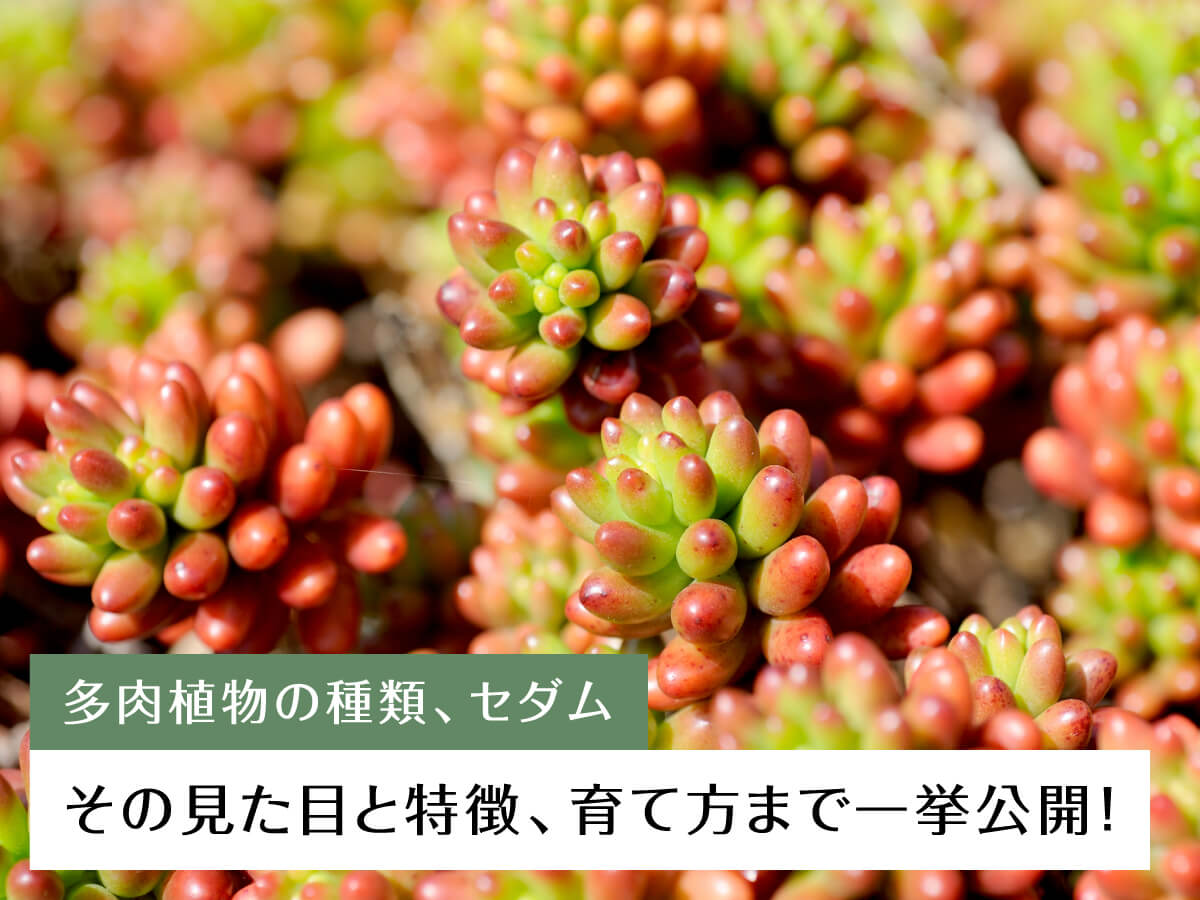
1. "Sedum rubrotinctum (Jelly Bean Plant)": Native to Central America, characterized by plump, glossy leaves. The leaves turn red from autumn to spring.
2. "Sedum Atlantis": Characterized by pale green and milky white variegated leaves. This variety won Plant of the Year at the 2019 Chelsea Flower Show.
3. "Sedum Red Berry": A Sedum whose leaves turn red when it gets cold, said to be a smaller, dwarf variety of Jelly Bean Plant.
These Sedum varieties each have different appearances and characteristics, but they all share the common trait of being hardy and easy to grow. Why not find a Sedum that suits your taste and enjoy cultivating it?
Sedum Rubrotinctum (Jelly Bean Plant)
Sedum rubrotinctum, as its name suggests, is a type of sedum with beautiful rainbow-colored leaves. In summer, it produces yellow flowers, and their contrast further enhances its beauty.
For cultivation, it generally prefers sunlight, so it is recommended to place it in a well-ventilated area. Water when the soil is dry, and especially in winter, maintaining dryness makes it more resistant to cold.
Like other sedums, Sedum rubrotinctum can also be propagated by cuttings or leaf cuttings, allowing you to easily increase your collection at home. Thus, due to its beauty and low maintenance, Sedum rubrotinctum is a recommended variety for succulent beginners.

Sedum Atlantis
Among the popular Sedum varieties, "Atlantis" is a species with a mystical beauty, as its name suggests. It features green leaves with yellow edges, and its colors evoke the lost continent of "Atlantis."
Basic data:
-
Scientific name: Sedum takesimense 'Atlantis'
-
Origin: Korea
-
Maximum height: Approximately 10-15cm
Atlantis prefers a sunny location with well-draining soil. It is also cold-hardy and can be grown outdoors without issue even in winter. However, it dislikes high temperatures and humidity, so it's important to water sparingly in the summer.
Cultivation is relatively easy, and it can be propagated by leaf cuttings or stem cuttings. To enjoy its beautiful leaf color, proper management from autumn to winter is crucial.
Thus, "Sedum Atlantis" is an easy-to-manage succulent that also offers a beautiful appearance. Even gardening beginners can fully enjoy it.

Sedum 'Red Berry'
Sedum 'Red Berry', as its name suggests, is a type of Sedum characterized by beautiful red, berry-like leaves. It is a dwarf variety compared to Sedum rubrotinctum, offering a compact yet visually appealing presence.
Furthermore, the leaves of 'Red Berry' become more vibrant in color when exposed to strong light. This clearly demonstrates the relationship between sun exposure and color change specific to succulents.
Cultivation is generally the same as for other Sedum species, preferring sunny and well-ventilated conditions, but 'Red Berry' has excellent cold hardiness. It can even survive outdoors in winter with frost protection.
Thus, Sedum 'Red Berry', combining beautiful appearance and ease of cultivation, is a variety that can be enjoyed by succulent enthusiasts from beginners to advanced growers.
Sedum 'Milk Uji'
"Sedum 'Milk Uji'" is a Japanese-bred succulent, as its Japanese name suggests. Its name comes from "milk + Uji" (a famous tea region in Japan), and its variegated small leaves boast a gentle color reminiscent of Uji milk.
Its cultivation method is basically to water thoroughly when the soil dries, and especially in summer, it's best to grow it in a place away from direct sunlight. Additionally, maintaining good air circulation by dividing the plant can promote healthier growth.
Sedum 'Aurora'
Sedum 'Aurora' is a variety characterized by beautiful aurora-like leaf colors, as its name suggests. Compared to common Sedum species, it has generally paler pigmentation, and its leaves are coral-colored and glossy. Especially during dry periods, its refreshing color stands out.
This 'Aurora' is a variation of 'Sedum rubrotinctum' (Jelly Bean Plant), differing in its overall paler leaf color and the presence of striped patterns. These patterned leaves are called "variegated." Therefore, "Aurora = variegated variety of Jelly Bean Plant."
Regarding cultivation, 'Aurora' is more susceptible to high temperatures and humidity than 'Jelly Bean Plant', so it prefers a well-ventilated, shady spot in summer. Also, strong sunlight can scorch and damage the leaves, so careful sun management is necessary.
Sedum 'Otome-Gokoro' (Girl's Heart)
"Sedum 'Otome-Gokoro'" is a succulent with delicate and beautiful pink leaves. Its flower language is "pure heart," and true to its name, it gives a fresh and lovely impression.
'Otome-Gokoro' grows to about 10cm tall, with slender leaves and a distinctive vibrant pink color. As it grows, the leaf color deepens, offering visual enjoyment.
Like other Sedum species, 'Otome-Gokoro' prefers sun and good drainage. It particularly dislikes humidity, so water only when the soil surface is dry. In winter, it is susceptible to frost, so it is recommended to manage it indoors.
Thus, "Sedum 'Otome-Gokoro'" is loved by many not only for its beautiful appearance but also for its ease of cultivation. Please experience its charm for yourself.

Sedum 'Little Missy'
Sedum 'Little Missy' is primarily a succulent plant of the "Crassulaceae family," characterized by its rich colors and unique shapes. It is popular not only in Japan but also in various parts of the world.
The average price for this species is about 570 yen, making its affordability one of its attractions. It loves sunlight, with 3-6 hours or more of daily sun being ideal. However, strong summer sun can cause leaf burn, so caution is needed. Regarding temperature, it can generally be grown outdoors in both summer and winter.
For watering, it's best to water thoroughly when the soil dries out. As for fertilizer, a liquid or slow-release fertilizer can be given in spring and autumn, but it's not strictly necessary as the plant can grow vigorously without it.
For cultivation, it's a good idea to repot into a larger pot when the current one becomes too cramped. This species can also be propagated by leaf cuttings or division.
Sedum 'Purple Haze'
Sedum 'Purple Haze' is a type of Sedum that boasts beautiful purple leaves from spring to autumn. As its name suggests, it was named for its ethereal atmosphere, reminiscent of a "purple haze."
Its appearance is characterized by thin, long leaves that grow densely to form a fluffy spherical shape. The leaves have the characteristic of shedding old leaves as new ones emerge, with each leaf growing independently.
For cultivation, it prefers sunlight, so growing it in a place with plenty of sun is recommended. Additionally, as is characteristic of Sedum in general, it prefers well-draining soil. Be particularly sparing with watering during winter.
The above describes the characteristics and cultivation methods of Sedum 'Purple Haze'. Its beautiful purple leaves will act as an accent in your garden or potted plants, creating an enjoyable gardening life.

Sedum Ourei (Kourei)
Sedum Ourei (Kourei) is so named because its leaves turn a vibrant yellow when exposed to sunlight, hence "Kourei" (yellow beauty). This beautiful coloration is a distinctive and appealing characteristic that sets it apart from other Sedum varieties.
Ourei is a large Sedum that can grow up to about 50cm in height. Its size and color allow for a wide range of uses, whether potted alone or combined with other plants to enjoy the contrast.
Key cultivation points include its drought resistance, similar to other succulents. However, proper watering and well-draining soil are essential to prevent root rot. It also prefers full sun, so cultivation in a sunny location is recommended. In winter, protect it from frost, and it's best to bring it indoors during severe cold.
4. What are succulents in the first place?
Succulents, as the name suggests (meaning "many flesh" in Japanese), refer to a general term for plants that have tissues that store a lot of water in their leaves or stems. They primarily inhabit harsh environments such as dry regions, and among them, the prominent Sedum is also a native Japanese succulent. Succulents are categorized into "summer-growing," "winter-growing," and "spring/autumn-growing" types based on their growing season, each requiring different growing conditions.
Succulents are drought-tolerant and survive dryness by storing abundant water in their leaves and stems. They can also produce beautiful flowers if the environment is suitable.
Cacti are also a type of succulent and possess water-storing tissues, but they are sometimes distinguished as "succulents and cacti" due to their diverse shapes and varieties.
Characteristics of Succulents
Succulents are plants characterized by their ability to store water in their stems, leaves, and roots, as their name suggests. These plants are tough against drought, a trait developed to survive in harsh environments like deserts and rocky areas. They are characterized by plump, water-storing parts, and their shapes vary widely depending on the species.
Furthermore, succulents are relatively easier to grow compared to ordinary plants, making them enjoyable even for beginners. Especially since they require less frequent watering, they are easy to care for even for busy individuals or those who tend to forget watering.
Due to these characteristics, succulents are widely used for indoor and garden decoration, as well as in mixed plantings. Among them, Sedum is popular for its wide variety and beauty.
Sedum's Place Among Succulents
Succulents, as their name suggests, are plants that store water in their leaves and stems to grow. They are considered beginner-friendly plants because they can survive in dry environments, making their roots less prone to rot and requiring less maintenance.
Among them, Sedum is highly regarded by succulent enthusiasts due to its immense variety of shapes, colors, and sizes. Furthermore, because it grows relatively quickly, you can enjoy a large plant in a short time. Many varieties are also cold-hardy and can be cultivated outdoors even in winter, allowing for enjoyment throughout the seasons.
Sedum is positioned as a particularly popular genre among succulents due to its rich variety and ease of cultivation.
5. How to Grow and Cultivate Sedum
Sedum prefers a sunny, well-ventilated environment. Providing plenty of sunlight helps the plant grow strong, and its leaf color and luster tend to improve. However, caution is needed as it can wither during hot, humid periods or if exposed to rain.
Specific cultivation tips include:
-
Ensure sufficient sunlight
-
Place in a well-ventilated area
-
Be cautious during hot, humid periods and rainy seasons
-
Even cold-hardy varieties should be moved indoors on sub-zero days
Given these points, Sedum is a low-maintenance and easy-to-grow succulent, making it recommended for beginners.
Basic Growing Instructions
Sedum is an easy-to-grow succulent for beginners, but there are three important care points. First, avoid high temperatures and humidity; especially in summer, reduce watering and place it in a bright, well-ventilated shaded area. Second, in spring and autumn, water when the soil dries out and grow it in a sunny spot during the day. Third, fertilizer is mostly unnecessary, but it's a good idea to mix in a slow-release fertilizer that lasts for one year when repotting.
Also, winter care is important: reduce watering frequency from autumn, and once winter arrives, reduce it to about once or twice a month until spring. While some varieties are cold-hardy, it's recommended to place them indoors or in a simple greenhouse for cold protection during winter.
Different Cultivation Methods by Type
Cultivation methods also vary by Sedum type.
For example, "Sedum rubrotinctum" (Jelly Bean Plant) requires a lot of sunlight and can tolerate direct sun. However, it is sensitive to cold in winter, so indoor management is recommended.
On the other hand, "Sedum Atlantis" prefers partial shade. It is recommended to avoid direct sunlight and grow it in a well-ventilated area.
Additionally, "Sedum Milk Uji" is sensitive to high summer temperatures, so cultivation in a cool location is suitable. It's important to choose well-draining soil and provide moderate dryness.
By understanding these differences and providing appropriate growing environments for each, you can cultivate beautiful Sedum plants.
6. Conclusion
This article explained the characteristics, types, and appearance of Sedum, a type of succulent plant. We also provided detailed cultivation methods. Sedum is popular among succulent enthusiasts because of its unique shapes and colors. You can enjoy observing its growth day by day and delight in its changes. It's important to experiment with different cultivation methods based on the type and find an environment that works best for you. Why not understand how to grow Sedum and enjoy your daily plant care? We look forward to seeing your plants grow.