We will explain in detail why succulents wither, how to care for them, and how to revive them if they do wither, in a way that even beginners can understand. We will also provide methods for proper care before they wither and tips for making succulents last longer.
1. Introduction
Succulents are popular plants, with many people growing them on their balconies or in their gardens due to their cute appearance and wide variety of colors. However, many people struggle with situations where their succulents "wither" or "turn to jelly."
There are various reasons why succulents "wither" or "turn to jelly." Inappropriate watering, lack of sunlight, and the effects of diseases or pests can all prevent succulents from growing healthily.
This article will explain in detail the main causes of succulents withering, care methods, and tips for reviving them. Whether you're a beginner who wants to start growing succulents or someone who's already growing them but is having trouble, please refer to this article.


2. Main Causes of Succulents Withering
The main causes of succulents withering can be largely divided into three categories: "inappropriate watering," "lack of sunlight," and "effects of diseases or pests."
(1) Inappropriate watering: Succulents need moisture, but if the amount or frequency is not appropriate, they cannot grow healthily. Too little watering will stop growth, and too much watering can cause root rot.
(2) Lack of sunlight: Succulents need sunlight. If the duration of sunlight is insufficient, photosynthesis may not occur properly, leading to the plant withering.
(3) Effects of diseases or pests: Succulents are also vulnerable to damage from diseases and pests, which can cause them to wither.
The above three are the main causes of succulents withering. Detailed explanations and countermeasures for each will be discussed in the next chapter.
(1) Inappropriate watering
A major reason why succulents wither is "inappropriate watering." Specifically, this refers to overwatering or under-watering.
If you overwater, succulents are highly likely to suffer from root rot, which will eventually cause them to wither. This is especially common in humid environments or during the rainy season. Conversely, if there isn't enough moisture, succulents won't have enough water for growth and will naturally wither. However, many drought-resistant succulents can survive for several months without water.
The appropriate timing and amount of watering vary depending on the succulent's growth type (spring/autumn, summer, or winter). During the growing season, water thoroughly once every 1-2 weeks if the soil is dry. During dormancy, water about once a month, adjusting based on the weather.
(2) Lack of sunlight
One reason why succulents wither is "lack of sunlight." Succulents are plants that love sunlight, and if they don't get enough sunlight, they will "etiolate" and may eventually wither. Specifically, a lack of sunlight causes the stems to stretch thinly and the leaves to spread out horizontally, weakening the plant.
To counter insufficient sunlight, it is effective to move the plant to a location where it receives ample sunlight. However, too much direct sunlight can cause sunburn, so it's necessary to provide gentle morning sun or use shade.
Furthermore, if etiolation occurs, reshaping by leaf propagation or beheading and ensuring proper water and nutrient absorption can increase the success rate of revival.
(3) Effects of diseases and pests
One cause of succulents withering is the effect of diseases and pests. Succulents are said to be particularly susceptible to "root rot" and "mealybugs."
"Root rot" is a disease caused by excessive moisture, and symptoms such as black discoloration of the leaves appear. Once root rot occurs, treatment is difficult, so prevention and early detection are important. Measures such as watering only after the soil has completely dried and ensuring excess water drains from the bottom of the pot are effective.
"Mealybugs" are small insects that appear between and on the underside of leaves and prefer dry conditions. To prevent insect infestation, it is necessary to take measures such as using a special insecticide for prevention.
By understanding the effects of these diseases and pests and taking appropriate measures, it is possible to maintain the health of succulents.
3. Explanation and Countermeasures for the "Jelly" Phenomenon in Succulents
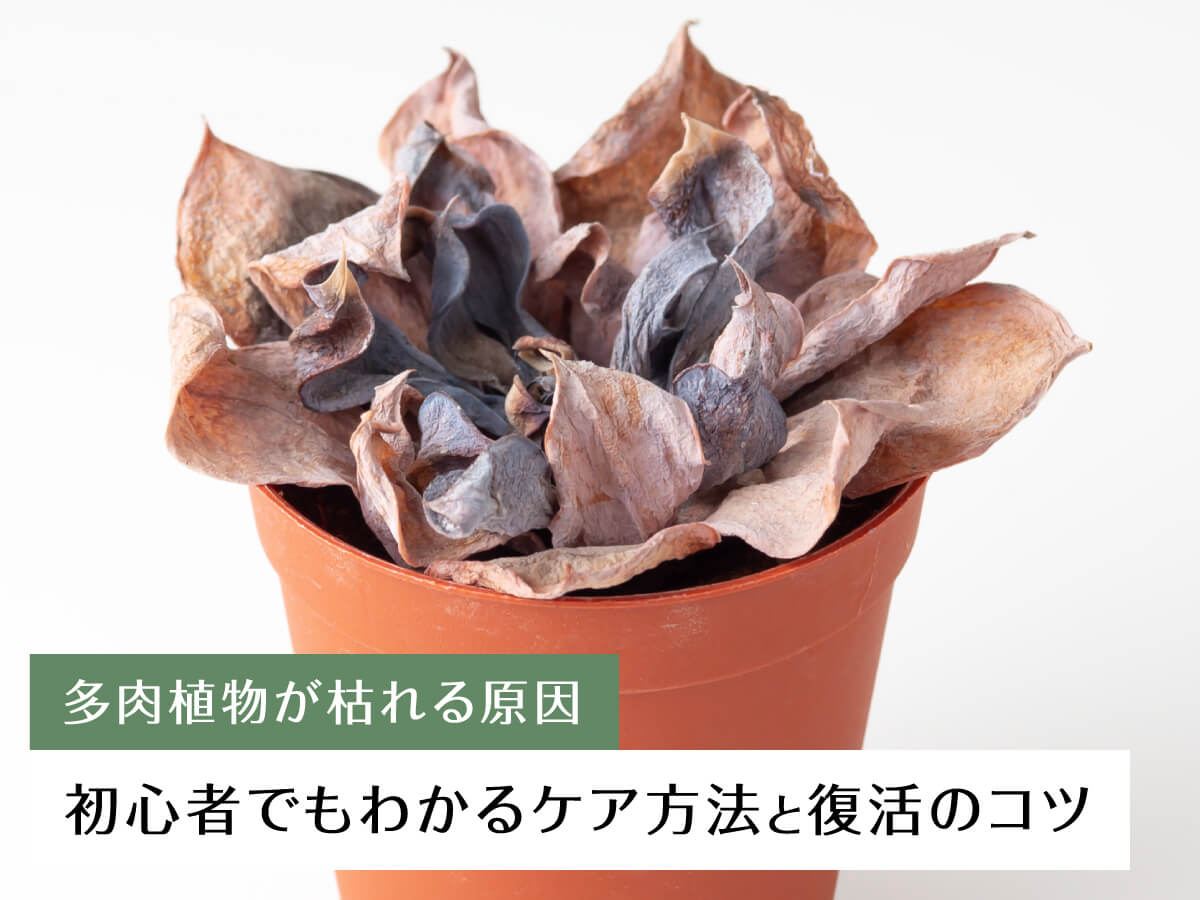
"Jellying" is a phenomenon where the fleshy parts of succulents swell due to excessive moisture and become transparent and jelly-like. This is a type of root rot caused by overwatering or poorly aerated soil.
To identify "jellying," check if the leaves are transparent and jelly-like, or if the veins are turning white from the leaf tips. If "jellying" progresses, the entire leaf will become transparent, and eventually the entire plant will rot.
To prevent this phenomenon, it is important to water moderately and use well-draining soil. Alternatively, if discovered, you can remove the rotten parts and propagate the healthy parts by cutting them.


(1) What is "jellying"?
"Jellying" is a specific phenomenon in succulents, mainly referring to a state where the plant shows a protective reaction to stress from cold or dryness. Specifically, the leaves become translucent and soft to the touch, hence the name. Furthermore, the entire plant may wilt. This phenomenon is part of the succulent's survival strategy to retain moisture internally. To address this, it is necessary to adjust the environment and ensure appropriate watering and sunlight.
(2) Why do succulents "jelly"?
Succulents "jelly" when exposed to extreme heat in summer or freezing temperatures. This phenomenon occurs when plant cells swell due to excessive moisture, causing cell walls to break and liquid to ooze out, resulting in "jellying."
Thus, the "jellying" phenomenon can be said to be mainly caused by excessive watering or insufficient measures against heat and cold. It is important to remember that proper watering and measures against temperature and humidity, as well as seasonal care, are crucial.

(3) How to identify and treat "jellying"
"Jellying" is one phenomenon observed when succulents wither. This condition is characterized by the leaves becoming translucent and soft from the base to the tip, and moisture oozing out when touched.
The cause of "jellying" is primarily excessive moisture due to overwatering. Succulents are drought-resistant plants, and providing too much water destroys their cells, ultimately leading to the "jellying" phenomenon.
To identify this condition, it is important to observe the color, shape, and feel of the leaves. Jellied leaves become translucent and soft, with an insulator-like texture.
As a countermeasure, it is crucial to first reduce watering and wait for the soil at the base to dry out. Afterwards, propagating healthy parts by cutting is an effective way to revive the plant.
Additionally, jellying can occur on humid days during the rainy season or when there are prolonged hot days in summer. On humid days, place the plant in a well-ventilated area or use a fan to promote faster drying of the soil. On hot summer days, provide shade to block direct sunlight and prevent the succulent from getting too hot. As a countermeasure, it's best to reduce watering as much as possible, and when watering, choose cooler or windy days while checking the weather forecast.
4. Possibility and Methods of Reviving Withered Succulents
Even if a succulent has withered, it may be possible to revive it depending on the situation. The key is to correctly identify the cause and provide appropriate care. The following outlines examples of revivable cases and their methods:
-
Revivable causes and methods
・Root rot due to overwatering: Immediately stop watering and remove any rotted parts. After drying thoroughly for about a week, repot in new soil.
・Weakened condition due to lack of sunlight: Gradually acclimate the plant to sunlight and ensure appropriate sun exposure.
2. Irreversible causes and recognition
・Overall advanced rot: Propagating healthy parts by cutting or leaf propagation is effective.
It's sad when our beloved plants wither, but by not giving up and providing appropriate treatment, succulents can display surprising resilience. Therefore, if you think your succulent has withered, first try to find the cause and aim for appropriate care.
(1) Revivable causes and methods
The main reason why succulents appear to have withered is "root rot." This is a phenomenon where the roots rot due to excessive moisture from overwatering, which hinders the absorption of water and nutrients, weakening the entire plant.
However, if root rot has just begun, revival is still possible. First, remove the rotted parts. Cut off any rotted leaves or stems with scissors, and remove all rotted parts of the roots. Then, if available, apply a cutting agent to the cut surface, dry it thoroughly, and then repot it in new soil to restore it to a healthy state.
By following the methods above, early detection and prompt action can revive wilting succulents.
(2) Irreversible causes and their recognition
Among the reasons why succulents wither, some are difficult to revive. The main causes are "diseases" and "pests." Succulents infected with diseases are difficult to revive unless the disease is completely cured, and infected new shoots may also emerge. Additionally, if the seedling is weak, it often withers. Regarding pests, many insects feed on succulents' sap, and if insects occur in the roots, the absorption of water and nutrients from the roots is hindered, which can cause the plant to wither. Early removal of pests is important.

5. Care Methods for Long-Lasting Succulents
To ensure succulents last longer, attention to the following three points is necessary:
(1) Choosing the ideal location: Succulents are organisms that love sunlight, so a sunny location is ideal. Good ventilation is also important, and using a fan in summer is recommended to prevent humidity.
(2) Watering frequency and amount: Succulents prefer dry conditions, so it's important to water only after the soil has completely dried out. However, when watering, give plenty until water drains from the bottom of the pot to ensure roots receive ample moisture, fresh oxygen, and nutrients.
(3) How to use fungicides and insecticides when necessary: Use fungicides and insecticides as needed to prevent damage from diseases and pests. It is important to follow the product's instructions when using them.
By following these care methods, succulents will grow healthily and last longer.
(1) Choosing the ideal location
The ideal environment for succulent growth is "outdoors." This is because outdoors, succulents can receive plenty of natural light, making it easier to secure the necessary hours of sunlight. In particular, an east-facing location that receives morning sun or a west-facing location where the afternoon direct sunlight is not too strong is ideal.
However, too much sunlight can cause sunburn, so it's important to provide moderate shade during summer. Also, care must be taken with wind and rain; while good ventilation is important, measures to protect from strong winds and winter frost are also crucial.
Succulents are adaptable to their environment, but choosing the right location as described above is essential to maximize their growth.
(2) Watering frequency and amount
Succulents are drought-resistant plants, but proper watering is necessary. Incorrect frequency and amount can lead to wilting.
During the growing season, water thoroughly when the leaves become wrinkled. The guideline is to water until it drains from the bottom of the pot, allowing the roots to absorb enough water.
During dormancy, watering is reduced to about once a month, or even withheld entirely. This is because succulents have evolved in dry environments and become more tolerant to cold by cutting off water.
The amount of water, on the other hand, varies depending on the size of the pot and the plant. It is important to determine the appropriate amount through observation.
Managing the watering frequency and amount as described above is fundamental to keeping succulents healthy.
(3) How to use fungicides and insecticides when necessary
Disease and pest control are essential for succulent health. The use of fungicides and insecticides is one part of this, and when used appropriately, it can protect plants.
Fungicides are mainly used for disease prevention. They help remove pathogens that damage plants and maintain their healthy condition. Since the method of use varies by product, always read the product instructions before use.
Insecticides, on the other hand, are effective for pest control. Regular use is recommended, especially for succulents with low resistance to pests. However, excessive use can also affect the plant, so use moderately.
Both can be purchased at garden stores, home centers, or online. However, it is crucial to always read the product description carefully and use it appropriately before use.
6. Summary
We have reviewed the causes of succulent withering and their respective countermeasures. The main reasons for wilting are inappropriate watering, insufficient sunlight, and the effects of diseases and pests. It is important to adjust the frequency and amount of watering appropriately, and also to adjust for ideal sun exposure. Furthermore, prevention and countermeasures against diseases and pests are indispensable. It is also necessary to understand and properly address the "jellying" phenomenon. "Jellying" is a unique phenomenon in succulents, and knowing how to identify and treat it allows for action before wilting. There are also methods to revive withered succulents, so it is important not to give up and try these countermeasures. Finally, continued care is essential for them to last a long time.