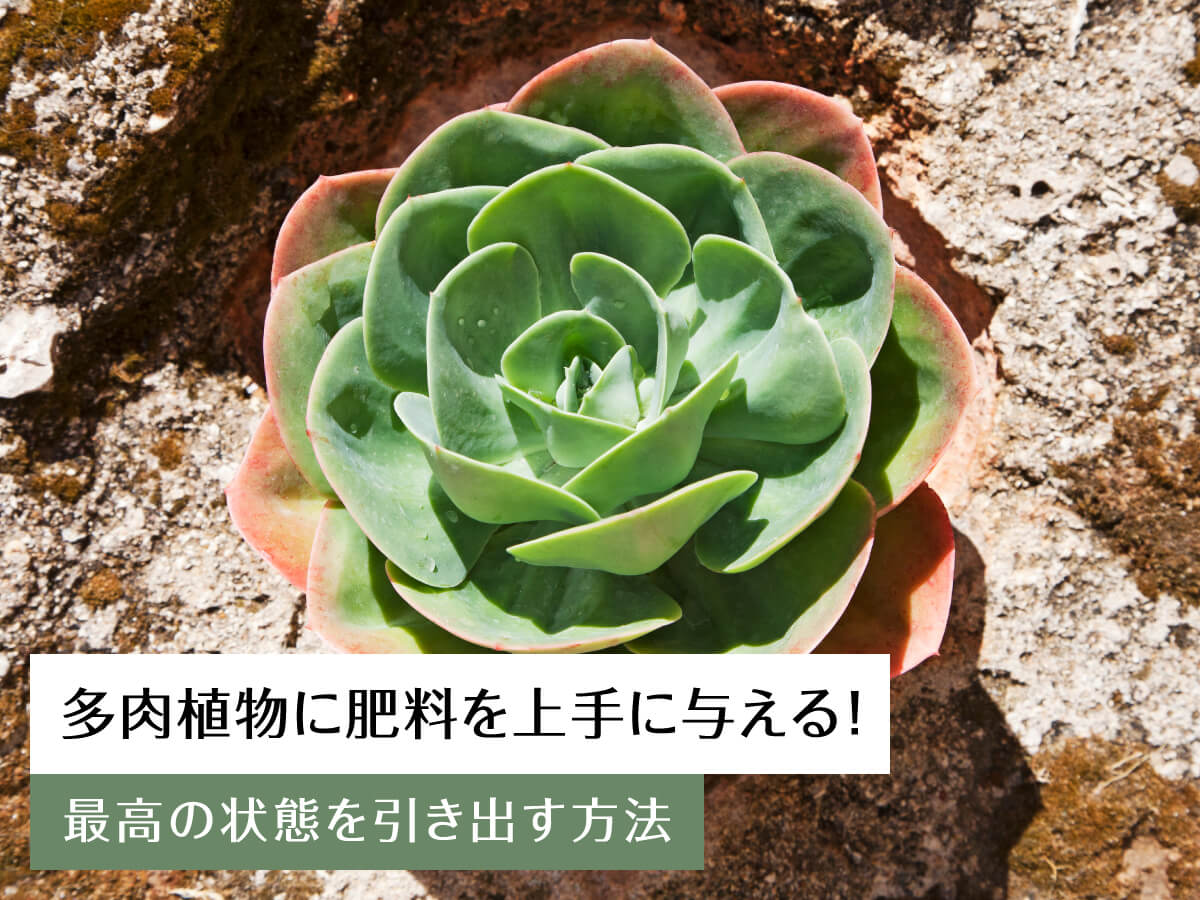
This article explains in detail how to properly fertilize succulents and why it's important. By understanding the right way and time to fertilize, you can keep your succulents in top condition.
1. The Relationship Between Succulents and Fertilizer
Succulents are popular for their unique shapes and easy care. However, to maximize their growth and color, proper fertilizer management is essential. Succulents, in particular, are highly susceptible to the effects of fertilizer because their leaves, stems, and roots are thick and store a large amount of water. By effectively utilizing fertilizer, you can promote the growth of succulents and bring out beautiful fall colors. This article will explain in detail the best types of fertilizers for succulents, how to apply them, and how fertilizer management affects the health and autumn coloration of plants.
2. About Fertilizing Succulents
Succulents also need fertilizer. Fertilizer is a substance that supplies the nutrients necessary for plant growth. In nature, fallen leaves, dead insects, and animal droppings are broken down by microorganisms and converted into organic nutrients. However, succulents grown indoors or on balconies rarely receive such natural blessings.
Fertilizer suitable for succulents contains a balanced mix of nutrients such as nitrogen, phosphorus, and potassium. These nutrients promote the growth of plant leaves and stems and make petals vibrant.
Fertilizing promotes the growth of succulents. By using fertilizer, you can supplement the nutrients provided by nature, encourage better flowering, and support healthy growth. Proper fertilizer management is an important factor for succulents to lead a fulfilling life.
(1) What is fertilizer and why is it necessary?
Fertilizer is a substance that replenishes the nutritional components that support plant growth and life activities. Specifically, nitrogen, phosphorus, and potassium are the main components. By applying fertilizer appropriately, plants can perform photosynthesis and grow healthily.
While succulents can grow without fertilizer because their natural habitat is barren and poor in nutrients, when cultivated indoors, on balconies, or in gardens, fertilizing provides sufficient nutrition and promotes growth. Without fertilizer, growth may be slow or flowering may be poor. Therefore, the necessity of fertilizer is high.
(2) Types and characteristics of fertilizers suitable for succulents
There are mainly two types of fertilizers suitable for succulents. One is "solid fertilizer," which is mixed into the soil and slowly releases nutrients. The other is "liquid fertilizer," which is mixed with water when watering and has a fast-acting effect.
Each type of fertilizer has the following characteristics:
【Solid fertilizer】 ・Slowly releases nutrients ・Long-lasting effect
【Liquid fertilizer】 ・Fast-acting ・Requires regular application
The management method for succulents varies depending on the type of fertilizer, so choose a fertilizer that suits your plant's condition and management style.
(3) Why fertilizer promotes growth
For succulents to grow healthily, a proper supply of nutrients is essential. Fertilizer acts as this source, providing elements such as nitrogen, phosphorus, and potassium that plants need. These nutrients are necessary for forming new leaves and stems and strengthening roots. In particular, since the environment in which succulents grow is often poor in water and nutrients, applying fertilizer supplements the lack of nutrients and promotes healthy growth.
Fertilizer also activates photosynthesis, leading to better autumn coloration and flowering. However, the right amount of fertilizer is crucial, as over-fertilization can cause etiolation and should be avoided.
3. Effect of Fertilizer: Relationship Between Autumn Coloration and Fertilizer
The autumn coloration of succulents is greatly influenced by the presence or absence of fertilizer. When fertilizer is abundant, succulents absorb its nutrients and continue to grow steadily. As a result, the plant maintains its green color, and autumn coloration is suppressed.
On the other hand, when fertilizer runs out, the plant experiences stress and begins to display autumn coloration. This is part of its survival strategy to increase photosynthetic efficiency. By appropriately managing fertilizer, it is possible to control the degree of autumn coloration.
However, inducing autumn coloration is not always beneficial. While moderate coloration is beautiful, excessive coloration is a sign of plant stress, and careful management is required.
Related articles here↓
Enjoying Pink Autumn Coloration in Succulents! Recommended Varieties and How to Grow Them
(1) Why autumn coloration does not occur while fertilizer remains
Succulents generally promote growth by absorbing fertilizer, but the presence of fertilizer affects autumn coloration. Even if fertilizer remains in the soil, if water is not supplied, the roots will not absorb nutrients, thus autumn coloration will not be promoted. This is because succulents have the characteristic of maintaining green leaves and suppressing autumn coloration when they are in a nutrient-rich state. On the other hand, when fertilizer runs out, the nutritional state declines, and the transition to autumn coloration progresses. In other words, during the period when fertilizer remains, the growth of succulents is prioritized, and autumn coloration is suppressed.
(2) The process of autumn coloration when fertilizer runs out
The autumn coloration of succulents is strongly influenced by fertilizer. Specifically, the process of autumn coloration when fertilizer runs out is as follows:
When succulents are fertilized, the components are absorbed and used for growth. However, when the fertilizer components are depleted, the plant begins to color in autumn as a self-protective measure. It is crucial to adjust the timing of fertilization to account for this period.
Specifically, after fertilizing succulents, the nutrients in the fertilizer are depleted after approximately one month. This triggers the plant to start changing the color of its leaves, leading to autumn coloration, as a form of self-defense.
The degree of autumn coloration varies depending on various conditions such as the type and amount of fertilizer, temperature, and hours of daylight. By understanding these factors and managing fertilizer appropriately, it is possible to bring out beautiful autumn coloration.
4. Differences between fertilizer and plant booster
In growing succulents, the proper use of "fertilizer" and "plant booster" is important. While these two are similar, their roles are very different.
First, fertilizer supplies the necessary nutrients to assist the plant's normal growth. It mainly contains components such as nitrogen, phosphorus, and potassium, which promote flowering and support growth.
On the other hand, plant booster promotes plant growth and contains minerals, vitamins, amino acids, and other elements. Unlike fertilizer, these do not directly affect plant growth but help activate the plant's internal functions.
In other words, fertilizer "provides nutrients," while plant booster "promotes growth." For the healthy growth of succulents, it is recommended to use both in a balanced way.

(1) Fundamental differences between fertilizer and plant booster
Fertilizer and plant booster are both essential for growing succulents and play important roles in supporting plant growth, but their functions are fundamentally different. Fertilizer replenishes the primary nutrients (nitrogen, phosphorus, potassium) that plants need for growth. On the other hand, plant booster plays a supplementary role in promoting plant growth. It contains trace elements, amino acids, and vitamins, and helps plants with photosynthesis and nutrient absorption.
|
|
Fertilizer |
Plant Booster |
|---|---|---|
|
Main Components |
Major Nutrients (Nitrogen, Phosphorus, Potassium) |
Trace elements, amino acids, vitamins, etc. |
|
Role |
Nutrient supply |
Growth promotion |
|
Purpose of Use |
Promote growth / Improve flowering |
Aid photosynthesis / Improve nutrient absorption |
By properly using both, you can grow healthier succulents.
(2) Differentiating the use of fertilizer and plant booster for succulents
While both fertilizer and plant booster support the growth of succulents, their roles differ. Fertilizer replenishes nutrients that aid in the growth of succulents. On the other hand, plant booster creates a suitable growing environment for plants and helps maintain their healthy condition.
Specifically, fertilizer is mainly applied during the growing season, while plant booster is used between fertilizer applications to maintain overall nutritional balance. Fertilizer has the effect of promoting flowering and growth, but excessive application can damage the roots, so caution is advised.
On the other hand, plant boosters strengthen the plant's own immune system and protect it from diseases and pests. Also, by properly using fertilizer and plant booster, you can promote the healthy growth of succulents.
5. Optimal Timing for Fertilizing
How you fertilize succulents varies depending on their growth stage. Understand these growth and non-growth periods and make sure to fertilize appropriately for each.
Succulents have a "growing season" when growth is active and a "dormant season" when growth slows down. During the growing season, frequent fertilization promotes healthy growth. On the other hand, during dormancy, it is necessary to reduce fertilizer supply. This is because excessive fertilization during dormancy can damage or rot the roots.
Also, for succulents to display beautiful autumn coloration, "fertilizer depletion" is important. During this period, avoid fertilizing and increase sun exposure to bring out their unique coloring.
(1) Characteristics of Growing and Non-Growing Seasons
Succulents have "growing seasons" and "dormant seasons (non-growing seasons)." These two periods greatly influence the growth and health of succulents.
【Table 1】
|
|
Growing Season |
Dormant Season |
|---|---|---|
|
Characteristics |
Actively growing, with visible activities such as sprouting new leaves |
Slowed growth |
During the growing season, succulents actively grow, and activities such as sprouting new leaves can be observed. During this period, proper fertilization can support healthy growth.
Conversely, during the non-growing season (dormant season), little to no growth activity is observed, or it slows down. During this period, plants need rest, and it is recommended to fertilize sparingly or not at all.
By providing appropriate care for each season, it is possible to maintain the long-term health of succulents and promote beautiful autumn coloration.
(2) How to fertilize during each period
The method of fertilizing succulents differs between the growing and non-growing seasons. During the growing season (spring to autumn), nutrients are needed for new shoots to emerge and continue growing. Therefore, it is recommended to apply slow-release fertilizer approximately once every two months, or fast-acting fertilizer approximately once every two weeks. On the other hand, during the non-growing season (winter), plant growth temporarily stops, so the required amount of fertilizer also decreases. During this period, apply fast-acting fertilizer approximately once a month, or it may not be necessary to fertilize at all. However, these are guidelines. Always follow the prescribed amount indicated on the fertilizer packaging.

(3) Fertilizer management to promote autumn coloration
Fertilizer management is crucial for achieving autumn coloration. One reason succulents don't change color is that autumn coloration doesn't progress when there's still enough fertilizer. To promote autumn coloration, the key is to time it when the fertilizer's effect is wearing off.
The specific management methods are as follows:
-
Provide a period without any fertilizer: The consumption of fertilizer components progresses, and autumn coloration begins.
-
Apply a small amount of fertilizer: This supports plant growth while maintaining autumn coloration.
By following these steps, you can bring out the beautiful autumn coloration of succulents. However, fertilizer management is a critical task directly related to plant health. It requires proper knowledge and experience, so please proceed carefully.
6. Recommended Fertilizers and How to Use Them
Recommended fertilizers for succulents include liquid and solid types.
(1) For solid fertilizers: Solid fertilizers are simply placed on the surface of the growing medium, and the fertilizer components slowly dissolve and are supplied during watering. While convenient, be careful not to over-apply.
(2) For liquid fertilizers: Liquid fertilizers are used by mixing a fixed amount with water during watering. In contrast, they are easier to adjust and have a relatively lower risk of overdose.
For both types, choose a fertilizer that suits the condition of your succulents, paying attention to the ratio of fertilizer components.
Regarding usage, it varies depending on the season and the growth status of the succulents, so it is important to follow the instructions for each fertilizer.
(1) Recommended solid fertilizers and how to use them
For succulents, we recommend organic fertilizers or slow-release chemical fertilizers. Specifically, "MagAmp K" from Hyponex, which is rich in essential trace elements and effective for plant growth and coloring, and "IB no Chikara Green Sodachi EX" from Hana Gokoro are recommended. Usage is simple: mix it into the soil when repotting or place it directly on the soil. Be careful to use an appropriate amount, as excessive application can damage the roots. After fertilizing, water thoroughly to allow the fertilizer to penetrate the soil.

(2) Recommended liquid fertilizers and how to use them
For succulents, "liquid fertilizer specifically for succulents" is particularly recommended. This is because its nutrients are water-soluble and can be directly absorbed by the roots, making it efficient. Also, unlike solid fertilizers, liquid fertilizers dissolve quickly, so their effects appear in a short period.
The basic method of use is to follow the instructions on the fertilizer and apply it to the plant regularly. Specifically, dilute the fertilizer with water and apply it directly to the soil. However, the frequency and concentration of application need to be adjusted depending on the type of fertilizer and the condition of the plant.
The use of liquid fertilizer is especially important during the growing season. If you find it difficult to judge on your own, it is recommended to follow the instructions of the fertilizer manufacturer.

7. How to Apply Fertilizer and Points to Note
"To effectively fertilize succulents, it's important to first know the appropriate amount. The frequency of application is also a key factor.
(1) Basics of fertilizer application: Too much nutrition can cause leaves to grow excessively large. Always follow the usage amount indicated on the fertilizer container.
(2) Precautions and tips for applying fertilizer: It's best to apply fertilizer mixed with water during watering, rather than directly mixing it into the soil. However, always water thoroughly after applying fertilizer. This prevents fertilizer from accumulating at the base of the plant.
(3) Fertilizer management for autumn coloration: To bring out autumn coloration, you need to control how you fertilize. It's best to reduce fertilizer from early autumn to winter and apply an appropriate amount from spring to summer.
Related articles here↓
[Etiolation in Succulents] Causes and Effective Pruning Methods Explained
(1) Basics of fertilizer application
To understand how to apply fertilizer to succulents, it is important to first keep in mind that "fertilizer is a source of nutrition for plants." The basic method of fertilizing succulents is generally to apply it during the "growing season" when the plant is actively growing. The growing season is from spring to autumn, and during this period, an appropriate amount of fertilizer is mixed into the soil. Depending on the type of fertilizer and plant, it is generally appropriate to apply it every 2-4 weeks. However, too much fertilizer can lead to nutrient excess and cause the plant to die, so the amount of fertilizer needs to be adjusted.
(2) Precautions and tips for applying fertilizer
When fertilizing succulents, keep the following precautions and tips in mind:
1. Type of fertilizer: Water-soluble liquid fertilizers and solid fertilizers are suitable for succulents. Also, it is good to choose a balanced fertilizer that contains the three major elements: nitrogen, phosphorus, and potassium.
2. Timing of application: Apply fertilizer according to the growing season. Especially from spring to early summer, fertilizer absorption is active.
3. Amount of application: The amount of fertilizer varies depending on the size and type of plant, but it is generally essential to follow the product's instructions. Too much fertilizer can damage the roots.
4. To promote autumn coloration: To promote autumn coloration, it is important not to over-fertilize. Moderate stress brings out beautiful colors.
By keeping these points in mind, you can effectively use fertilizer to grow healthy and beautiful succulents.
(3) Fertilizer management for achieving autumn coloration
Fertilizer management is crucial for autumn coloration. One reason succulents don't change color is that autumn coloration doesn't progress when there's still enough fertilizer. To promote autumn coloration, the key is to time it when the fertilizer's effect is wearing off.
For example, the amount of "My Garden All-Purpose Plant Fertilizer" that dissolves decreases as the temperature drops and the leaves begin to change color. This naturally stops the fertilizer's effect, promoting the autumn colors. Also, "Magamp K Small Pellets" have a short effective period, making it easy to adjust the fertilizer to stop at the timing of the autumn colors.
The shorter the duration of the fertilizer's effect, the easier it is to adjust it to the timing of the autumn colors, so short-term fertilizers are recommended to enjoy the autumn colors.
8. Succulent Health Management Using Fertilizer
Fertilizer is essential for maintaining the health of succulents. Providing appropriate fertilizer supports plant growth and vitality.
First, let's talk about "the importance of care using fertilizer." Fertilizer plays the role of supplying the nutrients plants need. In particular, the three major elements required by succulents, such as nitrogen, phosphorus, and potassium, are generally obtained from fertilizer.
Next, we will explain "changes in succulent health due to fertilizer use." By providing appropriate fertilizer, succulent growth is promoted, and it becomes possible for them to develop vibrant leaf colors and beautiful flowers.
And then, "the relationship between autumn colors and fertilizer management." The autumn coloration of succulents is not only related to sunlight but also to fertilizer management. Reducing the amount of fertilizer can promote autumn coloration in winter.
Fertilizer management is an important factor in maintaining the health and beauty of succulents. Grow your succulents healthier with proper knowledge and techniques.
(1) Importance of Care Using Fertilizer
Succulents captivate the hearts of many plant enthusiasts with their sharp leaves and plump, adorable appearance. The supply of nutrients is indispensable for their growth and health maintenance. Fertilizer plays this role. Fertilizer plays an important role in supplying the nutrients necessary for plant growth and maintaining a healthy state.
In particular, by providing succulents with appropriate fertilizer, their distinctive shapes are maintained and their vibrant colors are enhanced. Fertilizer is also a means for succulents, which are resistant to dryness, to obtain nutrients that cannot be compensated for by water alone. Therefore, care using fertilizer can be said to be essential for promoting the beautiful autumn colors and healthy growth of succulents.
(2) Changes in Succulent Health Due to Fertilizer Use
The use of fertilizer significantly impacts the health of succulents. The nutrients in fertilizer activate plant growth and coloration, and also contribute to protecting against diseases. However, depending on the amount and timing of fertilizer application, it can lead to nutrient excess.
For example, if too much fertilizer is given, succulent cells rapidly swell, and even if they appear healthy, they are actually weakened. This is because the cell walls become weak, and resistance to diseases and pests decreases.
The timing of fertilizer application is also important, and it is ideal to apply an appropriate amount during the growing season. By refraining from fertilizing during the non-growing season, the plant's own vitality can be nurtured.
Thus, proper management of fertilizer use is closely related to the health of succulents.

(3) Relationship between Autumn Colors and Fertilizer Management
The autumn coloration that enhances the beauty of succulents is closely related to fertilizer management. Fertilizer is basically "food" for plants, and when there is enough of it, plants maintain their green color. However, when fertilizer becomes scarce, plants try to increase their photosynthetic efficiency by changing the pigments in their leaves to secure energy. This is when autumn colors are observed. Succulent autumn colors are often seen in winter or during periods of fertilizer depletion. Therefore, by managing the amount and type of fertilizer, and the timing of application, it is possible to bring out autumn colors with high ornamental value.

9. Optimal Fertilizer Management for Succulents
Fertilizer management for succulents is essential for their growth and health maintenance. From choosing the right fertilizer to applying it, it is crucial to understand the characteristics of succulents and implement methods tailored to them. Fertilizer is an important factor that supports the growth of succulents, including their autumn coloration. Fertilizer management adapted to both the growing and non-growing seasons is required. It is also necessary to understand the distinction between fertilizers and vitalizers. Vitalizers primarily aim to promote growth, while fertilizers aim to supply nutrients and maintain health. We also introduced recommended fertilizers and their usage. Ultimately, by effectively using fertilizer, it is possible to keep succulents in their best condition.
Click here for tawawa's online shop with many cute succulents ↓

Please take a look!