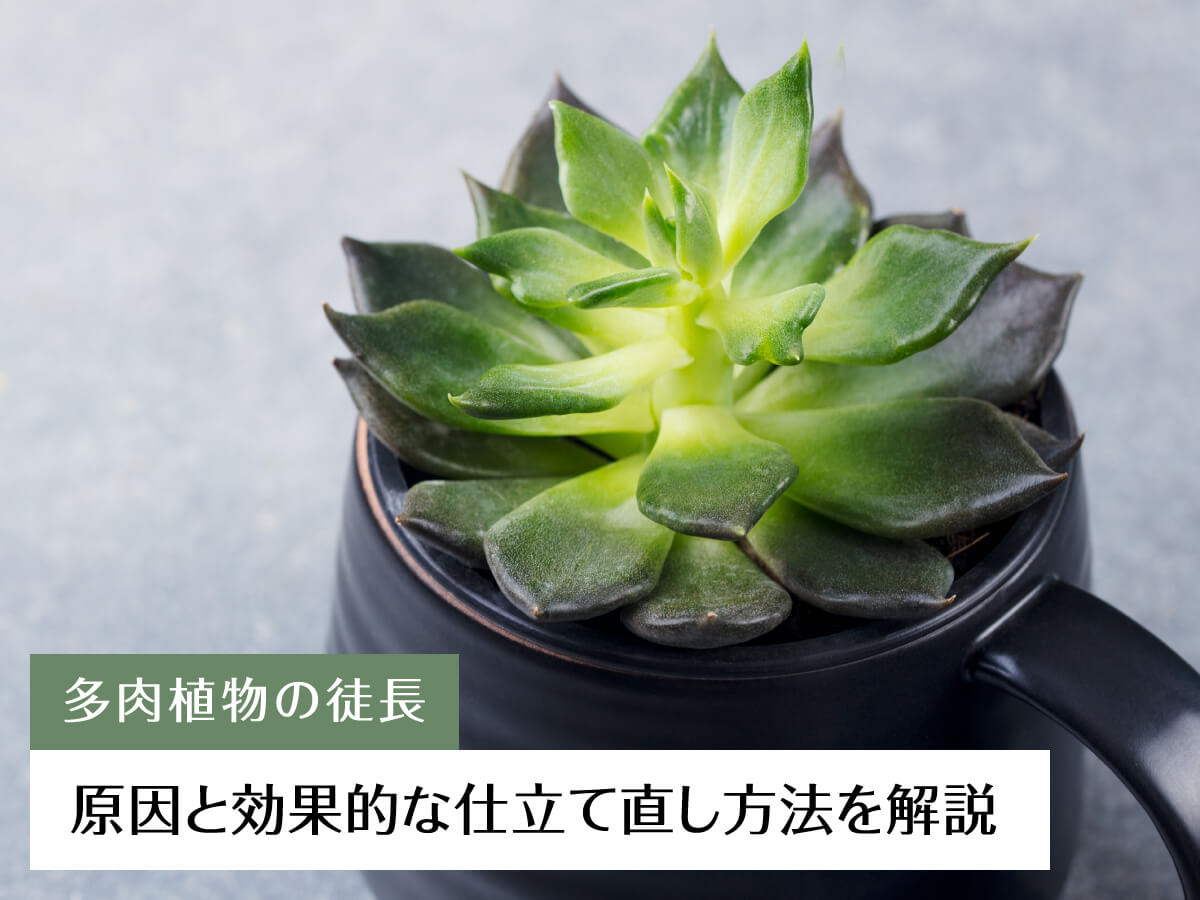
Even etiolated succulents can make a magnificent comeback with proper care. This article will clearly explain the causes of etiolation and how to reshape them.
1. What is Succulent Etiolation: Basic Knowledge and Causes
The phenomenon where succulents grow abnormally long and spindly is called "etiolation." Specifically, etiolation refers to the abnormal elongation of stems and leaves, causing the plant to lose its original shape. This condition is undesirable for the growth of succulents.
The main causes of etiolation include insufficient sunlight, overwatering, over-fertilization, and lack of air circulation. These all stem from a mismatch between the environment and care methods necessary for healthy succulent growth. For example, succulents prefer bright sunlight. However, if they don't get enough sunlight, their stems will stretch in search of light, leading to etiolation.
Having this knowledge can help maintain the health of your succulents and prevent etiolation.
(1) Definition and Characteristics of Etiolation
Succulent etiolation refers to a state where the plant's stem grows thin and elongated, with increased spacing between leaves, resulting in a leggy and stretched appearance, rather than maintaining its natural healthy form. Etiolation significantly alters the plant's appearance, deviating from its original compact shape. This condition occurs when there isn't enough sunlight for sufficient photosynthesis or when water supply is inadequate. If not managed properly, etiolation can weaken the plant's vitality.

Seedlings etiolated due to insufficient sunlight
(2) Main Causes of Etiolation: Insufficient Sunlight, Overwatering, Over-fertilization, and Lack of Air Circulation
The main causes of succulent etiolation are insufficient sunlight, overwatering, over-fertilization, and lack of air circulation. Let's look at how each of these impacts the plant in detail.
Insufficient sunlight causes etiolation, where succulents grow long and thin because they don't get enough light for photosynthesis. Overwatering is also a cause of etiolation, and proper water management is essential. Watering only after the soil has thoroughly dried prevents root rot and suppresses etiolation.
While a moderate amount of fertilizer helps succulents grow, too much can lead to etiolation. It is important to follow proper application amounts. Poor air circulation is also a factor in etiolation, as succulents need moderate airflow to breathe, so it's best to grow them in a well-ventilated location.
Implement these measures to prevent etiolation.
2. Disadvantages of Etiolated Succulents
Etiolated succulents affect not only their appearance but also their health.
(1) Changes in appearance: Etiolation causes stems to stretch excessively and increases the spacing between leaves. As a result, it becomes difficult to maintain a beautiful shape, and the plant's form becomes distorted. Since the aesthetic appeal of succulents is a major factor, etiolation is a significant disadvantage.
(2) Impact on growth: Etiolation weakens the plant's immune system, making it more susceptible to pests and diseases. Furthermore, it negatively affects the overall growth of the plant, including making it difficult for new stems to grow healthily.
As described above, etiolation in succulents not only diminishes their beauty but also negatively impacts the plant's health itself. Therefore, it is important to implement proper management to prevent etiolation.
(1) Changes in Appearance: Distortion of Form
Etiolated succulents undergo significant changes in appearance. Their distinctive shape compromises the beauty of their naturally plump leaves. Specifically, the stems become thin and leggy, and the spacing between leaves increases. This disrupts the overall balance, making the plant look stretched out. Additionally, for stemless varieties like Echeveria, the leaves spread horizontally from the central growth point, causing the rosette to lose its shape.
While this condition might seem like a "sign of growth" at first glance, it is not healthy growth. To enjoy the inherent beauty of succulents, caution is advised. If left unaddressed, this condition can lead to uneven growth and an imbalance in nutrients.

Seedling etiolated and leaning due to insufficient sunlight
(2) Impact on Growth: Nutrient Imbalance
When succulents become etiolated, it affects not only their appearance but also their growth. Specifically, an imbalance of nutrients often occurs. Succulents have numerous leaves on short stems, with each leaf uniformly receiving sunlight and absorbing water and nutrients. However, when the stem stretches due to etiolation, nutrients are not distributed properly, leading to a situation where the lower leaves do not receive sufficient nutrients. As a result, the lower leaves may turn yellow or wither. If etiolation occurs, taking appropriate measures early can help maintain the plant's healthy state.
3. Reshaping Etiolated Succulents
To reshape etiolated succulents, proper cutting and subsequent care are crucial.
(1) Reshaping succulents with long stems: If the stem has grown long, cut the stem midway and plant that section in soil to create a new plant.
(2) Reshaping succulents with thick stems: Even if the stem has become thick, cut the stem and reuse that section. At this time, pay attention to the cutting position and angle.
(3) Utilizing cut sections (stem cuttings and leaf cuttings): Cut sections or fallen leaves can be reused as stem cuttings or leaf cuttings. This is an excellent opportunity to grow new plants or create multiple plants.
(4) Dealing with new sprouts from the mother plant: If new sprouts emerge from the mother plant, separate them from the mother plant and grow them independently once they have grown.
By performing such reshaping, etiolated succulents can regain their beautiful form.
(1) Reshaping Succulents with Long Stems
Reshaping succulents with elongated stems begins by cutting at the appropriate position. Cut the part of the stem with leaves at the tip, either 3-5 cm from the stem or leaving a few lower leaves on the stem.
If there are leaves on the part of the stem to be planted in soil, remove them. These leaves can also be used for leaf propagation. The traditional method for cut sections was to air-dry them before planting, but nowadays, many people insert them directly into fresh soil. While air-drying was thought to dry the cut surface and prevent mold or rot, recent thinking suggests that immediate planting promotes root development. Please choose the method that suits your succulent variety and your preferred growing style. When repotting, select well-draining soil to prevent root rot.
By following these steps, even etiolated succulents can be grown healthily. The key is to care for them with love and attention.

Cut between the stretched leaves with scissors.
(2) Reshaping Succulents with Thick Stems
For succulents with thick stems, such as Echeveria, which have almost no visible stem, the main methods for reshaping etiolation are pruning and division.
First, let's look at the pruning method. Pruning involves cutting the stem midway to encourage new shoots to emerge from that section. First, identify a healthy section and cut a few millimeters to a few centimeters above it with clean scissors. If there isn't enough space for scissors, use fishing line or a utility knife. Remove the lower leaves from the cut section and plant it in new soil to complete the process.
Next is the division method. Succulents like Echeveria can develop offsets or be multi-headed plants, and if they grow too densely, some parts may become etiolated due to lack of sunlight. In such cases, dividing and repotting each stem can help restore the shape of each plant and even propagate new succulents.
Using these methods, etiolation in thick-stemmed succulents can be effectively addressed.

Cut using fishing line.

Cleanly cut seedling after trimming.
(3) Utilizing Cut Sections: Stem Cuttings and Leaf Cuttings
When cutting the stem of an etiolated succulent, methods like stem cuttings and leaf cuttings can be used instead of discarding the pieces.
Stem cuttings involve planting a cut stem in soil to create a new plant. Leaf cuttings, on the other hand, involve taking a leaf and placing it on soil to grow a new plant.
1. Stem Cuttings: Remove the leaves from the part of the cut stem that will be inserted into the soil, then plant it. Afterward, perform regular care.
2. Leaf Cuttings: If fallen or removed leaves are healthy, they can all be used for leaf propagation. Bury the base of the leaf in soil. Gradually, roots will emerge, and new leaves will grow.
By using these methods, you can propagate new plants from a single succulent.

Top: Original seedling after cutting
Bottom Left: Stem cutting from the cut top section
Bottom Right: Leaf propagation from leaves removed from the cut seedling's stem
(4) Dealing with New Sprouts from the Mother Plant
If new sprouts emerge from an etiolated succulent, the appropriate response depends on the health of both the mother plant and the new sprouts. Specifically, if the mother plant is losing vigor, prune it without harming the new sprouts to create an environment where the new sprouts can grow vigorously.
When new sprouts are emerging from the mother plant, the mother plant is supplying nutrients to the new sprouts. However, the mother plant can also be weakened by having its nutrients drained. Therefore, it is recommended to separate the new sprouts from the mother plant at the appropriate time and grow them individually.
Furthermore, if the new sprouts have grown too large and the mother plant is weakening, removing the new sprouts is also an option. This reduces the burden on the mother plant and helps it grow vigorously.
By taking these measures, even etiolated succulents can be grown healthily. However, the appropriate response varies depending on the plant species and its condition, so it is recommended to consult an expert for detailed advice.
4. Optimal Timing for Succulent Reshaping
The optimal time for reshaping succulents, or cutting them, is during their growth period. During this time, the plant's vitality is high, allowing for quicker recovery after cutting and the expectation of new sprouts. However, it is recommended to start managing the original plant, whose unexposed parts are now visible after cutting, in bright shade and gradually acclimate it to sunlight.
It is best to avoid reshaping during the rainy season or hot summer months, as growth ceases during these periods. Especially in summer, plants are more susceptible to damage, and recovery after reshaping will be slower. Therefore, it is important to plan the reshaping carefully.

Two months after cutting an etiolated seedling. New seedlings have grown.
5. Succulent Care Methods to Prevent Etiolation
There are four main points for caring for succulents to prevent etiolation:
-
Sunlight management: Succulents require adequate sunlight and are prone to etiolation if they don't get enough. However, avoid direct summer sun; use shade or place them in partial shade.
-
Watering frequency and amount: Generally, succulents prefer dry conditions, so water after the soil has completely dried out. It's important to understand the characteristics of each species, as some may require moderate watering or have specific needs at certain times.
-
Fertilization: Fertilize during the growing season and reduce it during dormancy. Follow the recommended amount and avoid excessive fertilization.
-
Good air circulation: Poor air circulation can increase humidity, making succulents susceptible to mold and mites. Maintaining adequate airflow prevents these issues.
By practicing these methods, you can grow healthy succulents.
(1) Sunlight Management
Succulents generally prefer sunny environments. Therefore, insufficient sunlight can be a cause of etiolation.
To prevent etiolation, it is important to properly manage the duration and intensity of sunlight. Specifically, aim to provide an environment with more than 6 hours of sunlight per day, preferably full sun. However, direct sunlight in midsummer can be too strong and cause leaf burn, so adjustments, such as avoiding strong afternoon sun, are necessary depending on the season and time of day.
In colder regions, it may be necessary to keep succulents indoors during winter. In such cases, using grow lights in addition to natural light from windows is one option. This allows you to control the light intensity and duration, preventing etiolation.
As described above, proper sunlight management can prevent etiolation in succulents.
(2) Watering Frequency and Amount
The watering frequency for succulents is generally said to be once a week to once every three weeks. However, this is just a guideline, and the actual frequency varies depending on the succulent species, season, and environment. Ideal watering involves giving the right amount of water based on the succulent's condition.
The right time to water is when wrinkles appear on the succulent's leaves. When the leaves dry out due to lack of moisture and develop wrinkles, that's when you should water them. Succulents prefer dry conditions, so it's good to water not only when the soil is dry but also when the leaves show signs of dryness. A word of caution: overwatering can lead to root rot, so be mindful of giving an appropriate amount of water.

Water sparingly, but deeply each time.
(3) Fertilization Method
Although it depends on the type of succulent and growing method, it is recommended to fertilize succulents from spring to summer, which is their growing season. The important point here is not to give more fertilizer than necessary. Succulents are inherently capable of growing in nutrient-poor soil, and excessive fertilization can lead to etiolation. Specifically, when using general houseplant fertilizer, it is advisable to adjust the amount to about half of the recommended dosage.
(4) Good Air Circulation
Good air circulation is also a crucial management factor for succulents. Moderate airflow activates succulent growth, suppresses pests, and prevents etiolation.
Especially in humid environments, poor air circulation can lead to the proliferation of mold and mites. Not only that, but poor ventilation can also increase humidity, potentially harming the health of succulents. Therefore, it is recommended to place them in a location with good airflow.
Furthermore, for indoor cultivation, using a fan to create artificial airflow can be effective. However, direct exposure to too much wind can cause excessive drying, so pay attention to the airflow strength and distance. Avoid completely still air and maintain moderate airflow.
6. Conclusion: Don't Give Up on Etiolated Succulents!
There's no need to give up on etiolated succulents. While etiolation is caused by improper care, by improving those management methods and performing appropriate reshaping, it's possible to restore them to their original beautiful form.
The main causes of etiolation are insufficient sunlight, overwatering, over-fertilization, and lack of air circulation. To resolve these issues, it is necessary to review sunlight management, watering frequency and amount, fertilization methods, and air circulation.
Additionally, there are methods to properly cut the etiolated parts and grow new plants through stem or leaf cuttings. In this way, even etiolated succulents can become a part of nurturing new life.
To maintain the beauty of your succulents, remember to apply proper care and implement measures against etiolation.
A wide selection of adorable succulents can be found at
tawawa's online shop here ↓

Be sure to check it out!