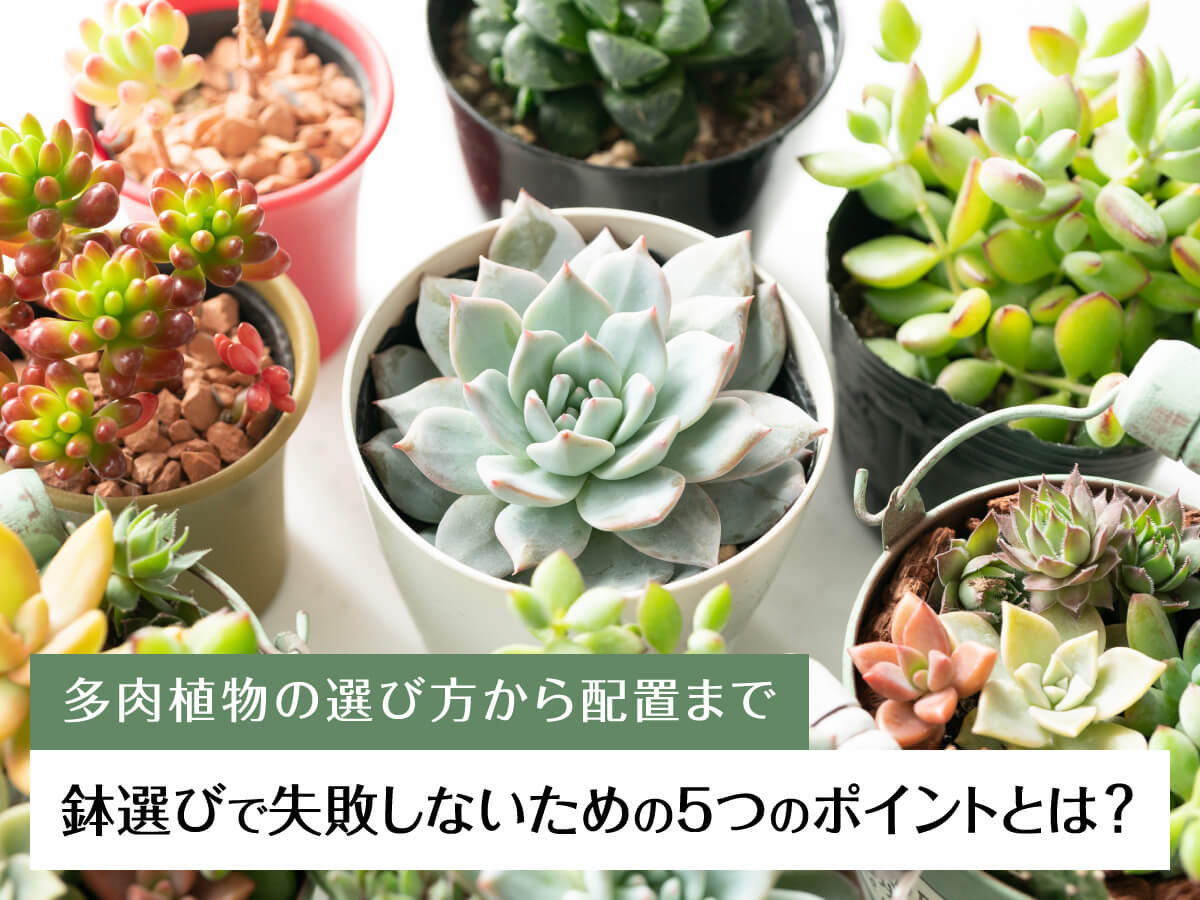
To successfully grow succulents, choosing the right pot and placement is essential. This article details 5 key points for choosing a pot to avoid mistakes, along with placement methods.
1. Introduction
Succulents have become popular in recent years due to their unique shapes and ease of care. However, choosing the right pot is crucial to maximize their appeal. Selecting an appropriate pot not only maintains the plant's health but also enhances its visual beauty.
This article explains 5 key points for choosing a succulent pot without fail, for both beginners and experienced growers. Deepen your understanding of how to choose materials, sizes, and shapes, whether there are drainage holes, and how to match plants with suitable pots, to enrich your succulent life.
2. 5 Key Points for Choosing a Succulent Pot
Choosing a pot for succulents greatly influences their growth and health. Below are 5 key points for selection:
(1) Pot material selection: Well-draining pots are suitable for succulents. Choose materials such as plastic or ceramic.
(2) Pot size selection: It is important to choose an appropriate pot size. Select based on the plant's size and growth rate.
(3) Pot shape selection: The shape of the succulent and the pot affect visual appeal. Choose a shape that matches the plant's characteristics.
(4) Presence of drainage holes: Pots with holes in the bottom drain excess water, preventing root rot.
(5) Matching pot and succulent type: The optimal pot varies by succulent type. Consider the compatibility between the pot and the plant.
By keeping these points in mind, you can grow beautiful and healthy succulents.
(1) Pot Material Selection
In growing succulents, choosing the pot material is a crucial factor. Each material has its advantages and disadvantages.
First, plastic pots are lightweight and easy to handle. They are also affordable, making them recommendable for beginners, but water evaporation is slow, posing a risk of root rot.
On the other hand, ceramic pots have a beautiful appearance and excellent breathability and moisture retention. However, their heavy weight makes them difficult to move, and they tend to be more expensive.
Glass pots are transparent, allowing observation of root growth. However, glass retains too much moisture, so watering frequency needs to be adjusted.
Ultimately, it is important to choose the material according to your growing method and the type of succulent.

(2) Pot Size Selection
Choosing the right pot size has a significant impact on the healthy growth of succulents. If it's too small, the roots will be cramped, and if it's too large, excess moisture will remain.
For a first potting, a size where the plant's roots barely fit is recommended. For example, for a succulent about 5cm in diameter, a pot about 7-8cm in diameter would be good. The basic approach is to gradually increase the pot size as the plant grows.
Also, choose the depth according to the length of the roots. If it's too deep, drainage will be poor, and if it's too shallow, it won't be stable and may easily tip over.
Finally, growth speed is important. For fast-growing types, the pot will quickly become too small, so choosing a slightly larger one is advisable.
By selecting pot sizes with these points in mind, you can grow healthy succulents.
(3) Pot Shape Selection
Choosing the shape of the pot for succulents greatly affects not only their aesthetic appeal but also their health. Generally, shallow pots are recommended over deep ones. This is because succulent roots are often shallow, and deep pots can lead to poor drainage and root rot.
Furthermore, the growth pattern of succulents can change depending on the pot's shape. For instance, choosing a tall pot will encourage the succulent to grow upwards, while a wider pot will promote horizontal growth.
When planting multiple succulents in one pot, the shape becomes even more important. Round pots are suitable for layouts where plants are arranged radially from the center, while square pots are ideal for linear arrangements.
Considering these points, choose a pot shape that matches the characteristics of the succulents you want to grow and your desired layout.
(4) Presence of Drainage Holes
When choosing a pot for succulents, the presence of drainage holes is a crucial factor. Pots with drainage holes improve drainage and aeration, allowing oxygen to reach the roots more easily. This is an absolute necessity for succulents to grow healthily. However, a disadvantage is that repotting can be more troublesome.
On the other hand, with pots that don't have drainage holes, you need to remove the plastic inner pot from the outer pot every time you water. Also, if repotting is necessary, you'll need gardening tools and fresh soil. However, a benefit is that you can enjoy various designs more easily.
Below is a table summarizing the characteristics of pots with and without drainage holes.
|
Drainage Holes |
Advantages |
Disadvantages |
|---|---|---|
|
Present |
Good drainage and aeration |
Troublesome repotting |
|
Absent |
Enjoy various designs |
Troublesome watering every time |
(5) Matching Pot and Succulent Type
We will explain how to choose the optimal pot for each type of succulent. First, for "Echeveria," since its roots are shallow, a shallow pot is best. Furthermore, given its vibrant colors, complement it with a pot of simple color. Next, for "Sedum," it is good to highlight its individuality with an unusual-shaped pot. Also, "Kalanchoe" grows fast, so a slightly larger pot is recommended. Finally, "Lithops," whose unique shape is attractive, pairs well with a rustic ceramic pot. Try growing them with pots that bring out the best in each plant's characteristics for more enjoyment.
3. Basics of Succulent Pot Selection: Material and Size
For succulents, choosing the pot material and size is very important.
First, regarding materials, succulents tend to retain water, so a material with good drainage is ideal. Plastic and glass are aesthetically pleasing and affordable, but they have the disadvantage of slow water evaporation. On the other hand, ceramic and terracotta pots are suitable for succulent cultivation because they absorb excess moisture easily.
Next, regarding size, the pot's size significantly affects plant growth. Succulents tend to have extensive root systems, so it's important to provide enough space to prevent rootbound conditions. Generally, a pot slightly larger than the succulent's diameter is optimal, and it's best to gradually transplant it into larger pots as it grows.
Based on these points, choose the optimal pot for your succulent.
(1) Pot materials suitable for succulents, such as plastic, ceramic, and glass
Plastic, ceramic, and glass are the main materials suitable for succulent pots. Each has its advantages and considerations.
-
Plastic pots: They are lightweight and easy to handle. However, because of their low breathability, choose pots with good drainage holes.
-
Ceramic pots: They are aesthetically pleasing and offer excellent breathability. However, be aware that they are heavy and fragile.
-
Glass pots: Their transparency allows you to observe root growth. However, because they are transparent, algae can easily grow, and their low breathability requires caution.
Material selection depends on the type of succulent and the growing environment. Choose appropriate materials to support the healthy growth of your succulents.

(2) Choosing pot sizes according to succulent growth
Choosing pot sizes that match the growth of succulents is a crucial factor for maintaining the plant's health and aesthetic appeal. If a pot is too small, the roots will become cramped, making it difficult for water and nutrients to be absorbed. Conversely, if a pot is too large, it can retain too much moisture, leading to root rot.
Choose an appropriate pot according to the growth stage of your succulent. Of course, the optimal pot size varies depending on the individual plant species, its characteristics, and the growing environment. Please consider these factors when choosing a pot.
4. Pot Shape and Color to Enhance Succulent Beauty
Generally, shallow pots are suitable for succulents to make them stand out. This is because succulents have shallow roots, and a deep pot could cause water to stagnate.
The color of the pot is a critical element in highlighting the succulent's colors. For instance, white or light-colored pots pair well with green succulents. For red or purple succulents, black or dark-colored pots will make them pop.
The choice of pot shape and color depends on the succulent you are growing and its placement, so check each one individually.
(1) Pot shape according to succulent characteristics
Choosing the pot shape according to the succulent's characteristics is important for healthy plant growth and good appearance. For example, deep pots are suitable for succulents with deep-growing roots, while shallow pots are suitable for those with shallow, spreading roots.
Also, when planting many types of succulents in one pot, the pot's shape needs to consider not only size but also depth. For instance, while rosemary and haworthia are both succulents that prefer dry conditions, the former has deep roots, making a deeper pot suitable. Haworthia, on the other hand, has shallow roots, so a shallower pot is preferable.
By choosing a pot with these considerations in mind, your succulents will grow healthier and look more beautiful.
(2) Choosing pot colors to enhance succulent hues
One of the charms of succulents is their diverse range of colors. To maximize these colors, choosing the pot color is also an important point. Specifically, for succulents with pale colors, selecting a pot with deep, muted colors will make the plant's colors stand out. Conversely, for brightly colored succulents, pairing them with pale-colored pots like white or beige will further enhance their vibrancy.
Furthermore, the pot's material also affects the impression of color. For example, ceramic pots can create a natural look, gently highlighting the plant's colors. On the other hand, plastic or glass pots have the effect of making colors appear more vivid.
When choosing pot colors, please try to be creative to bring out the best in each succulent's colors.

5. Ensuring Good Drainage! Presence of Drainage Holes and Countermeasures
When choosing a pot for succulents, the presence or absence of drainage holes is a very important point. This is because the holes in the bottom of the pot play a role in draining excess water during watering and preventing root rot.
The advantage of pots with drainage holes is good drainage and aeration. This allows oxygen to easily reach the roots, and succulents grow healthily. On the other hand, repotting can be troublesome. Pots without drainage holes allow you to easily enjoy various designs, but you need to remove the plastic inner pot every time you water.
|
|
Advantages |
Disadvantages |
|---|---|---|
|
With drainage holes |
-Good drainage and aeration |
-Troublesome repotting |
|
Without drainage holes |
-Can easily enjoy various designs |
-Need to remove plastic pot every time you water |
In any case, good drainage is recommended for the health and growth of succulents.
Related article here↓
"How to Water Succulents Without Fail? Expert Tips for Watering"
(1) Importance of Drainage Holes
When choosing a pot specifically for succulents, one essential factor not to be overlooked is the presence or absence of "drainage holes" at the bottom of the pot. Drainage holes serve to discharge excess water and prevent root rot. Succulents, in particular, are sensitive to humidity, so good drainage is crucial.
The advantage of pots with drainage holes is improved drainage and ventilation, which helps maintain an environment where oxygen can easily reach the roots. However, a disadvantage is that repotting can be bothersome. It is generally ideal to repot in spring or autumn.
On the other hand, the benefit of pots without drainage holes is that they eliminate the hassle of repotting and allow you to enjoy a variety of designs. However, you must remove the plastic inner pot from the outer pot every time you water. The choice of pot type depends on individual lifestyle and how one interacts with succulents.
(2) Measures for using pots without holes
Even when growing succulents in pots without drainage holes, it is possible to promote healthy growth by taking appropriate measures. The first crucial step is to water sparingly. Excess moisture can cause root rot, so make sure no water accumulates at the bottom of the pot. It's also a good idea to line the bottom of the pot with non-degradable plumbing sponges or small stones to absorb and retain moisture.
Furthermore, regular repotting is an effective measure. Especially if you notice your succulent isn't thriving, consider switching to a pot with drainage holes.
While growing in pots without holes requires caution, by implementing the above measures, you can enjoy beautiful succulents.
6. Matching Pot and Succulent Type
Each type of succulent has its unique growth habits and ease of cultivation. Choosing a pot suitable for these factors is essential for the succulent's healthy growth and aesthetic appearance.
For example, "Columnar Cacti" have a tall, slender shape, so a pot with a wide base and low center of gravity would be good for stable cultivation. Also, to leverage their stylish appearance, a simple designed pot is recommended.
The table below lists common succulent types and examples of suitable pots for each.
|
Succulent Type |
Suitable Pot Characteristics |
|---|---|
|
Columnar Cactus |
Pot with wide base, low center of gravity, simple design |
|
Crassula (stem-forming) |
Small, deep pot, colorful design |
|
Echeveria |
Wide, shallow pot, natural material |
(1) How to choose a pot suitable for each succulent type
Each type of succulent has different growth patterns and root structures, so there is a suitable pot selection for each type. Generally, succulents tend to have shallow roots, so a pot with more width than depth is appropriate. Next, for fast-growing or large-growing species, choose a pot size that is correspondingly larger. Conversely, for slow-growing or small species, a smaller pot is fine. Also, for species with spreading roots, choose a wide-bottomed pot, and for deep-rooted species, choose a deep pot. By carefully selecting the pot, succulents can grow in a better environment.
(2) Examples of compatible pot and succulent combinations
The combination of succulents and pots can greatly enhance their appeal by utilizing each's characteristics. For example, for Echeveria, a wide, shallow pot is recommended to highlight its beautiful leaf shape. On the other hand, for Agave, which has deep roots, choosing a deep pot can prevent root rot.
The color of the pot is also an important factor. Pale-colored succulents can be accentuated with dark-toned pots, while brightly colored succulents pair well with pastel or white pots.
Finally, don't forget to choose pot materials that suit the succulent's characteristics. For example, a plastic pot that retains moisture is suitable for succulents that prefer more water.
7. Summary
This article explained how to choose a pot for succulents. We covered the basics of selection, including pot materials, shapes, the presence or absence of drainage holes, and how to match succulents with suitable pots. Choosing the right pot is a crucial step for the healthy growth of succulents. By considering the material, size, and shape, and selecting a pot that enhances the plant's characteristics, you can grow more beautiful succulents. Also, the presence of drainage holes is important for ensuring good drainage. When you're unsure about pot selection, please refer to this article.
Many cute succulents available
Click here for tawawa's online shop↓

Please take a look!