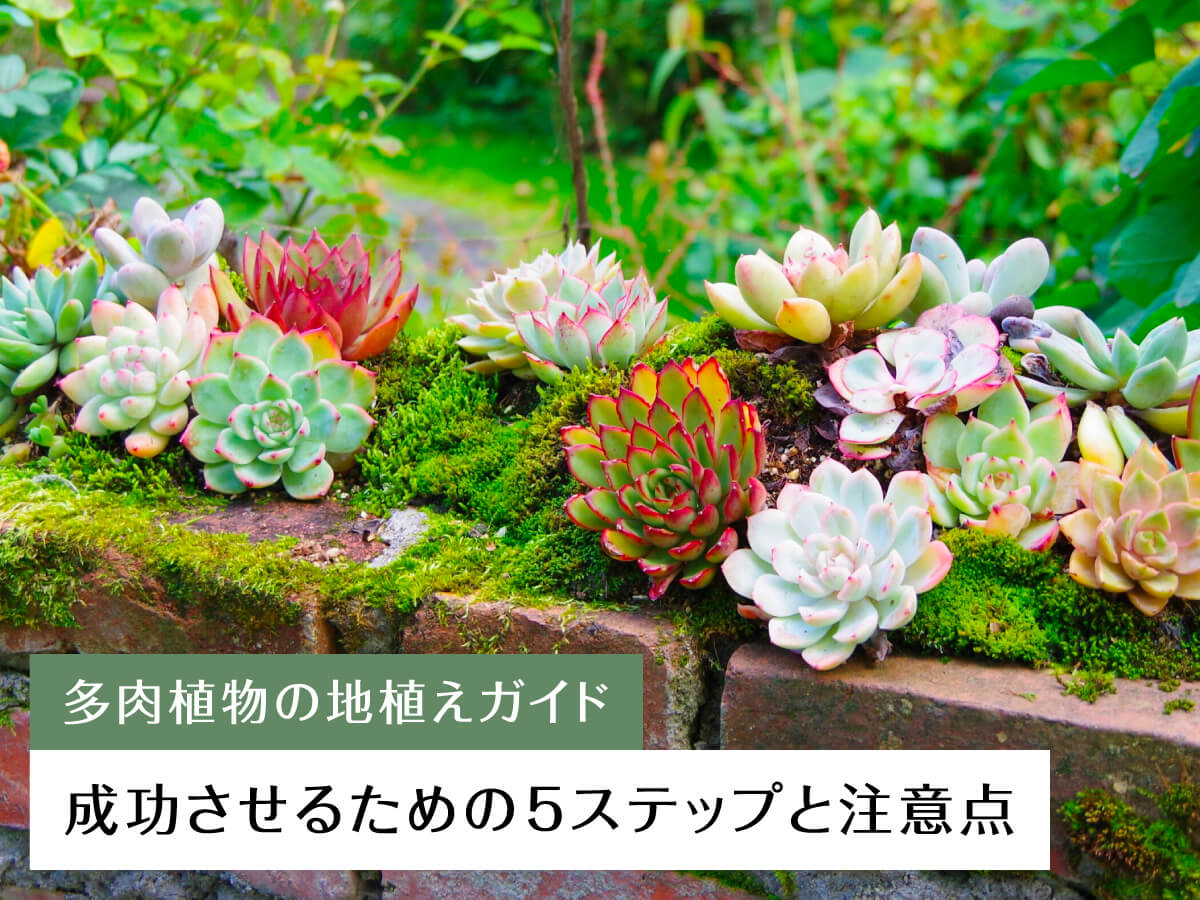
This article details five steps and considerations for successfully planting succulents directly in the ground. If you carefully follow each step, your succulents will surely grow beautifully in the ground.
1. Introduction
Succulents attract many enthusiasts with their charming appearance and unique ecology. However, their handling requires some ingenuity, especially when planting them directly in the ground. This guide will explain everything from the appeal of planting succulents directly in the ground to appropriate selection, steps for successful ground planting, and seasonal care methods. We will provide easy-to-understand explanations so that even beginners can confidently try planting succulents directly in the ground. We will also introduce arrangement examples using ground-planted succulents, so please take a look.
2. What is the appeal of planting succulents directly in the ground?
Succulents, as their name suggests, are plants that store water in their fleshy leaves and stems. This gives them the advantage of being drought-resistant and requiring less frequent watering.
So, what exactly makes planting succulents directly in the ground appealing? First, planting them directly in the ground allows you to observe the growth of succulents in a more natural environment. Second, once planted in the ground, they require very little maintenance, making them convenient for busy individuals.
However, ground planting also has disadvantages. For example, transplanting is more difficult compared to potted plants, and preventing and managing pests and diseases can be more complex.
Conditions for succulents suitable for ground planting include cold hardiness, heat resistance, ease of root spread in the ground, and tolerance to direct sunlight.
(1) What are succulents?
Succulents, as their name suggests, are a general term for plants with fleshy leaves and stems. They are highly drought-resistant and have the ability to store water internally to survive. This characteristic means they generally require less frequent watering. They also come in a wide variety of shapes, colors, and sizes, each displaying a unique appearance. As a result, they are popular as ornamental plants and are widely used in gardens, planters, small pots, and as interior decorations. Generally, they prefer environments with sufficient sunlight and good ventilation.
(2) Pros and Cons of Ground Planting
There are several pros and cons to planting succulents directly in the ground.
【Pros】
They can grow larger than in pots. Enjoy the size unique to ground planting.
Roots spread easily, leading to stable growth and robust health.
Less frequent watering compared to potted plants, saving effort.
【Cons】
Transplanting and moving are difficult. Carefully consider the planting location beforehand.
When planted in the ground, they are easily affected by the surrounding environment. Be mindful of competition with surrounding grasses and weed invasion.
Winter cold protection is necessary. It is crucial to choose varieties suited to the local climate to survive harsh winters.
Considering these points, it is important to choose based on your lifestyle and preferences.
(3) Conditions for succulents suitable for ground planting
Succulents are native to arid regions and can survive in harsh environments. The following three points are important for choosing succulents suitable for ground planting:
1. Growth type: There are three types of succulent growth. Choose plants with the appropriate growth type.
2. Durability: Some varieties can be difficult to manage, so it is desirable to choose durable varieties. For example, Sedum propagates well and increases significantly during its growing season, making it suitable for ground planting.
3. Environmental adaptability: It is important to choose varieties that are suited to the climate, soil, and other conditions of your residential area. Echeveria tends to be sensitive to humidity, so measures such as providing rain shelter are necessary during the rainy season and typhoon season.

3. How to choose the best succulents for ground planting
Choosing the best succulents for ground planting is based on the following three key points:
① Understand and choose based on growth type: Succulents have three growth types: "herbaceous," "caudex/bulbous," and "arboreal." The "herbaceous" type is best for ground planting, as these plants have root systems that spread easily and adapt well to being planted in the ground.
② Choose durable varieties: It is important to choose durable varieties for ground planting. For example, "Sedum" and "Graptopetalum" are highly durable and suitable for ground planting.
③ Choose varieties suitable for the region and environment: Select varieties that are adapted to the local temperature, hours of sunlight, and soil conditions. For instance, "Agave" and "Kalanchoe" prefer sunlight and are suitable for areas with long hours of sunshine.
By considering the above points when choosing succulents, you can successfully plant them in the ground and maintain their beautiful condition for a long time.

(1) Understand and choose based on growth type
The growth type of succulents is a crucial criterion for selection and serves as a starting point for finding species suitable for ground planting. Growth type describes how a plant grows and what shape it takes.
For example, "rosette type" has leaves that spread radially from the center, which is often suitable for ground planting. "Creeping type" spreads along the ground and is suitable as a ground cover. "Climbing type" has the characteristic of growing by intertwining with other plants or objects and can be used for green walls.
By understanding these growth types and knowing which type each succulent belongs to, you can choose the optimal succulent for your gardening style and desired landscape.
(2) Choose durable varieties
When growing succulents in the ground, their durability is also an important selection criterion. Especially for outdoor ground planting, where they are directly exposed to cold, heat, rain, and wind, it is recommended to choose varieties with excellent durability.
Among them, succulents known for their high durability include Echeveria, Sempervivum, and Sedum. These are said to adapt easily to various Japanese climates and are easy to grow for long periods.
Below are some durable succulents commonly used for ground planting.
Succulent Name |
Durability |
|---|---|
Echeveria |
High |
Sempervivum |
High |
Sedum |
High |
These varieties are readily available at general gardening shops and are suitable for beginners. When attempting ground planting, consider choosing from these varieties.

(3) Choose varieties suitable for the region and environment
When planting succulents directly in the ground, it is crucial to choose varieties that match the region and environment. For example, in cold regions, Echeveria 'Shichifukujin', Graptopetalum 'Oborozuki', and Sempervivum are recommended because they are strong against cold. These varieties grow well in the ground even in winter.
On the other hand, succulents that grow in arid regions often prefer sunlight, making them suitable for ground planting in places with abundant sunshine. However, to avoid strong sunlight, it is good to use shade cloth or other protective measures.
The table below introduces recommended succulents for each region and environment.
Region/Environment |
Recommended Succulents |
|---|---|
Cold regions |
Sempervivum, Graptopetalum |
Places with abundant sunshine |
Sedum |
For more details, research the characteristics of individual varieties and choose the succulents best suited to your environment.
(4) Ranking of recommended succulents for ground planting
When searching for the best succulents for ground planting, it is important to choose varieties based on their growth type, durability, and suitability for the local environment. Here, we present a ranking of recommended succulents for ground planting.
1st Place: Sedum. This variety is popular for its vigorous propagation, excellent cold hardiness, and ease of cultivation for beginners.
2nd Place: Echeveria. With a rich variety of species and easy propagation, it is perfect for creating your unique garden.
3rd Place: Graptopetalum. Characterized by vibrant colors and unusual shapes, it makes a striking visual impact.
4th Place: Crassula. It is a resilient plant that is also drought-tolerant, making it suitable for ground planting.
5th Place: Aeonium. While sensitive to cold, many varieties grow large, and their beautiful leaf colors and shapes stand out even when planted in the ground.
These succulents are suitable for ground planting and can be enjoyed by both beginners and experienced gardeners. Their hardiness and ease of care make them highly recommended for those new to ground planting.

4. Succulent Ground Planting Practical Guide
First, the ideal location for ground planting has ample sunlight, especially direct sunlight. The best time for ground planting is from spring to early summer, which coincides with the period of active succulent growth.
The necessary tools and materials are as follows:
Suitable succulents: Choose from the "Ranking of Recommended Succulents for Ground Planting."
Hoe or shovel: Necessary for digging the ground.
Fertilizer: Provides nutrients for the plants.
Soil: Prepare well-draining soil suitable for succulents.
The steps for ground planting are as follows:
Dig a hole of appropriate size and spread fertilizer at the bottom.
Place the plant in the hole and fill with soil up to the root collar.
Finally, water thoroughly and allow it to establish.
As for post-planting care, it is important to prevent dryness while avoiding overwatering. Also, apply fertilizer during the growing season and prune by removing dead parts to maintain a healthy state.
(1) Appropriate location and timing for ground planting
When planting directly in the ground, it is important to choose the optimal location and timing for succulents to thrive.
While some succulents prefer shade, generally, a location that receives 4 to 5 hours of sunlight per day is suitable. Additionally, an area with good air circulation where water does not remain in the soil for long periods is ideal.
Regarding timing, most succulents are sensitive to summer humidity and winter cold, making spring the most ideal time for ground planting. Starting cultivation in spring allows for healthy growth over a long period.
(2) Necessary tools and materials
The tools and materials needed for planting succulents directly in the ground are as follows:
First, prepare well-draining soil and appropriate fertilizer. The fertilizer should be a small amount used as a base fertilizer during planting. Next, you will need a shovel or hoe, and a watering can or hose.
These are the necessary tools and materials for ground planting, but the specific quantities and types may vary depending on the succulent species and environment, so please adjust accordingly.

(3) Ground planting procedure
First, before planting the chosen succulent directly in the ground, properly prepare the planting site. An ideal location is sunny, well-draining, and not too cold in winter. Dig a hole about twice the length of the succulent's roots. Then, place pumice, hyuga soil, sand, or similar materials at the bottom to improve drainage.
Next, gently plant the succulent you prepared in the hole, spreading its roots. Be careful not to plant it too deeply, as this can cause root rot.
Finally, cover with soil, gently press around the plant to stabilize it, and then water it.
These are the basic steps for ground planting. Even beginners should find it easy to try ground planting, as it is almost the same as planting in a pot.
(4) Post-planting care: watering, fertilizing, pruning, etc.
Caring for succulents after ground planting is a crucial step that significantly impacts the plant's growth.
First, regarding watering, succulents are drought-tolerant, but they still need a certain amount of moisture. For ground-planted succulents, water thoroughly when the soil is dry. However, be careful not to give too much water at once, as this can cause root rot. Adjust the frequency of watering according to the season and climate.
Next, for fertilizer, it is recommended to apply a moderate amount of slow-release fertilizer to succulents during their growing season from spring to summer. Using commercially available succulent fertilizer will yield better results.
Finally, regarding pruning, proper pruning helps maintain the health and beautiful shape of succulents. Regularly remove dead leaves and flower stalks to promote growth.
5. Seasonal Care Guide for Succulents Planted in the Ground
Here's a seasonal care guide for succulents planted in the ground.
First, for summer, many succulents are tolerant of heat. However, it's necessary to provide adequate moisture while avoiding direct sunlight and being mindful of drying out. Water in the early morning or evening, avoiding the high temperatures of midday.
Next, for winter, many succulents are susceptible to cold, so measures are needed to protect them from frost and snow. Using cold-resistant fabric or covers is recommended.
By following these seasonal care tips, you can enjoy your ground-planted succulents for a long time.
(1) Tips for Surviving Summer
Summer is the peak growing season for succulents, but exposure to strong sunlight and high temperatures can cause stress, leading to faded colors or shriveled leaves. Here are three key tips for succulents planted in the ground to survive the summer:
1. [Create Shade]: It is crucial to create shade to protect from direct sunlight. Especially avoid strong afternoon sun and ensure good ventilation to prevent high temperatures.
2. [Moderate Watering]: Water sparingly, giving a deep, thorough watering only after the soil has dried out. Avoid daily watering, as it can lead to root rot.
3. [Humidity Management]: If plants are dense and overgrown, prune them adequately before the rainy season or summer, when humidity is high, to improve air circulation and prevent crowding at the base of the plants.
By following these tips, you can help your succulents thrive through the summer.
(2) Tips for Surviving Winter
Caring for ground-planted succulents in winter is particularly important. First, cold-sensitive succulents need protection from frost and cold winds. Methods include applying mulch, covering them with plastic sheeting, or transplanting them into pots for indoor relocation.
Also, since winter brings drier conditions, aim for moderate watering. However, be careful as cold and humidity together can cause frostbite, so water sparingly and preferably during the warmer hours of the day.
Next, in areas with snowfall, clearing snow is also crucial. Regularly brush off snow to prevent plants from collapsing or branches breaking under its weight.
By following these winter care practices, you can ensure your beautiful succulents survive the winter healthily.
6. Arrangement Examples Using Ground-Planted Succulents
Succulents, with their diverse shapes and colors, can create beautiful arrangements when combined with other plants.
(1) Succulents only: By combining succulents of different heights, colors, and leaf shapes, you can achieve a three-dimensional and profound expression. For example, you can combine tall Aeoniums, large-headed Crassulas, or stem-forming Sedums with Echeverias or spreading Ruby Necklaces and String of Pearls.
(2) Succulents and foliage plants: Combining foliage plants and succulents allows you to enjoy the nuances of green and differences in texture. For instance, you can pair a Monstera with its distinctive leaf shape with a colorful Echeveria.
(3) Succulents and flowers: The combination of flowers and succulents, with the vibrancy of flowers and the calmness of succulents, creates a sophisticated atmosphere. For example, you can combine colorful pansies with the subdued hues of Sempervivum.
(1) Succulents Only
Planting combinations of succulents in the ground not only enhances visual enjoyment but can also aid in each other's growth. For instance, by planting varieties with different heights and shapes, you can create a three-dimensional landscape.
As one suggestion, "Sedum" succulents are well-suited for ground planting and come in many varieties, offering a rich diversity of colors and shapes. Combining them with other succulents allows you to create a colorful and beautiful garden.
Furthermore, there are creative ways to plant them. For example, you can build up some areas to create elevation changes, or design patterns that mimic flowing rivers or mountains. In this way, even with the same succulents, different combinations and planting methods can yield various expressions.
(2) Succulents and Foliage Plants
Combining ground-planted succulents with foliage plants is a wonderful way to expand your gardening horizons. Foliage plants and succulents complement each other well, with differences in shape and color creating striking contrasts and allowing for attractive arrangements.
For example, placing large foliage plants in the background and succulents in the foreground or at the base can create visual depth. Additionally, the volume of foliage plants and the unique shapes of succulents help maintain visual balance.
However, since both have different cultivation methods and environmental requirements, caution is needed when arranging them. For instance, succulents prefer sunlight, while some foliage plants prefer partial shade. Therefore, it's necessary to combine them while considering their respective environmental needs.
(3) Succulents and Flowers
Ground planting succulents with flowers not only creates a vibrant display but also allows you to enjoy the seasonal changes of the flowers. For example, combining spring-blooming bulbs with succulents means that the flowers will bloom in spring, and even after they fade, the succulents will keep the area beautifully adorned.
Furthermore, when ground planting, it's a good idea to choose flowers that are drought-tolerant, similar to succulents. For instance, drought-resistant flowers like Gazania and Portulaca are recommended.
However, depending on the flowers chosen, it may be necessary to consider their compatibility with succulents and adjust watering and sunlight accordingly. The combination of colorful flowers and succulents makes gardening enjoyable just by looking at them.
7. Summary
When ground planting succulents, it is crucial to select varieties based on their growth type and hardiness, and to ensure suitable conditions for the region and environment. Furthermore, it is necessary to prepare the appropriate location, timing, tools, and materials, follow the correct planting procedure, and commit to post-planting care. By paying attention to seasonal care, including tips for summer and winter survival, you can enjoy your ground-planted succulents for an extended period. Finally, we've also provided arrangement examples using succulents, so please refer to them.