This article provides an easy-to-understand explanation of the basic succulent care tips that beginners should know. We will cover basic care, such as watering, sunlight, fertilizing, and appropriate temperatures, as well as techniques for growing healthy and vibrant succulents.
1. Introduction: Interest and Charm of Succulents
Succulents generally refer to a group of plants characterized by their thick leaves or stems and their ability to store water. They are popular among many people due to their unique appearance and ease of care.
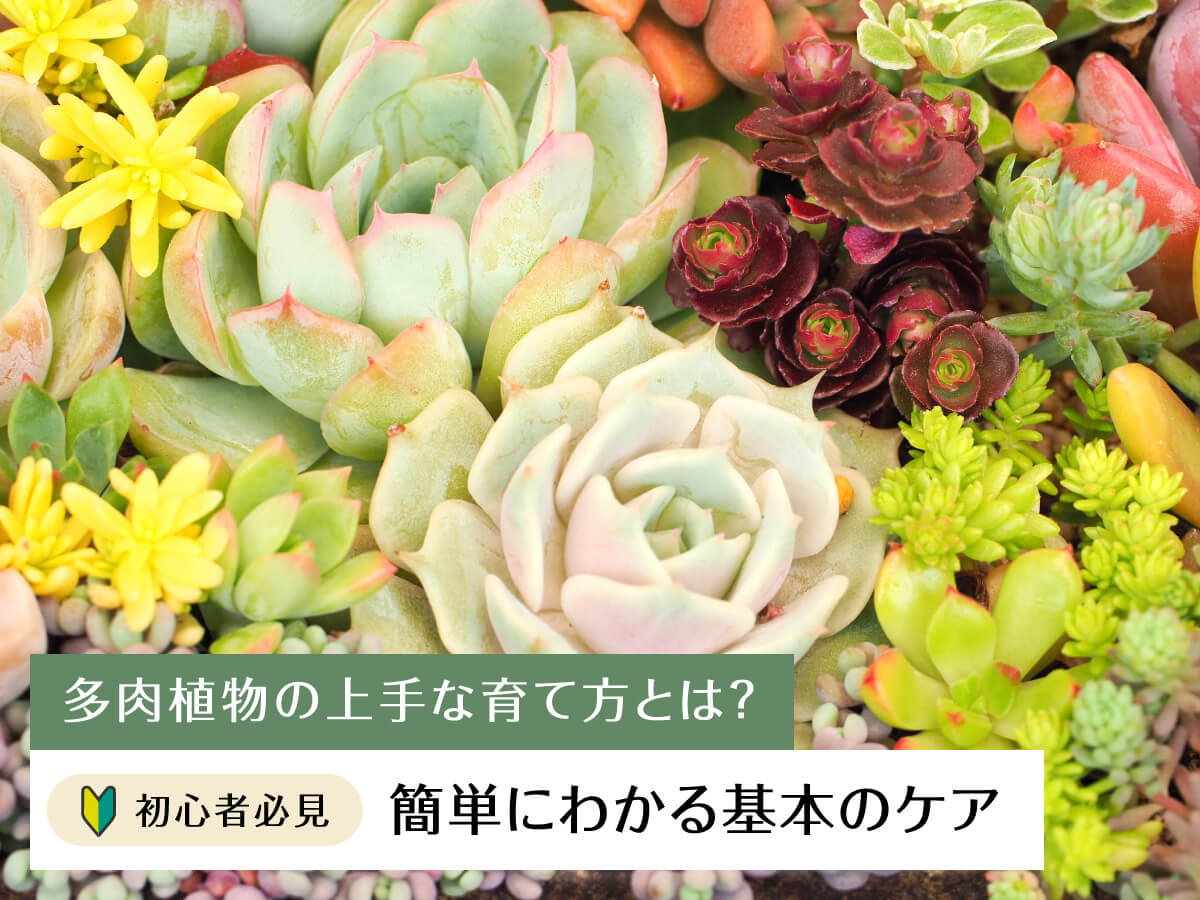
One specific appeal is their diversity. Succulents come in a variety of shapes, colors, and sizes, each with its own unique charm. You'll find them enjoyable not only to grow but also to observe.
Another appealing aspect is that watering and fertilizing are relatively simple. Succulents prefer moderate dryness and require less frequent watering, making them easy to grow even for busy individuals.
For these reasons, succulents are beloved by many.
(1) What are succulents?
Succulents, as their name suggests, are plants that have "a lot of flesh." Specifically, they refer to plants whose leaves, stems, and other parts are thickened to store water. Due to these characteristics, they are resistant to dryness and can grow even with infrequent watering. Therefore, they are attractive plants that can be easily grown by busy modern people and those who are not good at caring for plants.
Furthermore, succulents have a rich variety of shapes and colors, and each one is like a natural work of art. They have high ornamental value and can show various expressions depending on how they are arranged. Due to these characteristics, succulents are also popular as interior decorations.
(2) Why are succulents popular?
The popularity of succulents stems from their unique visual appeal and ease of care. Their shapes and colors are like jewels, enjoyable just to behold. Additionally, they generally require little effort to cultivate and don't need frequent watering, making them accessible even for busy individuals or plant novices. Furthermore, arranging several varieties in a single pot offers the joy of creating a unique personal collection. These charms are why succulents are widely cherished.

2. For Beginners: How to Choose Succulents
Choosing succulents is the most crucial step for beginners. If you choose based solely on their attractive appearance, there's a risk that they might wither after you start growing them.
Succulents have different growth patterns, and each grows at a different time of year. There are "spring and autumn growers," "summer growers," and "winter growers." Choosing a type that suits your climate is the secret to successful cultivation.
The place of purchase is also important. We recommend purchasing from a store that offers excellent after-sales support. You can receive growing advice from the store, so even if your plant becomes weak, you can deal with it without letting it die.
These are the basic tips for choosing succulents. Make the right choice and enjoy growing healthy succulents.
(1) Recommended succulent varieties and their characteristics for beginners
Here are some recommended succulent varieties and their characteristics for beginners.
"Echeveria 'Chihuahuaensis'": Its thick, triangular petals are as beautiful as a rose, making it perfect for flower lovers. It is cold-hardy, making it easy to grow even in northern regions.
"Crassula 'Mai Otome'": Features a geometric appearance and adapts to a wide range of environments, from northern regions to deserts.
- "Pachyphytum 'Tsukibijin'": Characterized by a delicate violet color, it creates a fantastical atmosphere. While cold-hardy, caution is needed during summer heat.
Even beginners can start with these varieties. Enjoy succulents that combine ease of care with charm.
Related articles here↓
Popular Echeveria Among Succulents! Introducing Its Varieties and Characteristics

(2) Tips for Choosing Succulents
There are three basic tips for choosing succulents. The first is "ease of care." Not all succulents thrive in the same environment, so it's important to choose a variety that suits your home's conditions (sunlight, humidity, etc.). The second is "preference." Succulents come in a wide range of shapes and colors, so it's best to choose one that matches your taste and interior decor. The third is "health condition." When purchasing, select a plant with firm, glossy leaves and a sturdy base.

3. Secrets to Success: Basic Succulent Care
The basics of succulent care involve choosing the right pot and soil, creating the right environment, providing water and fertilizer, and selecting the proper placement.
First, let's talk about choosing a pot and soil. Succulents need a pot and soil that drain well. The pot can be ceramic or plastic, but make sure it has drainage holes at the bottom. As for soil, a mix specifically for succulents, or a blend of akadama soil and pumice, would be ideal.
Next, creating the right environment. Succulents prefer sunny locations. However, direct sunlight in summer can be too strong, requiring shading. Also, some varieties don't tolerate direct sunlight even outside of summer, so be careful. Choose a location ranging from partial shade to full sun, depending on the succulent species and the season.
Proper watering and fertilizing are also important. Water thoroughly when the soil is dry, and fertilize once a month from spring to autumn.
Finally, regarding placement, in cold regions where winter temperatures drop below freezing, it's best to bring them indoors or cover them with non-woven fabric or blankets. By following these basic care guidelines, your succulents will grow beautifully.
Related articles here↓
"Succulent Watering" — How to Avoid Failure? Expert Tips on WateringPlanting unrooted seedlings purchased in plastic slotted pots

(1) Choosing the Right Pot and Soil
Choosing the right pot and soil is a crucial aspect of growing succulents.
When selecting a pot, materials that allow for good drainage and ventilation are recommended. Ceramic pots, in particular, are suitable for succulents. Size is also important; choose one that matches the length of the succulent's roots.
Additionally, when choosing soil, soil with better drainage than general gardening soil is appropriate. This is because succulents originally grow in dry environments. If using commercially available soil, it's best to choose one specifically for succulents.
By selecting the right pot and soil, your succulents will grow healthily.

(2) Creating an Environment Where Succulents Thrive
Succulents grow in harsh environments in nature, so it's important to mimic those conditions when growing them at home. First, it's crucial to place them in a sunny location. Direct sunlight is ideal, and at least half a day of sun exposure is necessary (but beware of strong direct sunlight in midsummer).
Also, succulents dislike humidity, so place them in a well-ventilated area. They prefer dry air, so good airflow is important.
Furthermore, choose pots or planters with good drainage, and ensure that water doesn't accumulate at the bottom. If you grow them with these points in mind, succulents will thrive in a better environment.
(3) Appropriate Watering and Fertilizing
Proper watering and fertilization are crucial for growing succulents. Appropriate watering varies depending on the succulent's growth stage. For example, during the growing season, if the leaves become wrinkled, provide ample water until it drains from the bottom of the pot. During the dormant season, aim to water about once a month. Also, it's safer to water only the soil. Be careful not to let water accumulate between the leaves, as this can cause stuffiness or leaf burn.
Regarding fertilizer, it's ideal to apply slow-release fertilizer when repotting. After repotting, avoid over-fertilizing as it can lead to root rot; apply sparingly.
By keeping these points in mind and providing care tailored to each succulent's characteristics, you can cultivate healthy succulents.

(4) Choosing the Right Location
Succulents thrive best in environments where they receive direct sunlight, as they grow in harsh natural conditions. Growing them outdoors, in particular, is key to maintaining their beautiful forms.
However, intense direct sunlight all day or extreme summer sun can cause damage. Therefore, it is recommended to move them to the shade during the strongest midday sun or use a sunshade. In winter, it's crucial to provide frost protection to prevent cold damage.
For succulents that don't need as much sunlight or for growing them indoors in cold regions during winter, a south-facing windowsill is ideal. However, it's also necessary to take measures to maintain humidity so they don't dry out from winter heating.
Choose the optimal location and strive to create an environment suitable for succulent growth.

4. Advanced Skills: Repotting and Propagating Succulents
Repotting succulents is done when the plant has grown too large, its roots are growing out of the pot, or the plant itself seems to be losing vitality. The specific steps for repotting are as follows:
Remove the succulent from its pot.
Remove the old soil from the roots.
Trim any dead roots.
Place the plant in a new pot filled with soil specifically for succulents.
Add soil around it and gently firm it down.
There are three main ways to propagate succulents: division, leaf propagation, and stem cuttings. Division involves separating the plant's clumps, leaf propagation involves rooting leaves, and stem cuttings involve rooting stems. In all methods, dedicated succulent soil is placed in a new pot and the plant part is inserted.
Related articles here↓
[Succulent Repotting] Thorough Explanation of Timing, Methods, and Tips! Secrets to Avoiding Failure Revealed
(1) Purpose and Timing of Repotting
Repotting succulents serves two main purposes. The first is to maintain a healthy growing environment. The second is to move the plant to a pot of appropriate size as it grows. The best time to repot succulents is generally in early spring, before the new growing season begins. During this period, when the cold has eased and increased watering is possible, plants can adapt to a new environment with minimal stress. However, in special circumstances such as the discovery of diseases or pests, or root bound, repotting may be necessary at other times.
(2) How to Propagate Succulents: Division, Leaf Cuttings, Stem Cuttings
There are three main methods for propagating succulents: "division," "leaf cuttings," and "stem cuttings."
First, "division" involves separating smaller plants from a larger one. You cut off healthy new shoots, let them dry, and then plant them directly into a new pot.
Next, "leaf cuttings" involve selecting a healthy leaf, gently pulling it from the parent plant, and then inserting the base of the leaf shallowly into soil to root.
Finally, "stem cuttings" involve cutting a stem and inserting it into soil. There are methods where you let the cut end dry before planting, or plant it immediately after cutting. Experiment with the method that best suits your growing environment.
Succulents propagated using these methods will grow healthily with careful watering and sunlight management.

5. Ideas for Enjoyment: Arranging and Displaying Succulents
The ways to enjoy succulents are endless, depending on how you arrange them. Below, we'll discuss recommended arrangements and display ideas.
(1) Tips and Methods for Succulent Arrangements
Arrangements utilizing natural materials like driftwood are popular for their natural ambiance. By drilling holes in driftwood, filling them with soil, and planting succulents, you can enjoy a unique look.
(2) Ideas for Enjoying Color Coordination
Succulents come in many colorful varieties, and you can enjoy various expressions by combining their colors. For example, try gathering warm-toned succulents, or creating contrasting color schemes to make your own original arrangements.
(3) Ideas for Displaying Succulents
There are various ways to display them depending on the location and purpose. You can enhance the presence of succulents by creating wall arrangements or utilizing hanging types to use space effectively.
Based on these ideas, enjoy your own world of succulents.
Related articles here↓
[Beginner's Must-See] Succulent Arrangement Introduction Guide: Start from the Basics!

(1) Tips and Methods for Succulent Arrangements
Succulent arrangements allow you to enjoy a beautiful, colorful landscape by planting multiple varieties in a single pot. While attractive, a few key tips can help you create an even more stunning arrangement.
First, choose varieties with similar watering needs and sun adaptation. This ensures all plants can thrive in the optimal environment.
Next, for placement, consider variations in height, shape, and color. Placing taller varieties in the center and shorter ones around them creates a sense of depth. Combining richly colored varieties adds visual enjoyment.
Finally, the pot size is important. Choose an appropriate size to prevent roots from becoming cramped, and plant with enough space to promote healthy growth.
Keep these points in mind and try your hand at succulent arrangements.
(2) Ideas for enjoying color coordination
Succulents come in a wide variety of colors and shapes. Here are some ideas for how to use them to create beautiful color combinations.
First, try arranging them in monochromatic schemes. By gathering items of the same color, you can create a unified and beautiful display. For example, try planting red-toned Echeveria and Crassula together.
Next, try coordinating with contrasting colors. "Contrasting colors" are fundamental to color theory and have a very large visual impact. Try combining contrasting colors such as red and green, or blue and orange.
Finally, try coordinating with a sense of the season. For a spring image, pink and yellow would be good choices, while for autumn, focus on browns and reds.
We've introduced a few color coordination methods, but please also try creating your own original combinations.
(3) Ideas for displaying succulents
Succulents can be displayed in various ways, making the most of their attractive shapes and colors.
The first idea is an arrangement using driftwood. Planting succulents in driftwood creates a very striking display that complements the natural ambiance. You can also attach sphagnum moss to the surface of the driftwood and plant succulents there.
The second idea is to use empty cans or bottles. By using these as substitute pots for succulents, you can easily enjoy recycled interior decor.
The third idea is a wall arrangement to enjoy by hanging them on a wall. By lining succulents across an entire wall, you can create a stunning green wall.
The key to these arrangements is to enjoy customizing them to your liking. Try to find the best way to display succulents to maximize their charm.
6. Common mistakes and solutions in succulent care
When caring for succulents, be aware of the following common mistakes:
(1) Solution for dropping leaves: This is often caused by excessive watering. Water sparingly, enough for water to drain from the bottom of the pot.
(2) Solution for limpness: The main cause of this is insufficient sunlight. Succulents love sunlight, so if possible, place them in a sunny spot.
(3) Solution for wrinkled leaves: This is due to lack of water. If you notice wrinkled leaves, water thoroughly.
By implementing the above measures and reviewing your care routine, you can keep your succulents healthy.
Related articles here ↓
[Causes of Succulent Death] Care Methods and Revival Tips for Beginners
(1) Solutions when leaves fall off easily
When succulent leaves drop easily, it's often due to excessive watering. Succulents are drought-tolerant plants, and overwatering can lead to root rot, which in turn causes the leaves to fall off.
As a countermeasure, first review your watering frequency. Generally, we recommend watering when the soil is dry, and once the entire soil is thoroughly watered, drain it completely.
Also, after watering thoroughly until water drains from the bottom of the pot, it's crucial to wait until the soil in the pot is completely dry before watering again. This will prevent root rot and allow you to grow healthy succulents.
(2) Measures to take when the entire plant is limp
When succulents become universally limp, there are primarily two possible reasons. First, they might not be receiving adequate light. Succulents thrive in sunlight, so a lack of sun can hinder their growth. As a solution, it is effective to move the plant to a location with sufficient sunlight.
The second reason is improper watering. Since succulents are drought-loving plants, excessive watering can cause root rot, leading to the entire plant wilting. To remedy this, it is crucial to water again only after the soil has thoroughly dried out.
As mentioned above, to revive a limp succulent, it is important to re-evaluate the balance between sunlight and watering.
(3) Solutions for wrinkled leaves
Wrinkled succulent leaves can be caused by various factors, primarily lack of water, pests, or diseases.
First, in the case of underwatering, the leaves typically wrinkle from the outside in. If this is the situation, water thoroughly until water drains from the bottom of the pot. The leaves should absorb the water and return to their plump state within a day or a few days.
Next, if pests or diseases are suspected and the leaves show no improvement, it's important to consider pests or diseases. For early intervention, consider using insecticides or fungicides.
In any case, it is crucial to quickly identify the cause of wrinkled succulent leaves and implement appropriate countermeasures.
7. Summary: How to grow succulents successfully
To successfully grow succulents, the following points are important:
-
Choosing: Select varieties that are easy for beginners to grow.
-
Pots and soil: Choose breathable pots and well-draining soil.
-
Environment: Create an environment where succulents can thrive comfortably.
-
Watering and fertilizer: Follow proper watering and fertilization methods.
-
Repotting and propagation: Repot mature succulents and propagate new plants through leaf cuttings or stem cuttings.
Even if you encounter problems, you can diagnose the cause from symptoms like leaf drop or wilting and take appropriate action. With correct knowledge and dedicated effort, you can ensure the healthy growth of your beloved succulents.
Related articles here ↓
"Succulent Beginner's Guide" Easy-to-Grow Varieties and Basic Care Methods