This is a guide for beginners who want to propagate succulents. We will explain in detail the specific steps to increase your success rate and precautions to avoid failure. Please refer to this guide to create a lush green interior.
1. Introduction to Succulent Propagation
Succulents are characterized by their thick leaves and stems, which store a lot of water. In addition to their aesthetic appeal, succulents are known for being robust and resilient plants. Their wide variety of shapes, colors, and flowers also makes them enjoyable to collect.
There are three main methods for propagating succulents: "leaf propagation," "stem cuttings," and "division." The basic process for all of them is the same: first, take a healthy part of the plant, then plant it in soil. However, each method has its own specific considerations, and choosing the appropriate technique can increase your success rate.
Now, let's delve into each propagation method in detail.
(1) Characteristics and Appeal of Succulents
As their name suggests, succulents are plants with "fleshy leaves." Their greatest characteristic is their strong resistance to drought. The thick leaves have a function to store water, allowing them to grow in dry environments, making them easy to cultivate even for beginners who often make mistakes with watering frequency.
Furthermore, the appeal of succulents lies in their diverse shapes and colors. From slender to rounded forms, each possesses a unique shape, and their colors are incredibly rich, ranging from bluish to reddish hues. These characteristics provide people with the enjoyment of creating mixed plantings using various pots and containers, boosting the popularity of succulents.
(2) Basic Flow of Propagation Methods
There are three main ways to propagate succulents: "leaf propagation," "stem cuttings," and "division." The basic process for each is explained in the table below.
|
Method |
Basic Flow |
|---|---|
|
Leaf Propagation |
1. Select a healthy leaf and pluck it from the mother plant. 2. Insert the leaf shallowly into the soil and manage it in a bright shade or semi-shade location. |
|
Stem Cuttings |
1. Cut a small branch from the mother plant. 2. Insert the cut end into the soil and water moderately. |
|
Division |
1. Separate small offsets from the mother plant. 2. Plant the separated offsets in new pots. |
Remember these basic steps and try propagating succulents. Specific methods and tips will be explained in detail in the next chapter.
2. Propagating Succulents: Leaf Propagation
First, let's learn about leaf propagation. It's the easiest way to propagate succulents.
Related articles here↓
"Succulents" Propagate with Leaf Cuttings! Tips and Steps to Avoid FailureLeaf propagation with Echeveria leaves

(1) Leaf Propagation Method and Tips
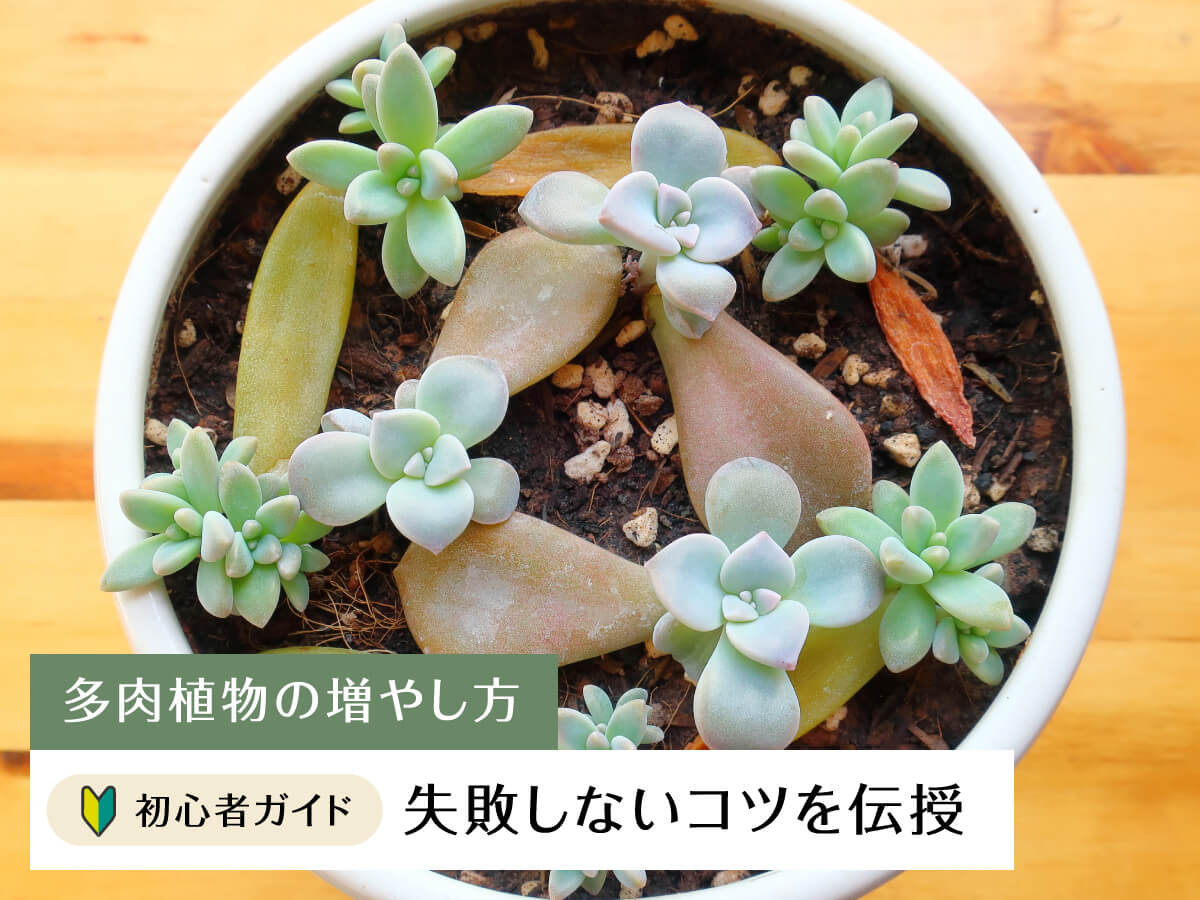
"Leaf propagation" is one method of propagating succulents, primarily Echeveria and Graptopetalum. As the name suggests, it involves planting a leaf to grow roots and create a new plant. The steps are outlined below:
-
Select a healthy leaf and gently twist it from side to side to pull it off the mother plant. Success is achieved when the entire base of the leaf is removed from the mother plant.
-
The key is to insert the lower part of the removed leaf shallowly into the soil.
For small leaves like Sedum, simply scatter them on top of the soil.
*Previously, it was common practice to dry the removed leaves before planting them in soil, but now many people plant the removed leaves directly into the soil, as this is believed to promote germination and rooting. -
Then, place it in partial shade or bright shade, water it moderately, and just wait for new shoots to emerge.
(2) How to Grow and Care for Leaf Cuttings
Depending on the species, small buds will emerge from leaf cuttings within one week to one month. This marks the beginning of a new succulent's life. At this stage, pay attention to the following points:
【Table】
|
Step |
Precautions |
|---|---|
|
1 |
Avoid direct sunlight and grow in a bright location |
|
2 |
Even succulents, which are drought-tolerant, require adequate water supply during this period. |
Regarding water supply, in particular, water enough to prevent the leaves from wilting, and be careful not to overwater. Also, these new plants grow vigorously, but they do not have the same cold hardiness as mature plants. It is recommended to manage them indoors during winter.

3. Propagating Succulents: Stem Cuttings
Stem cuttings are another method for propagating succulents. Cuttings of succulents without stems, such as Echeveria, are also known as "headless" cuttings.
Related articles here↓
[A Must-Read for Beginners] Key Points to Avoid Failure with Succulent Cuttings

(1) Stem Cutting Method and Tips
Stem cutting is a method of propagating succulents, primarily by taking a portion of the stem and growing a new plant. With skillful execution, your succulents will multiply.
-
Cutting: First, select a healthy stem and cut it cleanly with a sharp blade. An ideal length is about 5cm to 10cm.
As decapitation is a bit more difficult, details will be covered in another article. -
Planting: Insert the dried stem into moderately moist succulent soil. A depth of about one-third of the stem is ideal.
*Similar to leaf propagation, it was previously common practice to dry the removed leaves before planting them in soil, but now many people plant the removed leaves directly into the soil for cultivation without drying them.
Stem cuttings can be done year-round, but spring to summer (growing season) is recommended. Also, water only when the soil is completely dry. High humidity can cause the stem to rot.
(2) Suitable Species for Stem Cuttings and Their Reasons
Not all succulents can be propagated by stem cuttings. Species with thick, branching stems, such as "Crassula" and "Sedum," are suitable for stem cuttings.
【Suitable Species】
-
Crassula
-
Sedum
The reason is that these plants have the characteristic of growing new roots from the cut surface in a short period. When propagated by stem cuttings, new stems and leaves grow from the base, allowing the original shape to be maintained, so you can propagate them while preserving their appearance.
Additionally, new shoots will emerge from the cut mother plant, allowing you to grow multiple new seedlings from a single cutting.

4. Propagating Succulents: Division
Division is a method of propagating succulents by separating a large, mature plant. This is particularly effective when the plant has grown too large to manage or when multiple plants are competing in the same pot.
Related articles here↓
[If Your Succulents Grow Too Long] How to Improve Environment and Cut for Ideal Shape!Divide the overgrown parts to shape them.

(1) Division Method and Tips
"Division" is one method of propagating succulents. It is particularly suitable for succulents that have grown large or are densely clustered.
The method of division is as follows:
-
Remove the succulent from its pot. Handle it gently to avoid damaging the roots.
-
Locate the section to be divided and gently pull it apart by hand. Be careful not to damage the plant or roots by pulling too hard.
-
Plant the divided sections in new pots. Seedlings that have been distorted due to crowding will grow into a beautiful shape when replanted.
Key points for division are timing and watering. Spring to early summer and autumn are the best times for propagation, but it can be done year-round. As with other seedlings, water thoroughly after the soil has completely dried out.
(2) Suitable Species for Division and Their Reasons
Common succulent species suitable for division include "Echeveria" and "Sedum." These species tend to grow large, and division allows them to maintain their beautiful shape.
There are two main reasons why division is recommended. First, if a plant grows too large, it not only becomes aesthetically unpleasing but also may suffer from poor nutrient distribution, potentially harming its health. Second, division allows you to propagate new individuals, further expanding the enjoyment of succulents.
The table below summarizes the species suitable for division and their reasons.
|
Species |
Reason |
|---|---|
|
Echeveria |
Plants tend to grow large. For aesthetic arrangement. |
|
Sedum |
Plants tend to grow large. To improve nutrient distribution. |
As such, division is an important technique for maintaining succulent health and propagation.
5. Precautions for Propagating Succulents
Three important factors determine the success of succulent propagation: "timing of propagation," "selection of appropriate soil," and "watering method."
Related articles here↓
[Choosing Soil for Succulents] Beginners Won't Fail! How to Create Easy-to-Grow Soil?
(1) Propagation Season and Reasons
The best time to propagate succulents is from spring to early summer (around March to May) and in autumn (around September to November). This is because new shoots are more likely to emerge and root during these periods.
While it varies depending on the propagation method, in general, the success rate is higher when done in spring to early summer and autumn, when plant growth is active. This is because stable temperatures and humidity reduce stress on the plants themselves, making it suitable for propagation.
(2) Characteristics and Selection of Suitable Soil
The ideal soil for succulents is well-draining and well-aerated. A soil mix containing akadama soil, pumice, or kanuma soil is recommended. You can also use commercially available succulent-specific soil.
【Key Points for Selection】
-
Good Drainage: Succulents are prone to root rot, so choose soil that doesn't retain excess moisture.
-
Aeration: The soil should not be too compact and should be able to hold air.
-
Nutrients: For beginners, choosing soil specifically for succulents makes nutrient management easier.
Making appropriate soil choices based on these factors is a crucial step for healthy succulent growth. Provide the best possible environment for your beloved succulents.
(3) Watering Precautions and Reasons
Watering succulents may seem difficult at first glance, but by following key points, you can avoid failure.
First, the most important point is to "water only after the soil has completely dried out." Succulents dislike overly wet conditions. Prolonged dampness can lead to root rot.
Next, "water infrequently, but thoroughly each time." For leaf propagation, water more frequently than for larger seedlings. This is because the original leaves use their moisture and nutrients to produce new shoots and roots, so they tend to run out of water. For other methods, it is important to let the soil dry out completely before watering, just like with other seedlings.
By adhering to these points, succulents will grow healthily and can be propagated.

6. Ideas for Enjoying Succulents
Ways to enjoy succulents that you've propagated yourself include "mixed planting" and "terrarium use."
Related articles here↓
[A Must-Read for Beginners] Succulent Mixed Planting Starter Guide: Beginning with the Basics!
(1) How to Create Mixed Plantings and Their Appeal
Mixed planting is a styling method that brings out the maximum charm of succulents. The process is very simple.
First, choose a suitable pot, tin can, wooden box, or other container. Good drainage is best. Next, put soil in the pot or container and plant the succulents by inserting them into the soil. By combining different types and colors of succulents, you can create a mixed planting that looks like an enjoyable work of art.
The appeal of mixed planting is the ability to enjoy various succulents in one pot and to create your own original combinations. You can also enjoy the seasonal changes, and they become a decorative accent for your home or garden.
(2) How to Utilize as Terrarium Plants
A terrarium is a hobby of creating a small world inside a glass bottle or case, and terrariums using succulents are popular for appreciating their beautiful forms and enjoying the creation of miniature spaces.
【Terrarium Creation Steps】
-
First, prepare a transparent glass bottle or case.
-
Lay a layer of pumice or mineral stones at the bottom for good drainage.
-
Next, lay down specialized terrarium soil.
-
Finally, plant your favorite succulents to complete it.
In a terrarium, watering should be kept to a minimum. The key is to close the lid to maintain humidity. Also, don't forget to place succulents, which love light, in a bright location. In this way, enjoying succulents in a terrarium is one of the recommended ways to discover their charm from a new perspective.
7. Summary
In this article, we learned about propagating succulents and their appeal.
Related articles here↓
"Succulent Watering" How to Avoid Failure? Expert Tips for Watering
(1) Summary of Tips to Avoid Failure
Here's a summary of key tips to avoid failure:
|
Propagation Method |
Key Points |
|---|---|
|
Leaf Propagation |
It is important to remove the leaf from the base. Water slightly more frequently. |
|
Cuttings |
Choose a suitable species and, as with other succulents, water only after the soil has dried out. |
|
Division |
When repotting into a new pot, choosing a slightly larger pot will encourage better growth. |
Furthermore, three important points common to all propagation methods are "timing of propagation," "soil selection," and "watering."
-
Timing of propagation: Spring to early summer, and autumn are optimal. Avoid summer and winter, as growth slows down during these seasons.
-
Soil selection: Choose well-draining soil to prevent root rot.
-
Watering: While succulents prefer dry conditions, they will wither if not watered at all. Water thoroughly only after the soil has completely dried out.
Keep these points in mind and enjoy cultivating succulents.
(2) Revisiting the Appeal of Succulents
The appeal of succulents lies in their diverse shapes and the relative ease with which they can be propagated. Their thick leaves and stems exude strength and vitality.
Moreover, succulents display beautiful colors when they receive plenty of sunlight. This is a charm not found in other plants. The coloring of succulents is a sign that they are well-managed and growing vigorously.
Furthermore, succulents can be enjoyed indoors even during winter. (While outdoor cultivation is generally recommended, in colder regions, they should be kept indoors during winter and moved outdoors when it gets warmer to reshape them.) Therefore, the ability to enjoy them regardless of the season is also an attractive feature.
The table below summarizes the main appeals of succulents.
|
Appeal |
Description |
|---|---|
|
Diversity of shapes |
Significant differences in appearance even among the same succulent species |
|
Easy propagation |
Easily propagated through leaf cuttings, stem cuttings, etc. |
|
Beautiful coloring |
Vivid coloring when exposed to sunlight |
|
Enjoyable throughout the seasons |
Can be enjoyed even during winter |
By understanding these appeals and approaching succulents with the joy of cultivation, their propagation will become even more enjoyable.
Click here for tawawa's online shop
where you can find a wide variety of cute succulents!

Please take a look!