This article provides a detailed explanation of why succulents grow too long and how to deal with it. The root of the problem is often a lack of proper light, water, and nutrient management, but by improving these conditions and performing appropriate pruning, you can restore your succulents to their ideal shape. We will also introduce ways to utilize pruned succulents to enjoy a new succulent life.
1. Introduction
Succulents are loved by many for their hardiness and beautiful appearance. However, have you ever encountered the problem of "what to do if my succulent has grown too long?" Succulents, which originally thrive in arid regions, can grow too quickly if not provided with the proper growing environment, making it difficult to maintain their ideal shape. We will now introduce the causes and solutions for this, as well as ways to enjoy succulents that have grown too long. Let's explore the world of succulents together in more depth.

2. What causes succulents to grow too long?
There are three main reasons why succulents grow too long. The first is "not getting enough sunlight." When succulents grow in the shade, they stretch out to find light, a condition called "etiolation." The next reason is "excess nutrients or water." This occurs when the growing conditions are too protective. More nutrients or water than necessary can actually hinder plant growth. Finally, insufficient winter care is also a contributing factor to overgrowth. Succulents enter a dormant period in winter, during which their growth stops. However, if not properly managed, they may continue to grow and become elongated. Keep these points in mind to promote healthy succulent growth.
Related articles here↓
【Succulent Etiolation】Causes and Effective Reshaping Methods Explained
(1) Not getting enough sunlight
One of the main reasons why succulents grow too long is insufficient sunlight. Succulents perform photosynthesis through sunlight, creating the nutrients necessary for their life activities. When there is insufficient sunlight, they tend to stretch their stems to reach the light. However, this backfires, leading to a state of "etiolation" where only the stems grow thinly due to lack of light, and the gaps between the leaves become too wide. For proper management, it is desirable to provide an environment with good ventilation and at least 5 hours of direct sunlight per day.

(2) Excess nutrients or water
Succulents are plants that thrive in dry environments. Therefore, if they are watered excessively, their stems will grow long and thin. During the growing season, watering once every 1-2 weeks is ideal, and during the slow-growing season, once every 2-3 weeks, and during dormancy, once a month or even withholding water is ideal. Similarly, care must be taken with nutrients. Succulents can grow even in poor soil, so providing excessive nutrients will accelerate their growth rate, resulting in elongated stems. When applying fertilizer, adhere to the appropriate amount and apply it during the growing season.

(3) Insufficient winter care
Succulents require proper care even in winter. In particular, "insufficient winter care" is cited as a reason for overgrowth.
Succulents generally prefer sunlight, but in winter, daylight hours are shorter, leading to a lack of light sources for photosynthesis. As a result, the plants stretch out to find light.
Also, temperatures drop in winter, making it easier for succulent growth to stall. Therefore, the frequency of watering must also be reduced. Excessive watering can lead to root rot, so caution is necessary.
As a countermeasure, proper seasonal care is required, such as placing them in a location with sufficient sunlight and reducing watering.
3. How to deal with succulents that have grown too long
There are two main ways to deal with succulents that have grown too long: "environmental improvement" and "pruning."
(1) Environmental improvement If overgrowth is caused by conditions such as insufficient sunlight or excessive water, first improve those conditions. Adjusting the appropriate amount of sunlight and watering is necessary.
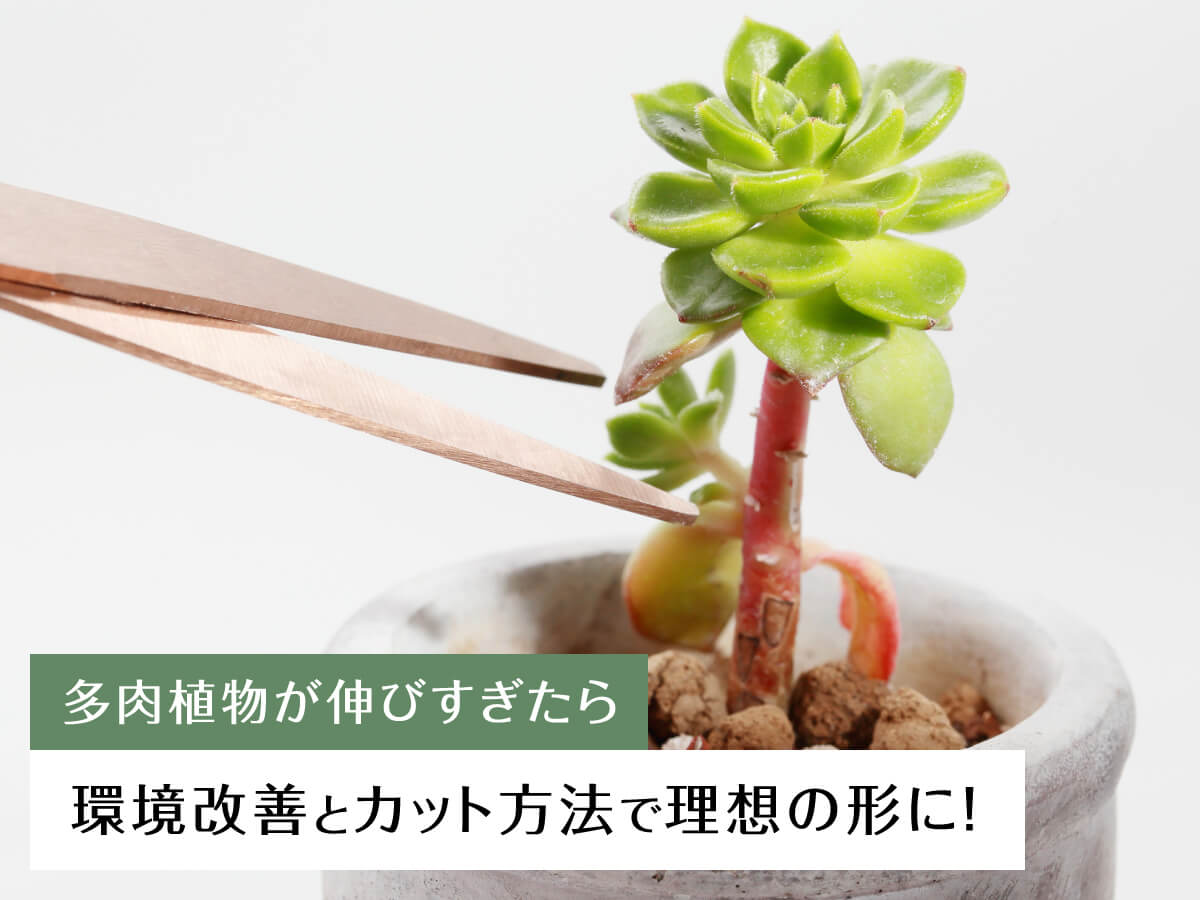
(2) Pruning If the plant has grown too long, pruning it at the appropriate position and regenerating it is an effective method. New shoots will emerge from the cut part.
In the next chapter, we will explain the specific steps and precautions for "pruning" in detail.
Related articles here↓
Do you know where to place succulents? The reason why "outdoors" is best
(1) Environmental improvement
There are three reasons why succulents grow too long:
1. Insufficient sunlight 2. Excessive water 3. Excessive nutrients
First, let's talk about "insufficient sunlight." Succulents need sufficient sunlight to perform photosynthesis and grow. If there is not enough sunlight, they will stretch their stems to reach the light. Therefore, it is important to grow them in a bright, well-ventilated location.
Similarly, "excessive water" can also cause overgrowth. Succulents are originally plants that grow in dry environments, so if they are watered too much, only their stems will grow long. It is recommended to water once a week and provide plenty of water each time.
Finally, "excessive nutrients" also requires attention. Succulents have the vitality to grow even in harsh environments, so if they are given excessive nutrients, their stems will grow beyond their natural growth rate. Fertilizers should be applied in appropriate amounts.
By improving the environment as described above, you can prevent succulents from growing too long.
(2) Pruning and regeneration methods
The pruning and regeneration methods for overgrown succulents are as follows. First, cut the succulent at a point where 3 to 4 lower leaves remain. Make sure that the lower leaves are not withered.
After pruning, either plant the succulent directly in soil or dry it for about 2 days and then plant it in dry soil. Also, new shoots will emerge from the pruned part, allowing you to reshape the succulent into a uniform form.
Leftover leaves and cuttings can be reused as cuttings or leaf cuttings. This allows you to propagate succulents without waste.
These methods allow even overgrown succulents to be beautifully regenerated.


4. Pruning steps and tips for overgrown succulents
Here are the pruning steps and tips for beautifully regenerating overgrown succulents.
(1) Choosing the cutting position: First, you need to decide where to cut the overgrown part. Generally, you cut the middle of the elongated stem. It is important to choose a healthy part that is not diseased or yellowed, if possible.
(2) Managing succulents after pruning: After pruning, dry the cut surface for 1-2 days before exposing it to water or soil. This prevents the cut surface from rotting and promotes new root growth. (Recently, many people also use a growing method where they plant the succulent directly into the soil immediately after pruning.)
(3) Propagation by pruning: Do not discard the pruned parts; instead, allow them to root by exposing them to water or soil. This allows you to propagate new plants from a single succulent.
Ultimately, even overgrown succulents can be beautifully regenerated with proper care. It is important not to give up and to provide appropriate care in any situation.
Related articles here↓
【Must-Read for Beginners】Tips for Successful Succulent Cuttings
(1) Choosing the cutting position
When pruning an overgrown succulent, choosing the cutting position is important. First, identify where to cut. The stem that has grown from the base, the space between leaves, and the tip of the stem are all potential cutting points.
Specifically, if new shoots are emerging from the center of the stem, cut off the upper part. It is also good to cut off any parts of the stem that have become thin. At that time, be careful to make the cut in the center of the plant. Even if new shoots are not emerging, if you feel the stem has grown too long, prune it as appropriate.
By performing such pruning, succulents can maintain a well-balanced shape. It also stimulates the plant's own growth.
(2) How to care for succulents after pruning
Pruned succulents can be beautifully regrown with proper care.
【1】If possible, first dry the pruned succulent. Once the cut surface is dry, insert it into dry soil. It is also possible to leave it as is until roots appear. (It is not necessarily bad to insert it directly into the soil immediately after pruning. If you are short on time, you can insert it into the soil as is.)
【2】If you try leaf cuttings, place the removed leaves on dry soil. It is a good idea to insert the tip slightly into the soil.
【3】After cuttings or leaf cuttings, provide appropriate sunlight and water to grow them. Be careful to ensure balanced growth and prevent overgrowth.
By following the steps above, it is possible to grow pruned succulents healthily again. Please also try the fun of propagating them through cuttings or leaf cuttings.
(3) Method of propagation by pruning
Not only pruning, but also subsequent management is important. First, dry the pruned part to protect the wound. Then, grow it in partial shade with reduced watering, and gradually acclimate it to sunlight. Once new roots emerge, resume watering.
The pruned part can be reused. This is called "cuttings," and there is a possibility that it will grow into a new plant. For cuttings, first dry them, then insert them into soil, and start watering immediately after planting or a few days later.
Even overgrown succulents can be restored to beautiful and healthy plants with proper treatment. This can also be an opportunity to propagate them, so don't panic and try to provide proper care.
5. How to enjoy after pruning
New shoots from pruned succulents can be used as material for new arrangements. In particular, succulent arrangements, where delicate succulents are gathered, bring together various shapes and colors in a single pot, attracting the eye. Creating your own unique arrangement with succulents you have carefully nurtured will further enhance the joy of growing them.
You can also try making mini bottle decorations using pruned succulents. By creating a succulent world within a small bottle, you can enjoy it as an interior decoration for your desk or living room. You can also enjoy it as a creative activity and experience a new way of interacting with succulents. (However, growing succulents indoors can lead to etiolation.)
Related articles here↓
【Must-Read for Beginners】Succulent Arrangement Beginner's Guide: Start from the Basics!
(1) The charm of succulent arrangements
When a succulent grows too long, pruning is one way to deal with it. At that time, by planting the pruned succulent as a cutting in a new pot, it can become part of a new arrangement.
The charm of succulent arrangements comes from combining various types of succulents in one pot. By combining the shapes and colors of each plant, you can create a beautiful landscape that is simply enjoyable to look at.
Furthermore, the process of each plant growing and changing is also one of its charms. An arrangement where different types of plants coexist and each brings out its maximum vitality brings great joy to the grower.
However, when making an arrangement, it is necessary to consider the growth environment and water requirements of each plant. With proper care, you will have even more enjoyment.

(2) Attempting mini bottle decorations
Mini bottle decorations are wonderful decorations made by repurposing pruned succulents. They are easy to start and can be enjoyed as interior decor. First, prepare a clean mini bottle. Inside the bottle, first place drainage stones to ensure drainage. Then, fill it with well-draining soil. Finally, carefully plant small parts of the pruned succulent.
Water when you feel it is dry. Place it in a bright location that does not receive direct sunlight. Succulents in mini bottles tend to grow compactly without getting too long.
These mini bottle decorations are not only for your own enjoyment but also make great gifts. The appeal is that each one can create its own original small world.
6. Summary
The fundamental reason why succulents grow too long is "not getting the proper environment." In particular, insufficient sunlight, excessive nutrients or water, and inadequate winter care are important factors. This problem can be prevented by environmental improvement, and even if they do grow long, they can be restored to their ideal shape with appropriate pruning.
Furthermore, this pruning can also be used as a propagation method, and can serve as an opportunity to try succulent arrangements or mini bottle decorations as new ways to enjoy succulents. Don't be afraid to try it, and your succulent life will become even more enjoyable.
Many cute succulents available
Click here for tawawa's online shop↓

Please take a look!