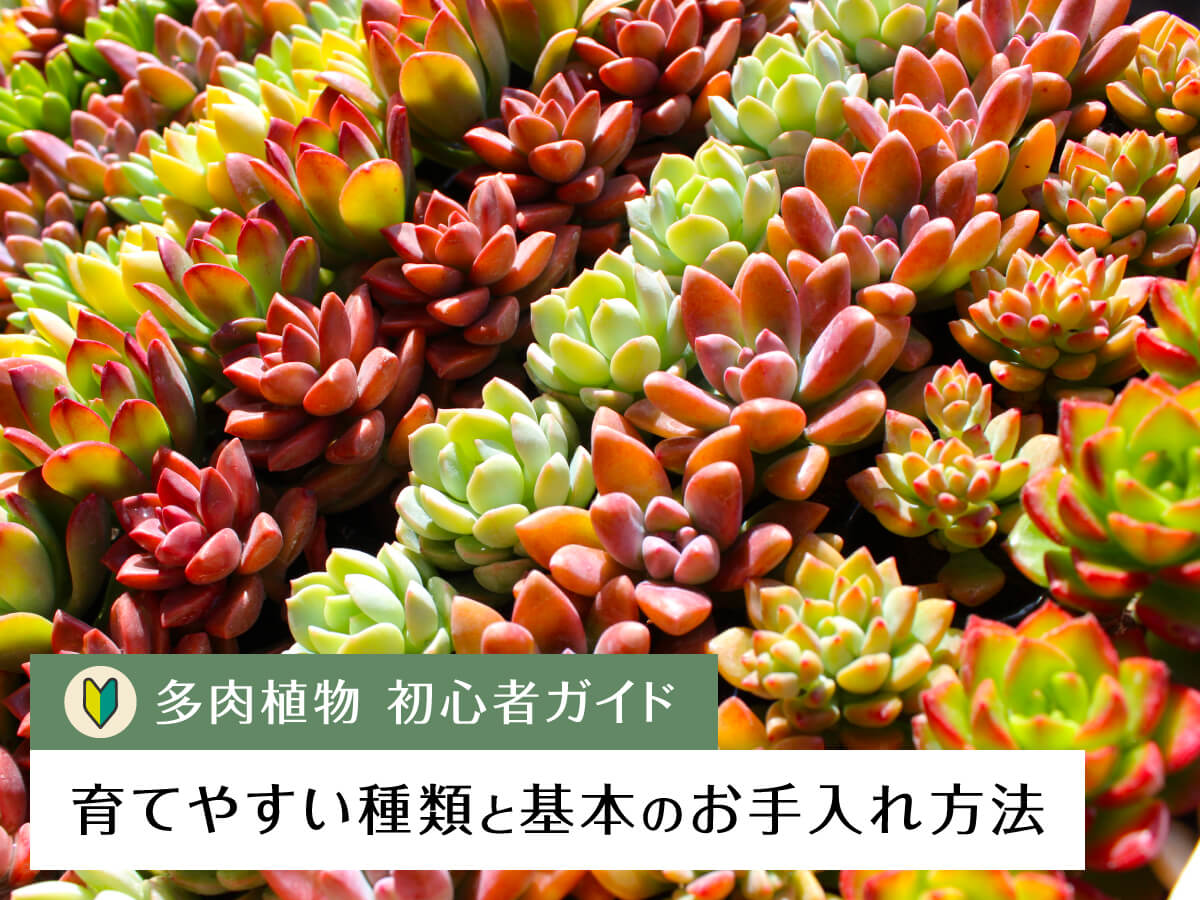
This is a guide for those new to growing succulents. We'll provide a detailed explanation of key points for beginners, including an introduction to easy-to-grow varieties, basic care methods, watering frequency, and the necessity of sunlight. We'll also share tips to maximize the charm of your succulents, so please use this as a reference.
1. Introduction
Succulents are popular plants for beginners due to their voluminous, unique shapes and their easy-to-care-for nature. However, when it comes to actually growing them, many beginners face challenges such as "which variety should I choose?" or "how should I care for them?". This guide will provide easy-to-understand explanations on how to choose, basic care methods, and even pest and disease control, so that beginners can fully enjoy the charm of succulents and grow them smoothly. Please use this guide to enrich your succulent life.
Related articles here↓
[Must-see for beginners] How to grow succulents well? Easy-to-understand basic care
2. What are succulents?
Succulents, as their name suggests, are plants whose leaves, stems, and roots are enlarged to store water. They primarily originate from arid regions, such as southern Africa and North to Central and South America (e.g., Mexico), and have evolved the ability to store abundant water as a survival mechanism.
They come in a wide variety of shapes, from plump, fleshy appearances to spiky ones, and even stone-like forms. Therefore, it is necessary to understand the individuality and characteristics of each succulent when growing them.
Due to their attractive appearance and ease of care, they are also popular as interior decor and are loved by many people as items that brighten up living spaces.
Related articles here↓
Explanation of succulent types and how to grow them
(1) Characteristics of succulents
Succulents, as their name suggests, are plants that have "fleshy" or thick leaves and stems that store a lot of water. Their main native regions are arid areas such as southern Africa and the Americas, primarily Mexico. Succulents evolved to survive in such low-rainfall environments by storing water, which gives them their plump appearance. Furthermore, succulents come in a wide variety of shapes. They are diverse, with rounded ones, spiky ones, and even stone-like forms. This rich variety is one of the charms of succulents.

(2) The appeal of choosing succulents
Succulents are attractive to beginners not only for their diverse shapes and beautiful colors, but also for their hardiness and low-maintenance nature. In particular, succulents can be easily grown indoors as long as their light and watering needs are met. Another feature is that the leaf color of the same plant changes with each season, making them enjoyable to observe without getting bored.
Furthermore, succulents are easy to propagate. For example, they can be multiplied by methods like leaf cuttings or division. Due to these characteristics, succulents are recommended not only for beginners but also for busy modern people and those who want to easily enjoy greenery.
3. Recommended succulent varieties for beginners
Here are some succulent varieties that even beginners can easily enjoy. First, the "Kalanchoe genus," which offers a rich variety of unique leaves and flowers; the "Echeveria genus," characterized by its rose-like shape and recommended for arrangements; and the "Sedum genus," which is a representative succulent with over 500 known varieties. Also, the "Graptopetalum genus" is particularly beginner-friendly among succulents, with varieties like Oborozuki having been cherished for a long time in gardens and hedges.
All of these are low-maintenance and easy-to-grow varieties. Their thick leaves make them resistant to drought, so they require less frequent watering. Beginners may want to start with these succulents.
Related articles here↓
Echeveria, popular among succulents! Introducing its types and characteristics
(1) Kalanchoe genus
The Kalanchoe genus primarily originates from South Africa, East Africa, and Southeast Asia. Among them, "Benibenkai," which blooms in various colors, has high ornamental value as a beautiful foliage plant. It is also relatively common in general horticulture.
There are over 200 varieties worldwide, each with unique shapes and colors. As succulents, they are relatively easy to grow, making them recommended for beginners.
Kalanchoe leaves have serrated edges called "kyoshi" (鋸歯), and some varieties have growth points on the serrated parts of their leaves; for example, "Fushicho" (不死鳥, Phoenix) forms new plantlets on the serrated edges, and these new individuals fall off and propagate.
Growing Kalanchoe is generally easy; they thrive with adequate sunlight and moisture. However, avoid overwatering. Water only when the soil has dried out.
For these reasons, it is a recommended plant for beginners trying succulents for the first time, and it can also be an opportunity to engage more deeply with plants.

(2) Echeveria genus
The Echeveria genus is characterized by its rose-like shape and is said to have ignited the succulent boom. Many varieties spread their leaves along the ground, forming beautiful rosettes. This beautiful shape makes them a striking presence when displaying succulents, such as in arrangements.
Furthermore, plants of the Echeveria genus are cold-hardy and easy for beginners to grow. However, they prefer well-drained conditions, so be careful with watering.
As a beginner-friendly succulent, Echeveria plants are highly recommended for their beauty and ease of care.

(3) Sedum genus
The Sedum genus is very popular among succulents, with over 500 varieties identified. Its characteristics include small, fleshy leaves that grow densely. It can be said to be a familiar succulent, often seen in natural environments in Japan.
Its growth requirements are relatively simple; it thrives in a location with plenty of sunlight and well-drained soil. As it prefers dry conditions, the basic watering rule is to water generously when the soil is dry.
Due to its vigorous growth, it is also frequently used in mixed plantings. Planting various types together can add visual variety.
From these characteristics, it can be said that Sedum is one of the succulents recommended for beginners who seek ease of cultivation.

(4) Graptopetalum genus
Graptopetalum is a captivating genus of succulents, considered ideal for beginners. Native to Central America and Mexico, its fleshy leaves and rosette-like growth, similar to Echeveria, make it popular for its charming appearance. It is also highly resistant to both cold and heat, making it relatively easy to manage outdoors. Even beginners can fully enjoy growing it.
Among the Graptopetalum genus, "Bronze Hime" and "Shurei" are well-known, with thick leaves that turn attractive shades of red and pink. They are among the easiest varieties for beginners to grow.

(5) Other beginner-friendly varieties
As "other beginner-friendly varieties," Agave and Haworthia are also recommended.
Agave is a succulent with a stylish impression, featuring stiff, straight leaves growing upwards from the ground. Varieties like "Chinochita" and "Horrida" are known to be easy for beginners to grow. They are drought-resistant, and the signs for watering, such as wrinkled leaves, are easy to spot.
On the other hand, Haworthia has leaves that spread in a rosette shape, and come in various forms such as plump leaves or sharply pointed ones. Also, they are tolerant of shade, so it is possible to grow them indoors in a bright location year-round.
These varieties are easy for beginners to grow and will allow you to fully enjoy the pleasures of succulents.
4. How to choose succulents
When choosing succulents, keep the following three points in mind:
(1) Choose by growth type: Succulents have different growth types depending on their growth period. For example, there are spring/autumn types that grow in "spring and autumn," summer types that grow in "summer," and winter types that grow in "winter." Choose according to your growing environment.
(2) Choose a variety suitable for your growing environment: For example, spring/autumn or summer type succulents are suitable for the Kanto region, while winter type succulents are suitable for Tohoku.
(3) Choose healthy seedlings: It is also important to purchase from a store with good after-sales service and check the health condition. For beginners, purchasing from a specialized store with extensive after-care is recommended.
By choosing appropriately, you can grow succulents that suit your environment and enjoy them.
(1) Choose by growth type
When choosing succulents, considering their "growth type" is important. There are three main growth types for succulents, each thriving in different climates and environments.
-
Spring/Autumn type: Growth is active in spring and autumn (temperatures 10-25°C).
-
Summer type: Grows in summer (temperatures 20-35°C).
-
Winter type: Grows in winter (temperatures 5-20°C).
Considering these factors and choosing succulents of a growth type that matches the climate of your growing location is key to promoting healthy growth.
(2) Choose a variety suitable for your growing environment
Succulents grow in a variety of environments, so choosing a variety suitable for your home environment will lead to better results. For example, if you plan to grow them in a sunny spot, sun-loving Sedum or Echeveria are recommended.
For indoor growing, Haworthia, which does not require direct sunlight, is recommended. Conversely, if growing outdoors, cold-hardy Sempervivum would be a good choice.
By choosing varieties that match your growing environment, even beginners can easily grow succulents.

(3) Choose healthy seedlings
To choose healthy succulent seedlings, pay attention to the following three points. First, the "color and shape of the leaves." Healthy succulents have vibrant leaf colors and maintain their characteristic shapes well. Conversely, be cautious if the color is faded or the shape is distorted.
Second, check the "condition of the stem and roots." Choose a plant with a firm stem and white, strong roots. If the stem is blackened or wrinkled, there's a possibility of root rot.
Third, check for "the presence of pests." Look carefully for signs of insect damage or actual pests. By performing these checks, you can choose healthy succulents that are easy to grow.
5. Basic succulent care
For succulents, sunlight and watering are key.
-
(1) Watering timing and method: Succulents are drought-tolerant plants, but that means they need moderate dryness. They do not like the high temperatures and humidity of Japanese summers, so special care is needed during the rainy season and on humid days. Water only after the soil has completely dried out.
-
(2) Suitable potting soil and how to choose it: Succulents require well-draining soil. It is also important to use appropriate fertilizer depending on the variety.
-
(3) Necessary fertilizer and how to apply it: For varieties that require fertilizer, it is generally applied during the growing season from spring to autumn, or slow-release fertilizer is mixed into the soil during repotting.
The above outlines the basic care methods for succulents. With proper care, your succulents will grow beautifully.
Related articles here↓
[Must-see for beginners] How to grow succulents well? Easy-to-understand basic care
(1) Watering timing and method
Watering succulents differs between their growing season and dormant period. During the growing season, look for the sign of wrinkled leaves, and then water thoroughly from the base. During the dormant period, aim for no water or watering once a month.
Particular attention should be paid to watering from around the rainy season to autumn. During this period, watering during the cool evening hours allows the plant to absorb water more easily and prevents stuffiness. Also, be careful to water only the soil, avoiding getting water between the leaves.
Furthermore, since succulents have evolved in harsh environments, it's best not to be too overprotective with watering, and instead grow them with a slightly Spartan approach. Master succulent watering by keeping these points in mind.

(2) Suitable potting soil and how to choose it
Choosing the right potting soil is crucial for the growth of succulents. Since the balance of water and air in the soil is key, well-draining and well-aerated potting soil is recommended.
Generally, a mixture of akadama soil, pumice, vermiculite, and kanuma soil is suitable. However, the appropriate type and blend of potting soil differ depending on the succulent variety, so research specific to the type you are growing is necessary.
Additionally, commercially available succulent potting soils are an option. These are easy for beginners to use and allow for a simple start.
A specific example of a mix is akadama soil:pumice:vermiculite:kanuma soil in a ratio of 4:4:1:1. This blend ensures good drainage and aeration, allowing succulents to grow comfortably.
(3) Necessary fertilizer and how to apply it
Succulents need fertilizer. By providing it, you can promote healthy growth, such as good leaf color and abundant flowering. Fertilizer primarily requires three main elements: nitrogen, phosphorus, and potassium. These contribute to leaf and stem growth, promote flowering, and strengthen the plant.
Specifically, fertilizer is applied during the active growth periods of spring and autumn. However, succulents have a weaker absorption capacity for fertilizer, so they should be given about half the amount of fertilizer compared to typical houseplants.
Over-fertilization can stress the plant, so caution is needed. By understanding the appropriate fertilizer and how to apply it, you can grow beautiful succulents.
6. Repotting succulents
Repotting succulents is crucial for ensuring adequate space for growth and maintaining their health.
(1) Repotting timing: The best time to repot succulents is generally in spring. This is when the cold of winter has eased, and preparations for a new growth period are complete.
(2) Choosing and preparing soil for repotting: Well-draining soil is suitable for repotting. Commercially available succulent potting mix or garden soil mixed with pumice or akadama soil is recommended.
(3) Repotting procedure
-
Remove the plant from its pot and discard the old soil.
-
Place new soil in a new pot, then place the plant on top.
-
Fill the rest of the pot with soil and secure the plant firmly.
With proper repotting, succulents will grow healthier.
Repotting succulents is crucial for ensuring adequate space for growth and maintaining their health.
Related articles here↓
[Succulent Repotting] Thorough explanation of timing, methods, and tips! Secrets to success also revealed
(1) Repotting timing
The best time to repot succulents is primarily in spring or autumn. This coincides with the period when succulents are actively growing, making it the ideal time to minimize stress and allow them to adapt to new soil or pots. It's also important to withhold watering before repotting. Succulents that have absorbed water tend to have swollen leaves that are easily damaged, and it takes them longer to adapt to new soil. Therefore, it's recommended to stop watering a week before repotting.
(2) Choosing and preparing soil for repotting
Choosing the right soil when repotting succulents is a crucial factor that affects their growth. Succulents prefer well-draining soil with good aeration. Commercially available "succulent soil" or "cactus soil" are recommended. These contain sand and pumice, which ensure good drainage and prevent root rot.
For preparation, it's a good idea to lay stones or pumice at the bottom of the pot, then add the prepared soil on top. This allows excess water to drain more easily.
(3) Repotting procedure
Repotting succulents follows these steps:
-
Materials needed: New pot, new potting soil, succulent removed from old pot.
-
Start: First, carefully remove the succulent from its old pot.
-
Root inspection: Check the roots of the removed succulent for any diseases or pest damage. If problems are found, treat them appropriately.
-
Planting in new pot: Place new potting soil in the new pot, then position the succulent on top. Secure the plant by filling around it with potting soil.
-
Final check: Finally, ensure the plant is firmly settled in its new pot.
Following these steps will help maintain the long-term health of your succulents.
7. How to propagate succulents
Due to their nature, succulents can be easily propagated at home. Here are three typical methods of propagation:
(1) Leaf Propagation: This method involves growing a new plant from a single succulent leaf. Select a healthy leaf, remove it, and place it on potting soil. Roots and shoots will then emerge from the part of the leaf touching the soil.
(2) Stem Cuttings: This method involves growing a new plant by cutting a part of the stem and planting it in potting soil. Insert the cutting into the soil, and new roots will begin to emerge after a few weeks.
(3) Division: This method involves dividing a large succulent into new individual plants. Carefully divide the plant using a sharp tool and plant it in soil.
Try these methods to hone your skills as a succulent grower.
Related articles here↓
Propagate Succulents by Leaf Cuttings! Tips and Steps to Avoid Failure
(1) Leaf Propagation Method
The most common method for propagating succulents is "leaf propagation." First, gently remove a healthy leaf from the mother plant. The key point is that the leaf should be detached completely from the base. Place the detached leaf in the desired growing location, and water only when the soil is dry. Then, new shoots will emerge from the base of the leaf, and a new succulent plant will grow. However, not all leaves will produce new shoots, so try several leaves.


(2) Cutting Method
One way to propagate succulents is through cuttings. First, choose the part of the stem you want to use for the cutting and cut it off. It's best to cut a healthy-looking branch, leaving about three leaves. Insert the cutting, cut side down, into a pot. Firm the soil around the cutting to stabilize it. Additionally, it's essential for the plant's growth to avoid direct sunlight immediately after planting and to place it in a well-ventilated area.
(3) Division Method
One method of propagating succulents is "division." This method is particularly suitable for succulents that grow quickly and produce many offsets.
First, identify offsets that have separated from the mother plant. Once these offsets have grown to a certain size, gently pull them out by hand, or if necessary, use a sharp tool to separate them from the mother plant. Be careful not to apply too much force during this process.
Plant the separated offsets in new pots. This will result in new succulent plants.
The above describes how to propagate succulents by division. If you perform this carefully, your succulents will multiply quickly, so please give it a try.
8. Succulent Pests and Diseases and Their Countermeasures
Succulents are susceptible to pests and diseases. In particular, spider mites and aphids are common pests found on succulents.
(1) Spider Mites and Their Control: Spider mites thrive in dry conditions, so be cautious of their presence during winter or in indoor heated environments. Preventive measures include maintaining appropriate humidity levels and regularly wiping down leaf surfaces.
(2) Aphids and Their Control: Aphids prefer new shoots, so they are particularly common in early spring. Prompt removal upon detection and utilizing natural predators like ladybugs are effective countermeasures.
Furthermore, early detection is crucial for all pests and diseases. Therefore, regularly observe your plants and take immediate action if you notice any abnormalities.
By implementing the above measures, let's cultivate beautiful and healthy succulents.
(1) Spider mites and their control
Spider mites are one of the most troublesome pests for succulents. Spider mites leave small white or yellow spots on leaves, and in severe infestations, the entire plant can turn white or leaves can wilt.
For countermeasures, early detection is crucial. Observe your plants diligently and take immediate action if you notice any abnormalities. The goal is eradication using effective miticides. Miticides are commercially available, and it is important to use them appropriately.
Additionally, spider mites prefer dry conditions, so maintaining appropriate humidity levels can also be a preventive measure. It is also important to avoid sudden temperature fluctuations and provide a stable environment.
(2) Aphids and their control
Aphids are common pests found on succulents. Aphids gather on new shoots and young leaves of plants, sucking out their nutrients.
To control aphids, regular observation is essential. Periodically check the leaf tips and undersides to ensure the plant gets enough light and air circulation for growth.
If aphids are found, it is necessary to take immediate action. For relatively small infestations, washing them off with water or wiping them away with a cloth is effective.
On the other hand, for large infestations or frequent occurrences, using commercially available insecticides can be an option. However, always check the proper usage and safety precautions for insecticides and avoid excessive use.
(3) Particularly important: Root rot and its countermeasures
Root rot is the most critical issue to watch out for when cultivating succulents. This is a disease where the roots of succulents rot due to improper watering. Beginners, in particular, often tend to think that more watering leads to better growth, but the opposite is true; overwatering can lead to root rot.
To prevent root rot, keep the following three points in mind:
-
Ensure water drains properly from the bottom of the pot: Choose pots with drainage holes at the bottom for good drainage.
-
Water only after the soil has dried: Succulents are drought-tolerant plants. Refrain from watering again until the soil has completely dried since the last watering.
-
Avoid watering during the daytime in summer: Watering when the soil is hot from the sun can cause the roots to steam. Water in the evening during summer.
By keeping these points in mind, you can protect your succulents from root rot.
Related articles here↓
[Reasons Why Succulents Die] Care Methods and Revival Tips Even for Beginners
9. Stylish Ways to Display Succulents
Succulents can be enjoyed as part of your interior decor due to their durability and varied shapes. "Wall hanging" is particularly recommended. By using an enamel tray as a frame, planting with sphagnum moss, and securing it with kite string, you can create an atmosphere like a landscape painting of succulents. Also, because succulents come in a wide variety of colors and shapes, you can create your own unique wall hanging. Furthermore, succulents are robust plants that can be placed in various living spaces such as the kitchen, study, or washroom. Experiment with different arrangements and enjoy creating your own succulent interior.
Related articles here↓
[Must-See for Beginners] Succulent Arrangement Beginner's Guide: Start from the Basics!
(1) Arrangement Ideas
An arrangement is an idea to beautifully design various succulents in a single pot. A recommended method for beginners is to first place a larger succulent in the center and then plant smaller succulents around it. Dome-shaped succulents like "Echeveria" or "Agave" are suitable for the center. For the surrounding area, trailing types such as "Sedum" or "Graptopetalum" would be good. The important thing is to choose species that thrive in similar environmental conditions. By varying the colors and shapes, you can enjoy various expressions in a single pot.

(2) How to decorate rooms and balconies
Succulents can be beautifully displayed in limited spaces such as rooms and balconies. The trick is to create an arrangement that utilizes the plant's shape and color. First, choose varieties with different sizes and leaf shapes and arrange them so that each one stands out. Next, pay attention to color balance. Combining brightly colored plants with richly colored ones will make them stand out even more.
Another great way to display them is by hanging them on a wall. By using "Nordic-style hanging planters," for example, you can transform a room into a lush green space.
Furthermore, on a balcony, you can create a three-dimensional garden by using wooden shelves (available at 100-yen stores) to arrange succulents in tiers.
10. Summary and Next Succulents to Try
So far, we have learned the basic knowledge, care methods, and propagation techniques for succulents. From beginner-friendly varieties to various pests and diseases and their countermeasures, by utilizing this information, you are sure to become deeply captivated by the charm of succulents.
Now, for the next succulent you might want to try, we recommend "Pachyphytum." Not only is it cute, but the process of its growth is also enjoyable, satisfying both beginners and experienced growers. However, it is sensitive to cold in winter, so caution is needed.
Based on the knowledge you've gained, please try challenging yourself with new succulents. You'll undoubtedly be drawn in by their charm.

(1) Summary
The above summarizes the basic information and techniques for beginners who are growing succulents for the first time. First, it is important to understand the characteristics of succulents and choose a type that suits your living environment. We then learned about proper care methods, transplanting timing and methods, propagation techniques, and pest and disease control. Finally, we explored ways to enjoy succulents through decoration ideas and introducing succulents to try next. Based on this information, why not try incorporating the beauty and healing of succulents into your daily life?
(2) Introduction to succulents you want to try next
For beginners who want to try new succulents, we recommend the following three types:
1. "Agave": A succulent with a stylish appearance and hard, straight leaves. "Chinita" and "Horrida" are especially recommended for beginners.
2. "Echeveria": A beautiful succulent that spreads its leaves like rose petals, with "Shichifukujin" and "Hana-urara" being easy-to-handle varieties for beginners.
3. "Sedum": A succulent with plump, gummy-like leaves. "Nijinodama" and "Ourei (Yellow Empress)" are recommended for beginners.
You can enjoy growing these succulents while learning their appropriate care methods. Please give them a try.

Related articles here↓
Types of Succulents, Sedum! Appearance, Characteristics, and How to Grow Them, All Revealed!
Click here for tawawa's online shop
with many cute succulents↓

Please take a look!